
Alwar continued to experience poor air quality following Diwali, with the Air Quality Index (AQI) reaching 265 on the morning of Tuesday, November 10. Pollution levels have been rising during the night, while some improvement has been observed during the afternoon as sunlight and increased air movement help disperse pollutants. Meanwhile, temperatures are gradually changing, with cooler conditions expected during the morning and evening in the coming days.
Air pollution levels remained elevated in Alwar on Tuesday morning. According to AQI.in, a website providing air quality information, the city's AQI stood at 265 at 8:51 am. Under Indian air quality index standards, this falls under the poor category.
During the same period, the concentration of particulate pollutants in the air also remained high. PM2.5 was recorded at 181 micrograms per cubic metre, while PM10 stood at 211 micrograms per cubic metre.
These fine particles, originating from dust and smoke, can enter the body through breathing. PM2.5 particles are particularly small, and prolonged exposure to them can increase the risk of respiratory problems.
Air quality in the city has remained poor since Diwali. Pollution levels were also elevated on Monday, with no significant improvement recorded by Tuesday morning.




Air pollution levels in Alwar have been fluctuating throughout the day. Air quality tends to deteriorate during the night and remains poor in the early morning. In contrast, pollutant concentrations begin to decline somewhat during the afternoon as sunlight increases and air movement improves.
Lower temperatures and slower wind speeds at night can cause pollutants to accumulate close to the ground, potentially keeping air quality poor until the morning.
However, the afternoon decline in pollution does not indicate that the city's air has become completely clean. AQI levels begin rising again after sunset. People who go outdoors early in the morning may therefore need to take additional precautions.
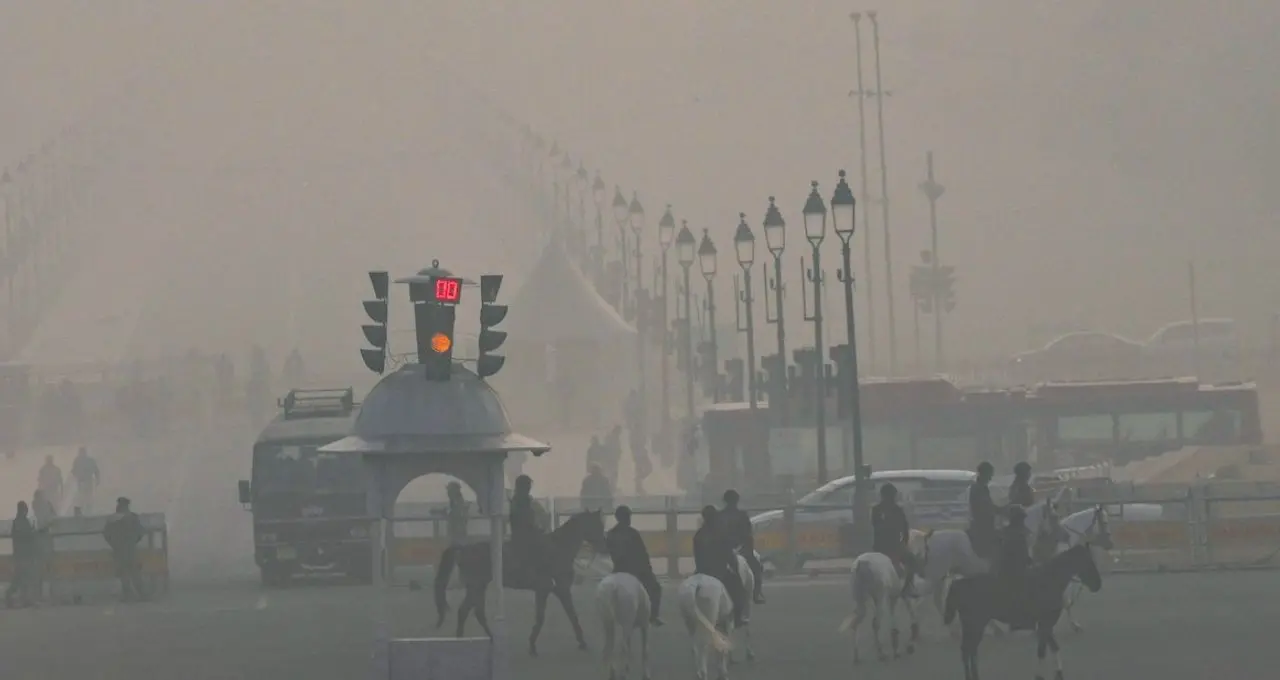
Alongside the pollution situation, weather conditions in Alwar are also gradually changing. Light clouds were visible in the sky on Tuesday morning, and temperatures were relatively cool during the early hours. Temperatures are expected to rise as the day progresses.
According to the weather department's forecast, Alwar is likely to record a maximum temperature of 31 degrees Celsius and a minimum temperature of around 15 degrees Celsius on Tuesday.
The difference of approximately 16 degrees between daytime and nighttime temperatures could result in slightly warm conditions during the afternoon and cooler weather in the morning and evening. As November progresses, nighttime temperatures are expected to decline further.
Daytime temperatures in Alwar may fluctuate over the next few days. According to the weather forecast, the maximum temperature is expected to remain around 30 degrees Celsius on November 11 and 12.
The mercury could subsequently fall to 28 degrees Celsius on November 13. However, this decline is not necessarily expected to continue for an extended period.
The maximum temperature is forecast to reach 29 degrees Celsius on November 14 before rising again to 31 degrees Celsius on November 15.
The sky is expected to remain mostly clear during this period, with no significant likelihood of rainfall forecast at present. Sunshine is likely to continue during the daytime, while cooler conditions may become more noticeable during the morning and evening.
With pollution levels rising during the night and early morning, residents may need to take precautions while planning their daily outdoor activities.
Young children, elderly people and those with respiratory conditions should avoid prolonged exposure to poor air quality.
When pollution levels are high in the morning, running or undertaking strenuous exercise in open areas and along roadsides may increase exposure to pollutants. People who need to go outdoors can consider using a well-fitting N95 mask.