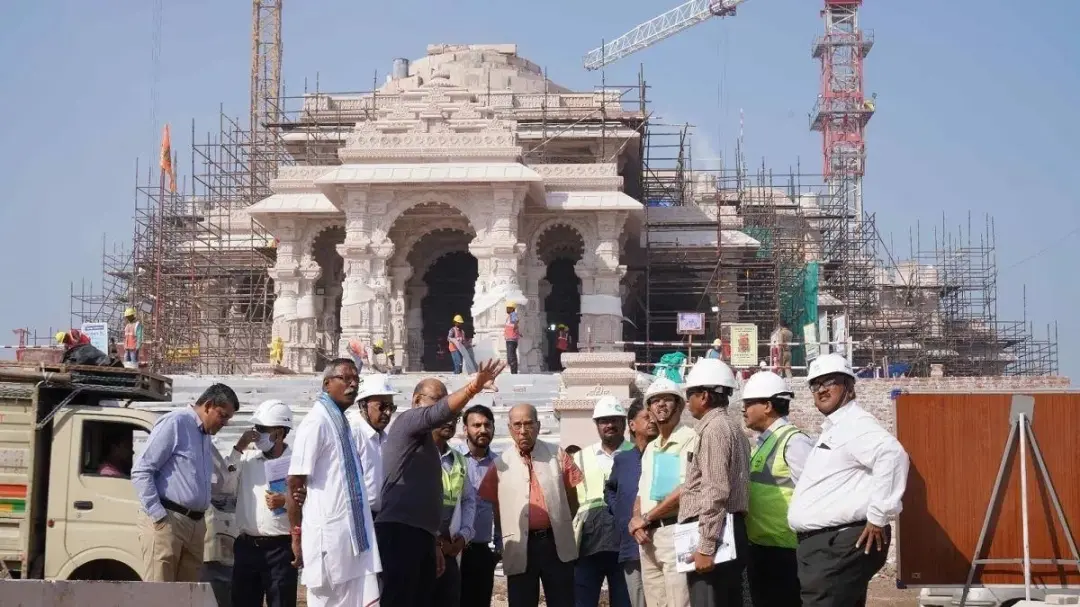
Ayodhya: Champat Rai, who served as general secretary of the Shri Ram Janmabhoomi Teerth Kshetra Trust, has spoken about key decisions related to the construction of the Ram Temple. According to Rai, Nripendra Misra played an important role in the selection of Larsen & Toubro (L&T) for construction of the Ram Temple in Ayodhya. Misra served as chairman of the Ram Temple Construction Committee and held meetings with L&T engineers and visited the construction site during the initial phase of the project.
Rai also discussed the process of selecting people and institutions associated with the temple construction. According to his statement, the construction work was not limited to a single company, with specialist institutions and companies brought in for different technical and construction-related responsibilities. These included L&T, Tata Consulting Engineers and other specialist agencies. A 2021 CSIR presentation also recorded the presence of Nripendra Misra, Champat Rai and officials from L&T and Tata Consulting Engineers at a review meeting related to the Ram Temple construction.
As chairman of the Ram Temple Construction Committee, Misra was responsible for overseeing key aspects of the project. In February 2020, he was appointed head of the temple construction committee of the Shri Ram Janmabhoomi Teerth Kshetra Trust. At the same time, Champat Rai was appointed general secretary of the trust.


L&T’s name emerged prominently when construction began. In a March 2020 report, Champat Rai said L&T had the experience and capability required to complete such a large project. According to the report, the company had also expressed its willingness to undertake the temple construction on a non-profit basis. During this period, a senior L&T engineer visited Ayodhya with Nripendra Misra.
The technical challenges associated with the temple construction were different from those involved in conventional projects. Expert institutions were consulted regarding the foundation and strength of the ground in Ayodhya. In view of the debris and soil conditions found underground, CSIR-NGRI, CBRI, IIT and other specialist institutions were involved in technical studies.
Rai’s latest statement also refers to the involvement of a firm from Noida in the construction process. According to him, there was a system of assigning responsibilities to people and specialists of their choice. However, any allegation or claim of favouritism concerning an individual or company would need to be considered alongside the official position of the concerned party before being treated as established fact.
Several agencies and specialist institutions were involved in the Ram Temple construction. L&T handled important responsibilities in the main construction work, while different specialist institutions were consulted on design, engineering, soil testing, structural stability and other technical matters.
Misra’s role was not limited to the selection of the construction company. He regularly reviewed construction progress, foundation technology and issues related to ensuring the temple’s long-term safety. During a visit to the construction site in 2020, he sought information from Champat Rai about the temple’s foundation, plinth, roof and construction progress.
Particular attention was also given to the temple foundation. Specialists worked to ensure the long-term stability and safety of the structure. Officials associated with the construction committee said at the time that experts were working continuously on the structural strength of the temple.
The project involved both religious requirements and complex engineering work. The temple was constructed in accordance with traditional architecture and religious requirements while using modern engineering standards. In later interviews, Misra also spoke in detail about the technical and administrative challenges encountered during the construction.
Champat Rai had for a long period publicly provided information about the progress of the temple construction. He inspected the construction site and coordinated with engineers and officials associated with the project. His statements and recent discussion have again raised questions about the level at which decisions were taken during the initial stages of the temple construction.
The main construction work of the Ram Temple is now almost complete. According to a recent report, along with the main construction of the temple complex, work on the museum and other parts of the complex is also being addressed.
Rai’s comments on decisions related to the construction process provide information about the administrative arrangements behind the project, particularly the selection of L&T and the involvement of different specialist institutions.
The statement that “people of their choice” were associated with the construction should be viewed in the context of Rai’s remarks. A conclusion that any company or individual received an improper benefit can only be drawn if documentary or official evidence supports such a claim. Public records confirm the participation of L&T and various technical institutions in the project.
The Ram Temple construction process involved coordination among the trust, the construction committee, engineering companies and scientific institutions. Nripendra Misra served as chairman of the construction committee, while Champat Rai served as general secretary of the trust and was among the key figures associated with the process.