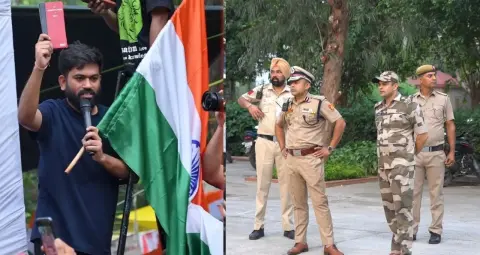
Delhi University’s North Campus witnessed a large student protest demanding the immediate implementation of the University Grants Commission’s UGC Equity Regulations 2026. Hundreds of students participated in demonstrations opposing a recent judicial stay on the regulations and asserting the need for equality and safety in higher education.
The protest, termed the ‘Equity March’, was organised under the leadership of multiple student groups, including the All India Students’ Association. Students marched through the North Campus holding placards carrying messages on equality, justice, and opposition to discrimination. Protesters stated that the agitation would continue until the UGC Equity Regulations 2026 are implemented.
Students expressed dissatisfaction over the judicial stay imposed on the equity regulations, describing it as a setback to their movement. According to the protesters, the regulations were intended to address caste-based discrimination in higher education institutions. They said the stay has intensified discontent among students and poses risks to the protection of marginalised groups.
Participants highlighted concerns regarding the safety of students from Scheduled Castes, Scheduled Tribes, and Other Backward Classes. They stated that the non-implementation of the regulations would leave SC, ST, and OBC students feeling unsafe on university campuses. Protesters alleged that discrimination continues to exist in several higher education institutions and that curbing it without enforceable regulations remains difficult.

Student organisations stated that the UGC Equity Regulations 2026 are not merely procedural guidelines but establish a mechanism for institutional accountability. According to the protesters, the regulations include provisions for grievance redressal, monitoring, and action, aimed at ensuring prompt response to complaints of discrimination.
The protesters linked their demand to the spirit of the proposed ‘Rohit Act’, referring to the Rohith Vemula Act, which seeks to create a central law to prevent caste-based and identity-based discrimination in higher education institutions. They stated that the UGC Equity Regulations 2026 represent a step in the same direction.
Students recalled Rohith Vemula, a University of Hyderabad student who died in 2016 following alleged caste-based discrimination. They said his case had sparked nationwide debates and campus movements on discrimination in higher education, which they described as contributing to the formulation of the UGC Equity Regulations 2026.
Delhi University students stated that the regulations were the outcome of years of protests, sit-ins, and debates across universities nationwide, which they said compelled the UGC to introduce such measures. They alleged that the judicial stay on the regulations reflects an attempt to maintain existing unequal systems.
Protesters stated that following the stay, students from marginalised backgrounds are again experiencing a sense of insecurity. They alleged that complaints of discrimination are often suppressed or not addressed seriously, and that the UGC Equity Regulations 2026 could provide protection to affected students in such cases.
After the Equity March, a public meeting was held where several student leaders addressed the gathering. Former Jawaharlal Nehru University Students’ Union president Nitish said that years of struggle and sacrifice had forced the UGC to frame accountability-based regulations. He said the stay on the regulations indicates that caste-based discrimination continues to persist at higher institutional levels.