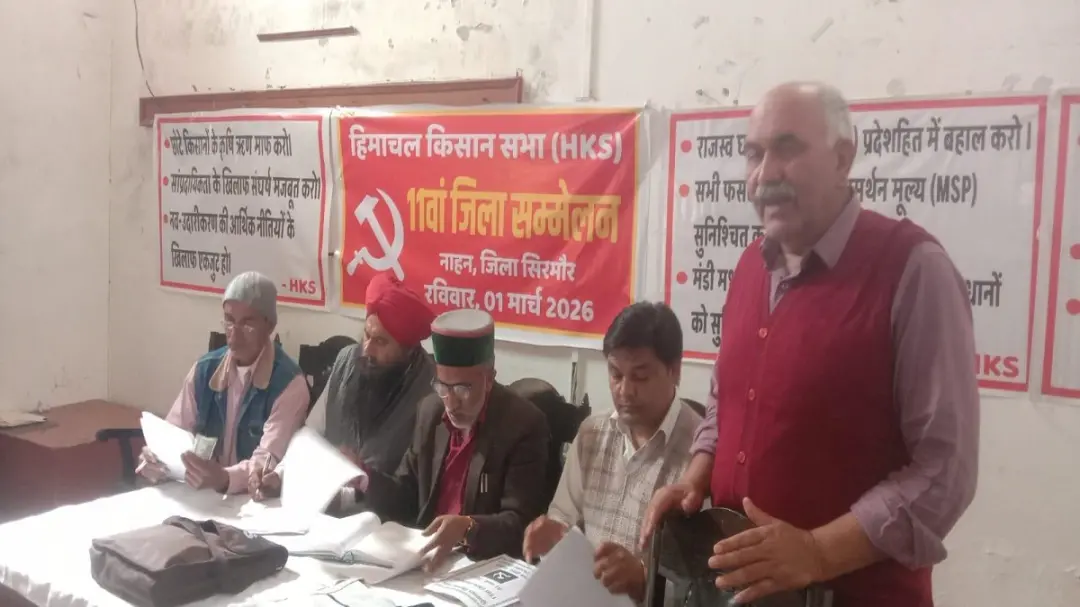
The 17th district conference of the Himachal Kisan Sabha was held at Sauli Khadd in Mandi, Himachal Pradesh. The conference discussed several issues concerning farmers and horticulturists, including land rights, compensation for land acquired for development projects, employment for local youth, stray animals, milk production, electricity, health and education.
The Himachal Kisan Sabha demanded that five bighas of land be provided to landless and poor farmers, forest land under their possession be transferred in their names, fair compensation be provided for acquired land and employment opportunities be ensured for local youth in development projects. The conference was inaugurated by Kisan Sabha state general secretary and former MLA Rakesh Singha.
Speakers at the conference said a policy should be formulated to provide land to farmers who do not have agricultural land of their own. The Kisan Sabha demanded that five bighas of land be allotted to poor and landless farmers. It also called for resolving, through a policy, cases related to land rights of farmers who have been in possession of land for a long period. The organisation specifically demanded that forest land under their possession be transferred in their names. The demand was raised in connection with the land rights of farmer and rural families.




The issue of land acquisition for four-lane roads, national highways and other major projects was also raised. Kisan Sabha speakers demanded that affected families receive fair compensation for land acquired for such projects. They also demanded arrangements to ensure employment for local youth in these projects. The Kisan Sabha said the interests of local families affected by development projects should also be taken into account in policy-making.
The Kisan Sabha also raised the difficulties faced by farmers because of stray animals and wild animals. The problem of crop damage faced by farmers engaged in agriculture in hilly areas has been under discussion for a long time. The conference demanded that the government formulate a concrete policy to address the issue. The organisation also said there was a need for appropriate arrangements to promote milk production alongside farming and provide farmers with better income from it.
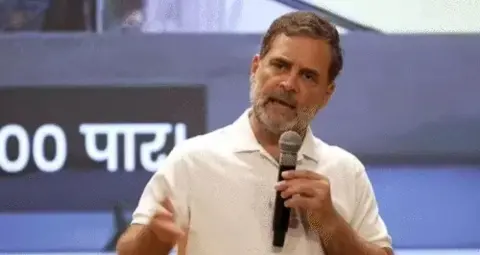
The issue of electricity was also raised at the conference. The Kisan Sabha decided to launch a campaign against the installation of smart electricity meters in households and the privatisation of the electricity sector. Newly elected district president Kushal Bhardwaj spoke about the organisation's opposition to smart meters and the privatisation of the electricity board. The Kisan Sabha said it would raise the issue further and launch a movement, describing it as a matter concerning consumers and farmers.
The Union government has presented a different position on smart metering. According to the Ministry of Power, smart metering works have been approved in 28 states and Union territories under the Revamped Distribution Sector Scheme (RDSS). According to the ministry, 5.28 crore smart meters had been installed across the country under various schemes as of December 31, 2025. The government says smart meters provide consumers with information on electricity consumption in near real time and allow facilities such as bill payments and recharges to be used through digital means.
According to government information, the objective of smart metering is also to improve the billing and revenue collection capabilities of electricity distribution companies. The Ministry of Power had informed Parliament that after smart metering and other reforms, the Aggregate Technical and Commercial (AT&C) loss in the country declined from 21.91 per cent in financial year 2021 to 15.04 per cent in financial year 2025. The government has also said that standard documents related to smart metering contain provisions concerning data security and cybersecurity.
The Himachal Kisan Sabha, however, had previously registered its objections to some aspects of smart metering. In August 2026, the Kisan Sabha submitted a memorandum in Sundernagar against the smart metering project and demanded that it be stopped. The organisation raised issues including the cost of meters, the potential financial burden on consumers, employment of electricity workers and the security of consumer data.
The Mandi conference also raised issues related to basic facilities such as health and education. Kisan Sabha speakers said there was a need to strengthen these services in rural areas. The organisation demanded better arrangements in these sectors, linking the availability of basic facilities for farmers and rural families with the agricultural economy.
The promotion of milk production and ensuring a fair price for milk were also discussed at the conference. The Kisan Sabha demanded better arrangements for milk procurement. It also called for addressing problems faced by rural families engaged in animal husbandry. The issue of stray animals was also discussed in this context.
Organisational decisions were also taken at the conference. Thirty delegates were selected for the state conference to be held in Rampur on October 13 and 14. A new 31-member district committee was also formed. Kushal Bhardwaj was elected president, Bhupendra Singh secretary and Jogendra Walia treasurer. The conference was jointly chaired by Kushal Bhardwaj, Mahendra Rana, Jagmel Thakur, Prem Chaudhary and Rita Devi.
At the conference, Rakesh Singha raised questions about the farmer policies of the central and state governments. He said the organisation would continue to raise the issues faced by farmers. His statements formed part of the demands and political position presented by the organisation at the Kisan Sabha conference. The decision taken by the government on these demands will become clear through the subsequent process.
Through the Mandi conference, the Kisan Sabha raised issues concerning land, electricity, employment, compensation, stray animals, milk procurement, health and education. The organisation placed particular emphasis on its demand for five bighas of land for landless farmers and rights over forest land under their possession. It also decided to launch a campaign against smart metering and privatisation of the electricity sector. The central government, meanwhile, has continued to present smart metering as a scheme aimed at improving the electricity distribution system and providing digital facilities to consumers.
The Kisan Sabha will next focus on the state conference scheduled to be held in October. The 30 delegates selected from Mandi will participate in the conference in Rampur. The organisation's future strategy on issues concerning farmers and horticulturists will be decided there. How the demands raised at the Mandi district conference are taken forward at the state level will become clear through the next conference and subsequent organisational activities.