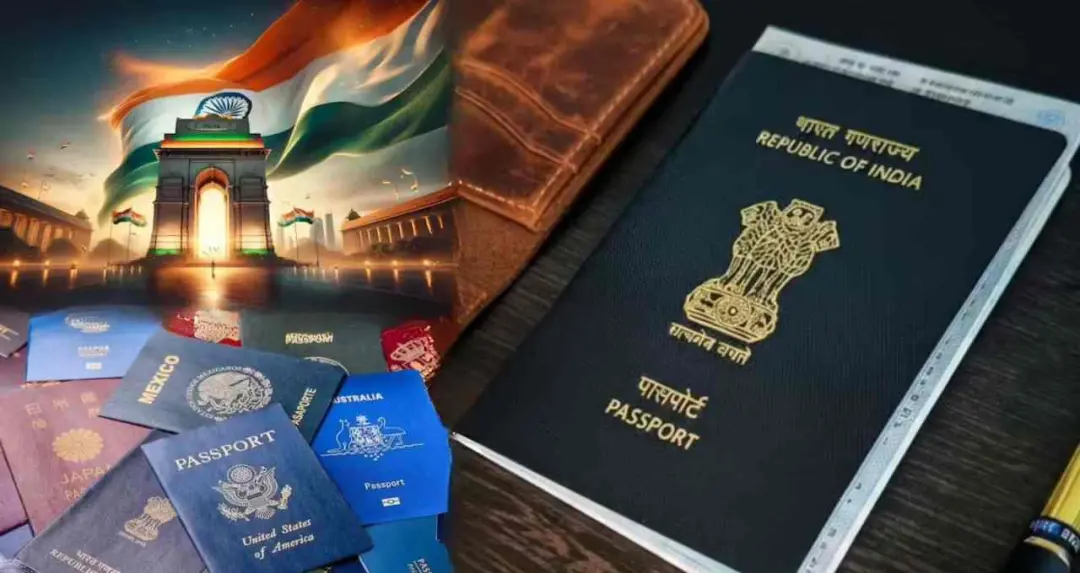
India remains one of the world’s largest and fastest-growing economies, with its economic footprint expanding significantly over the past decade. Despite this growth and its increasing influence on the global stage, the Indian passport has yet to secure a position among the world’s 50 most powerful passports.
According to the Henley Passport Index 2026, India ranks 80th globally. The ranking marks an improvement from the previous year, when India was placed 85th. However, the country remains behind nations whose citizens enjoy visa-free or simplified access to a substantially larger number of destinations.




The Henley Passport Index evaluates 199 passports and 227 travel destinations worldwide. Passport rankings are determined by the number of destinations that citizens can access without obtaining a visa in advance, through visa-on-arrival facilities, or via Electronic Travel Authorization (ETA).
Indian passport holders currently have relatively easy access to 56 destinations. However, travelers still require prior visas for approximately 170 countries. This remains a key factor behind India’s comparatively lower position in global passport rankings despite its economic size.
Experts note that a country’s GDP or overall economic scale does not directly determine passport strength. Passport power is primarily influenced by diplomatic relations, visa agreements, immigration risk assessments, security standards, and international trust. As a result, even the United States, one of the world’s largest economies, does not occupy the top position in passport rankings. Similarly, China, the world’s second-largest economy, remains behind several developed countries in terms of passport strength.
India’s passport ranking has experienced fluctuations over the past two decades. The country ranked 71st in 2006 before declining to 88th in 2015. The global mobility of Indian passport holders was also affected during the COVID-19 pandemic period. Since then, rankings have gradually improved, although India’s progress has remained relatively limited as several countries have expanded visa-free travel arrangements at a faster pace.
Experts believe that one of India’s primary challenges is the comparative nature of passport rankings. Even if India secures visa-free access to additional destinations, its ranking may not improve significantly if other countries conclude similar agreements more rapidly. Factors such as per capita income, migration-related concerns, document security, and border control standards also influence decisions by foreign governments regarding travel access.
As a result, several smaller but developed economies continue to hold ber passports than India. Experts say India will need to focus on expanding bilateral visa-free travel agreements. Increased international cooperation in trade, tourism, and diplomacy could also broaden travel access for Indian citizens.
Recent decisions by countries such as the Philippines and Malaysia to provide visa-free entry facilities to Indian nationals are viewed as positive developments. If the number of such agreements increases, India’s passport ranking could improve further in the coming years.