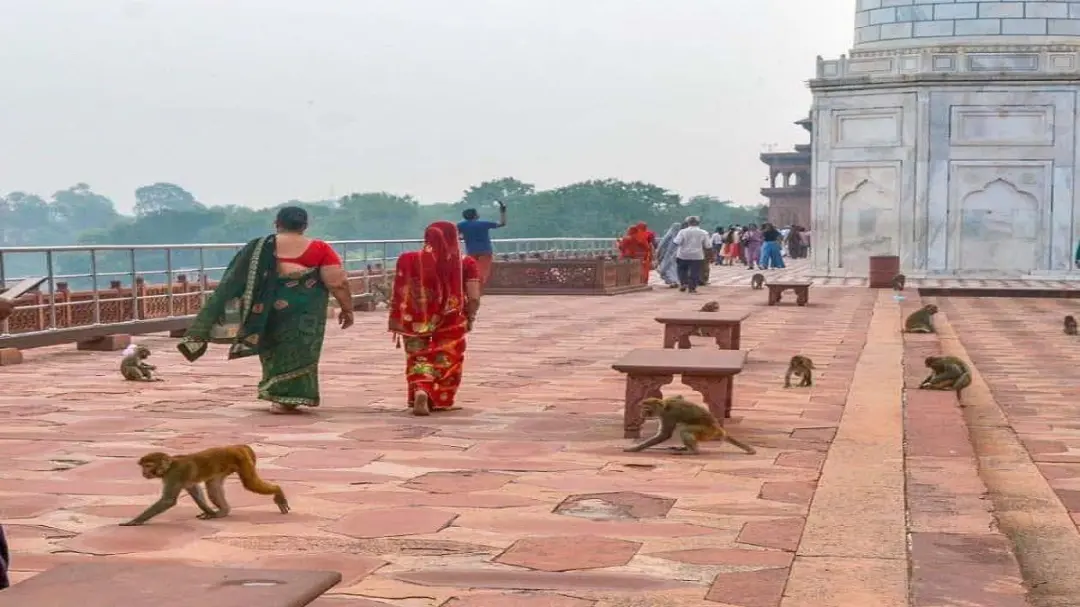
Monkey attacks on tourists at the world-famous Taj Mahal in Agra have continued to raise concerns over visitor safety. Several incidents of monkey attacks have been reported at the monument complex in recent days, with foreign tourists also injured. Amid the latest incidents, tourists are reportedly fearful, while demands have been raised to control monkeys within the monument premises and strengthen security arrangements. In September, a foreign woman tourist was bitten by a monkey near the Royal Gate. Earlier in July, a woman tourist from South Korea was also attacked by a monkey.
In the latest developments, incidents of monkey attacks involving tourists visiting the Taj Mahal have been reported. According to reports, groups of monkeys move around tourists and sometimes suddenly lunge at them. Foreign tourists have also been injured in recent cases. The incidents have raised questions about safety and tourist facilities at an international tourist destination such as the Taj Mahal.
On September 16, Suzanne N Barrett, a woman tourist who was part of a group of tourists from Britain, was bitten by a monkey near the Royal Gate of the Taj Mahal. The woman was reportedly visiting the monument with her companions. After the sudden attack, panic also spread among other tourists present at the site. CISF personnel took the injured woman to the dispensary inside the Taj Mahal complex, where she received first aid before being sent by ambulance to a private hospital.


Earlier in July, South Korean tourist Kim Meh was also bitten by a monkey inside the Taj Mahal complex. According to the report, she had arrived at the Taj Mahal with her companion in the morning and was waiting near the ticket window. During this time, a monkey bit her on the right hand, causing bleeding. The tourist was first taken to the primary health centre at the Taj Mahal and arrangements were later made to send her to a hospital.
The July incident also reportedly involved a delay in getting an ambulance for treatment. According to the report, despite contacting the ambulance driver, the vehicle did not arrive for about an hour. The tourist was subsequently sent to the hospital in a battery-operated car. Information also emerged that the Archaeological Survey of India had sent a report to the Chief Medical Officer regarding the ambulance driver's failure to arrive on time.
Monkey attacks have not been limited to foreign tourists. Recent reports have also documented incidents involving children and tourists from different parts of India. On August 31, six-year-old Ayansh, who had travelled from Haryana to visit the Taj Mahal, was bitten on the hand by a monkey near Mehtabkhana. A report also mentioned a monkey attack on a tourist from Karnataka near the Western Gate.
Monkey attacks at the Taj Mahal complex have been under discussion for several months. In June, tourist Savitri Bai Kashyap from Chhattisgarh was reportedly bitten by a monkey near Amrud Teela. A woman tourist from West Bengal was also reportedly attacked by a monkey. These incidents also included reports of monkeys suddenly lunging at food and beverages being carried by tourists.
The problem of monkey and other animal bites in Agra is not limited to the Taj Mahal complex. The number of patients visiting the district hospital for anti-rabies vaccination also reflects the scale of the problem. In August, 3,619 new patients reached the district hospital after animal bites. Of these, 740 people had been bitten by monkeys. During the same period, 2,663 people were bitten by stray dogs and 273 by pet dogs.
According to district hospital records, among the 3,619 new patients who arrived in August, 3,152 had one wound, while 467 patients had two or more wounds. The report said wounds in several patients were located on sensitive parts of the body, including the neck and face. Such cases require medical supervision and timely anti-rabies treatment.
Health experts have advised people to avoid using home remedies after an animal bite. According to the district hospital's anti-rabies nodal officer, in the event of a bite, the wound should immediately be thoroughly cleaned with soap and running water, followed by consultation with a doctor for an anti-rabies vaccine and other treatment as required. People have also been advised against applying salt, chilli or other household substances to the wound.
The presence of monkeys at the Taj Mahal has long been a challenge for tourists. Large numbers of people from India and abroad visit the monument every day. Incidents in which monkeys suddenly attack tourists can affect visitor safety as well as the tourism experience in Agra. Such incidents can particularly cause difficulties for young children, elderly people and foreign tourists.
Tourists have repeatedly demanded that the monkey population be controlled, monitoring be increased at sensitive locations and clear safety instructions be provided to visitors. There are separate arrangements for tourists at the entrance and within the Taj Mahal complex, and the monument is associated with the Archaeological Survey of India. According to the official Taj Mahal website, separate ticket queues are available for foreign and domestic tourists, while entry is managed through designated gates.
However, warning boards alone may not be considered sufficient to prevent monkey attacks. Identifying locations where monkey activity is higher is necessary for tourist safety. Along with this, measures such as monitoring by trained security personnel, controlling the open display of food items and seeking assistance from the Forest Department when required may need attention.
The continuing reports of monkey bites at the Taj Mahal have also raised questions about how wildlife management and tourist safety arrangements can be improved to protect the millions of tourists visiting the World Heritage Site. The issue has become more sensitive following injuries to foreign tourists in recent incidents. The incidents involving a South Korean tourist in July and a British tourist in September indicate that the issue is not limited to local visitors.
At present, tourists are advised not to go very close to monkeys, not to feed them and not to walk around with food items in front of them. If a person is bitten or scratched by a monkey, the wound should immediately be cleaned with soap and running water and medical treatment should be sought at a healthcare centre. Anti-rabies treatment for animal-bite cases is reportedly available at Agra District Hospital.