Indian Mathematician Neena Gupta Recognised in TIME100 Next India 2026 List
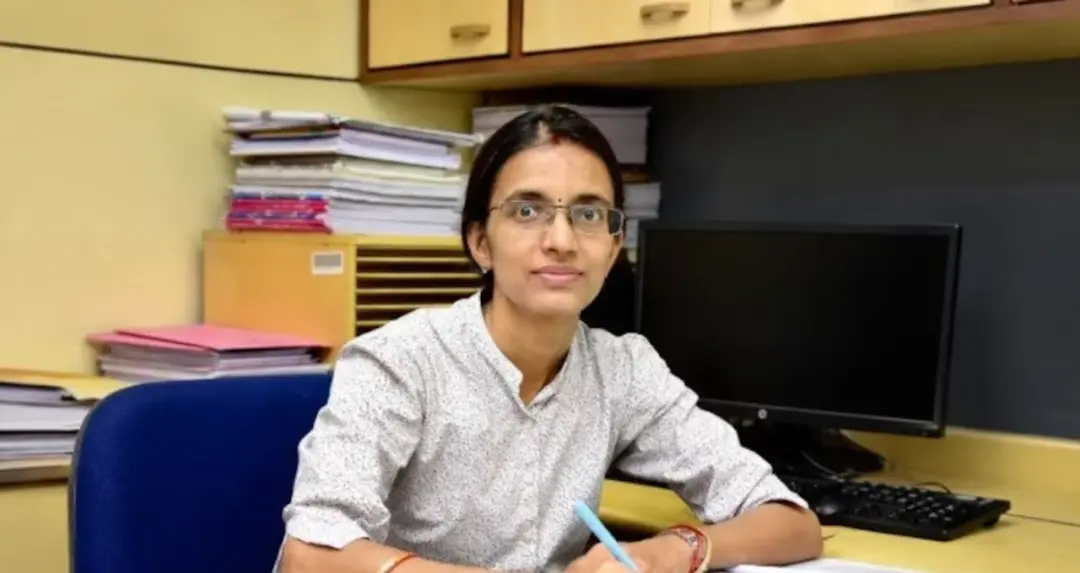
Indian mathematician Neena Gupta has been included in the TIME100 Next India 2026 list in recognition of her contributions to mathematics. She gained international recognition for resolving an important form of the Zariski Cancellation Problem, a mathematical question that has remained a subject of research for nearly seven decades.
Who Is Mathematician Neena Gupta?
Neena Gupta was born on November 24, 1984, in Kolkata. She developed an interest in mathematics during her childhood and grew up in a family environment that placed importance on education and the subject.
She completed her BSc Honours degree in Mathematics from Bethune College, Kolkata, in 2006. She subsequently enrolled at the Indian Statistical Institute (ISI), Kolkata, where she obtained her master's degree in Mathematics in 2008.




Her interest in advanced mathematical concepts continued to develop during her academic career. In 2011, she completed her PhD from ISI Kolkata, specialising in algebra.
Research on the Zariski Cancellation Problem
Gupta gained widespread recognition for her research on the Zariski Cancellation Problem, a significant mathematical problem in algebraic geometry.
The problem was originally formulated in one of its forms by renowned mathematician Oscar Zariski in 1949. It examines whether two algebraic varieties that become isomorphic after an additional dimension is introduced must also have been isomorphic in their original forms.
The question remained challenging for mathematicians for decades.
In 2014, Gupta demonstrated that the answer could be negative under specific mathematical conditions in an important form of the problem.
She established a counterexample using a three-dimensional algebraic structure developed by mathematician Takanori Asanuma. Her research opened a new direction for understanding the problem over fields of positive characteristic.
Awards and Recognition
Neena Gupta has received several national and international recognitions for her contributions to mathematics.
In 2014, she received the Young Scientist Award from the Indian National Science Academy.
In 2019, she was awarded the Shanti Swarup Bhatnagar Prize in Mathematical Sciences. In 2021, she received the Ramanujan Prize, an international recognition for young mathematicians.
She has also been honoured with the Nari Shakti Puraskar. In 2024, she received the Infosys Prize for outstanding research in Mathematical Sciences.
Her inclusion in the TIME100 Next India 2026 list adds to the recognition of her contributions to mathematical research.
Contributions to Mathematics and STEM Research
Gupta's research has brought international recognition to Indian mathematical scholarship. Her achievements also highlight the contributions of women researchers to science, technology, engineering and mathematics (STEM).
Her academic journey, from studying mathematics in Kolkata to gaining international recognition for her research, reflects her contributions to advanced mathematical research and the development of algebraic geometry.