Nippon India Mutual Fund’s gold and silver exchange-traded funds have crossed a combined asset under management of ₹1 lakh crore, according to exchange data. As of January 28, 2026, the Nippon India Gold ETF had an AUM of ₹55,124.5 crore, while the Nippon India Silver ETF managed ₹47,392.0 crore. The combined AUM stood at ₹1,02,516.5 crore.




National Stock Exchange data show that this makes Nippon India Mutual Fund the largest manager of gold and silver ETFs in India by combined assets. Among the top 10 asset management companies offering gold and silver ETFs, Nippon India Mutual Fund ranks ahead of ICICI Prudential Mutual Fund, HDFC Mutual Fund, and SBI Mutual Fund in terms of total AUM.
ICICI Prudential Mutual Fund reported a combined gold and silver ETF AUM of ₹48,165.7 crore, followed by HDFC Mutual Fund with ₹34,075.7 crore and SBI Mutual Fund with ₹33,103.6 crore. Kotak Mutual Fund managed ₹19,817.5 crore, Tata Mutual Fund ₹12,096.8 crore, Axis Mutual Fund ₹7,974.5 crore, Aditya Birla Sun Life Mutual Fund ₹7,878.3 crore, UTI Mutual Fund ₹6,568.4 crore, and Mirae Asset Mutual Fund ₹4,285.4 crore in gold and silver ETFs.
In aggregate, the top 10 asset management companies manage ₹2.76 lakh crore in gold and silver ETFs.
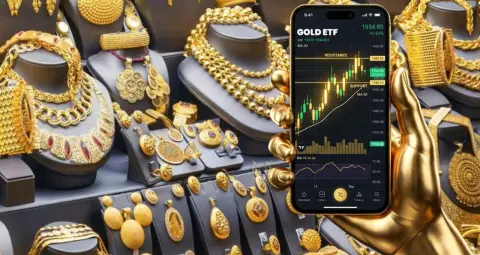
Market participants have increasingly used gold and silver ETFs as regulated, exchange-traded investment products. Gold ETFs are used for portfolio diversification and as an inflation-linked asset, while silver ETFs reflect demand linked to both precious metal investment and industrial usage.
The shift toward ETFs has expanded participation across retail, high net worth, and institutional investors. Factors cited for ETF adoption include transparent pricing linked to market rates, exchange-based liquidity, regulated structures, and daily disclosures, without concerns related to physical storage or purity.
Within the combined AUM of over ₹1 lakh crore, gold continues to account for a larger share, while silver ETF assets have grown in recent years. Silver ETF demand is linked to its use in renewable energy, electronics, and electric vehicles, as well as higher price volatility and lower investment ticket sizes compared with gold.