The traditional Sama-Chakeva festival is being celebrated across Darbhanga and other parts of Mithilanchal, with festivities now approaching their conclusion on Kartik Purnima. The celebrations began after the completion of the Chhath festival and have brought traditional Maithili folk songs and cultural activities to streets, neighbourhoods and villages.
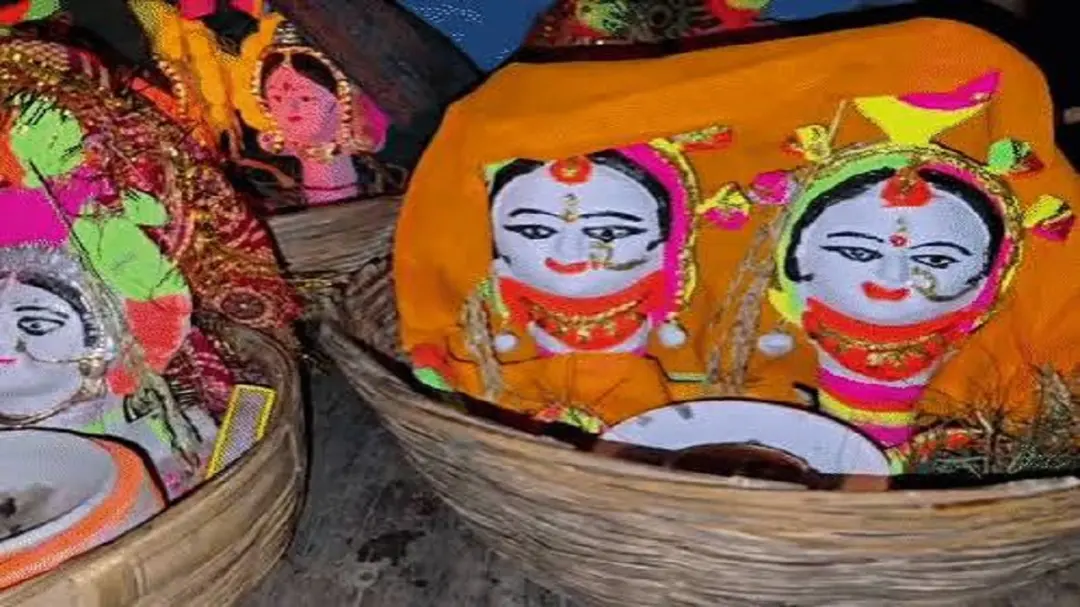
As evening falls, women and young girls gather at neighbourhood squares and open spaces, carrying colourful bamboo baskets decorated with clay figures of Sama, Chakeva and other traditional characters. Through the festival, sisters pray for their brothers' longevity, prosperity and happiness. The celebrations will conclude on Kartik Purnima with traditional farewell rituals and the immersion of the clay figures.
Sama-Chakeva is one of the ancient folk traditions of Mithila and is regarded as a celebration of the love, trust and sacrifice shared between brothers and sisters.
The festival begins on the seventh day of the Shukla Paksha of Kartik and continues until Kartik Purnima. During this period, women and young girls gather in groups every evening, carrying decorated baskets from their homes to courtyards, open spaces and neighbourhood squares.
The clay figures are placed together as participants sing traditional Maithili folk songs. One group sings a line, while another responds. Prayers for brothers' long lives and the well-being and prosperity of families are recurring themes in these songs.


The festival is associated with a traditional legend involving Shyama, also known as Sama, the daughter of Lord Krishna.
According to the popular folklore, a man named Chugla falsely accused Sama. Angered by the incident, Lord Krishna cursed her to live in the form of a bird. Witnessing the injustice suffered by his sister, her brother Chakeva resolved to free her from the curse.
Through penance, Chakeva succeeded in restoring his sister to human form. The story conveys themes of a brother's sacrifice, his affection for his sister and the struggle against false accusations.
This legend is one of the reasons Sama-Chakeva holds a special place in Mithila's cultural traditions as a festival celebrating the bond between brothers and sisters. However, some variations in the narration of the story and the characters involved are found across different villages.
Several types of clay figures are prepared during the festival, including representations of Sama, Chakeva, Chugla, Satbhaiya, Vrindavan and different birds.
The figures are decorated with colours and arranged in bamboo baskets known as dala. Women and young girls gather every evening to perform the traditional Sama rituals with these figures.
Chugla also occupies a distinctive place in the celebrations. In local folklore, the character represents individuals who spread rumours and create misunderstandings within family relationships.
In several places, a symbolic ritual involving the burning of Chugla's moustache is also observed. The ritual conveys a message against falsehood, gossip and practices that create divisions within families.
One of the most emotional traditions of the festival takes place on Kartik Purnima, when the clay figures of Sama are given a ceremonial farewell.
The farewell ritual resembles the departure of a daughter to her marital home after marriage. During the ceremony, women sing traditional Samadaun songs expressing the sadness of separation, the emotional bond with the family and wishes for a happy life.
Following the farewell ceremony, the clay figures are immersed in rivers or ponds. In some places, brothers also participate in the ritual and join their sisters in bidding farewell to Sama.
The ceremony brings the festival's message of brother-sister affection to a close in an emotional atmosphere.
Sama-Chakeva is associated not only with religious beliefs but also with Mithila's folk art and relationship with nature.
During the month of Kartik, migratory birds arrive in the plains from the Himalayan region and surrounding areas. The tradition of creating and decorating clay figures of birds during the festival is also associated with respect for nature and avian life.
The colourful figures arranged in bamboo baskets reflect Mithila's traditional clay art and folk aesthetics. The celebrations also help preserve and pass on Maithili folk songs, traditional crafts and oral folklore from one generation to the next.
Enthusiasm for the festival remains visible in both rural areas and urban neighbourhoods of Darbhanga. Women and young girls gather in groups every evening to participate in the traditional Sama celebrations.
Children are also being introduced to the festival's stories and customs at home. Elderly women are teaching traditional songs to younger generations to ensure that the region's cultural heritage continues to be preserved.
The annual Sama-Chakeva celebrations will conclude on Kartik Purnima with the farewell and immersion of the clay figures. The traditional Maithili songs associated with the festival are expected to return to the streets and neighbourhoods of Mithila once again after next year's Chhath celebrations.