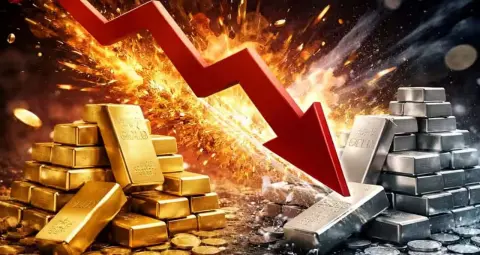
Silver prices recorded a sharp decline on Thursday, falling 21 percent to ₹3,32,002 from ₹4,20,048. Gold prices also declined, easing to ₹1,54,157 from ₹1,80,779.
In the silver futures market, prices touched a record high of ₹4,20,048 under the March contract on Thursday before dropping by ₹88,046 within a day to ₹3,32,002. The decline followed a rapid rise over the previous days, with nearly the entire 10-day increase reversing in a single session.
In the international market, silver prices on COMEX fell to $95.12 per ounce from $121.79 per ounce recorded a day earlier, indicating higher volatility compared with gold.




Gold prices also declined alongside silver. On MCX, the February gold contract had reached a record high of ₹1,80,779 per 10 grams on Thursday before falling to ₹1,54,157, marking a decline of ₹26,622, or 14.72 percent. On COMEX, gold prices slipped to $4,950 from $5,586 per ounce.
Market participants cited profit booking after an exceptional rally over the past week. Ajay Kedia, Director at Kedia Advisory, said gold and silver had risen beyond required levels over a short period.
Vandana Bharti, Research Head at SMC Global Securities, said domestic silver prices could move to ₹3.20 lakh over the next week, while gold could decline to ₹1.42 lakh. She said the current correction in silver was not comparable to the scale of the 1980 episode.
According to Kedia Advisory, January 2026 witnessed an exceptional rally, with gold registering a 28 percent monthly rise, last seen in January 1980. Silver surged nearly 70 percent during the month, marking its fastest monthly increase. Following such rallies, corrections are typically observed.
Historical data show that during correction phases, silver has declined more sharply than gold. Between 1977 and 1980, gold declined about 66 percent while silver fell 90 percent. During the 2008–2011 period, gold corrected by around 38 percent, while silver dropped more than 60 percent.
The gold–silver ratio recently moved to around 45, compared with levels of about 107 during last year’s geopolitical tensions. Analysts said such low ratio levels have not historically been sustained and have previously reverted toward the 70–72 range.
Kedia said investors should exercise caution in fresh buying and focus on protecting existing gains amid heightened volatility. Bharti said silver could fall to $78 per ounce and gold to $4,860 per ounce, while reiterating projected domestic levels of ₹3.20 lakh for silver and ₹1.42 lakh for gold.
Analysts also cited geopolitical tensions between the US and Iran, tariff-related uncertainties, expectations around the Indian budget, a firm dollar, and higher margins as factors contributing to increased market volatility.
The 1980 silver market episode, known as ‘Silver Thursday’, followed heavy accumulation by the Hunt brothers—Nelson Bunker Hunt and William Herbert Hunt—who acquired a significant share of global non-government silver between 1973 and 1979. In 1980, silver prices collapsed, including a single-day fall of about 50 percent.