US President Donald Trump recently indicated that he plans to ban people from certain countries, which he described as “Third World countries,” from entering the United States.
US News: The term ‘Third World Countries’ originated during the Cold War era when the entire world was divided into two powerful blocs: the Western Bloc led by the United States and the communist Eastern Bloc led by the Soviet Union. Countries that were not part of either of these blocs were called “Third World.” Today, this term has become a historical reference, but it has re-entered global discussion due to recent US policies.


In recent developments, US President Donald Trump has described some countries as “concerning” and announced stringent restrictions on people arriving from them. Many experts consider this move not only discriminatory but also diplomatically damaging for regions such as India, Africa, Asia, and Latin America.
The Cold War and the Concept of the ‘Third World’
The concepts of the First, Second, and Third Worlds developed during the Cold War.
- First World: Democratic and industrialized countries such as the USA, Canada, Western Europe, Japan, South Korea, and Australia.
- Second World: The Soviet Union, Eastern Europe, China, North Korea, Vietnam, and other communist countries.
- Third World: Countries that were not directly aligned with either bloc. These predominantly included developing or agrarian nations in Africa, Asia, and Latin America.
Over time, the term “Third World” began to be used often for poor or underdeveloped countries, although its original meaning was associated with non-alignment.

Which Countries Is the US Concerned About?
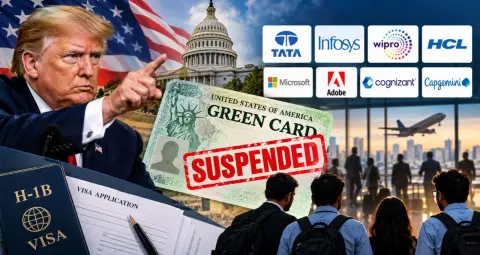
Joseph Edlow, Director of US Citizenship and Immigration Services (USCIS), recently stated that Green Card applications from every foreign national from “concerning countries” would undergo strict scrutiny. This statement came after an alleged incident in Washington where an Afghan national opened fire on two National Guard soldiers.
Under an executive order by the Trump administration, 19 countries were categorized as “concerning.” A complete ban on entry to the US was imposed on citizens from 12 of these countries, while partial restrictions were placed on 7 countries.
- Countries with complete bans: Afghanistan, Myanmar, Chad, Congo-Brazzaville, Equatorial Guinea, Eritrea, Haiti, Iran, Libya, Somalia, Sudan, and Yemen.
- Countries with partial bans: Burundi, Cuba, Laos, Sierra Leone, Togo, Turkmenistan, and Venezuela.
Most of these countries are traditionally referred to as Third World or developing nations. According to experts, the US's concern is not limited to security; China's growing global influence is also a major reason behind it. China is strengthening its foothold in many developing countries across Africa, Asia, and Latin America through investment, infrastructure, and trade.