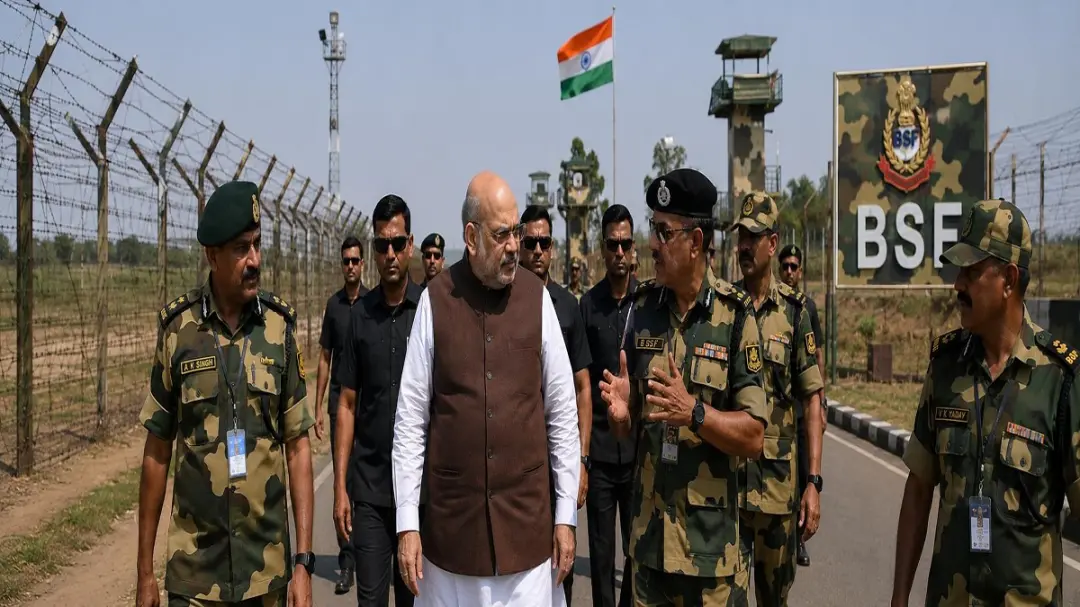
Union Home Minister Amit Shah said on Friday in Siliguri, West Bengal, that India and West Bengal cannot be considered fully secure until the country’s borders are secure. He linked the security of the strategically important Siliguri Corridor, commonly known as the ‘Chicken Neck’, with national security and stressed the need to strengthen security in the area.
The Siliguri Corridor is a narrow and strategically important area connecting mainland India with the northeastern states. Several international borders are located around the corridor, making its security a longstanding strategic priority.
Amit Shah said national security cannot be ensured only by strengthening internal security systems and that securing international borders is equally necessary. He highlighted border surveillance, the presence of security forces and effective measures to prevent infiltration.




Shah also referred to the India-Bangladesh border in West Bengal. He alleged that during the tenure of the previous government, the state did not provide the necessary land despite requests from the Centre to facilitate the construction of border fencing.
He said better coordination between the Centre and the state government is necessary to strengthen border security.
According to Shah, border security is directly linked to the country’s internal security. He said that if illegal infiltration and other security challenges along the borders are not effectively controlled, they can affect not only border areas but also other parts of the country.
During Shah’s visit, emphasis was also placed on a plan for a triangular security grid for the Siliguri Corridor. According to reports, the objective is to strengthen security in the region through surveillance of international borders, improved coordination among various security agencies and the use of modern technology.
Border security agencies will have an important role in the proposed arrangement. Modern surveillance equipment, improved communication systems, continuous monitoring of sensitive areas and coordination among security agencies at the local level can increase the capacity to respond quickly to suspicious activity.
Shah said people living in border areas are also an important part of the security system. Expanding the reach of government schemes and basic facilities among villagers and local communities living near the border is also part of a broader approach to security.
Development in border villages strengthens the connection of local populations with the administration and security system.
The issue of providing land for border security was also discussed during Shah’s visit. According to the report, the Centre appreciated the state government’s cooperation in making 1,129 acres of land available in West Bengal for the BSF and SSB. The land is expected to help meet infrastructure requirements related to border security.
Alongside the Siliguri Corridor, security along the India-Bangladesh border remains an important issue in the region. Fencing, surveillance and the deployment of security forces are used to address challenges including illegal movement and infiltration. The Union Home Ministry has continued to emphasise coordination with states to strengthen border security.
Shah also stressed development alongside security. The central government is focusing on strengthening roads, communications, electricity and other basic infrastructure in border areas.
The statement in Siliguri came as the Centre’s focus on connectivity with the northeastern states and border security continues. The security of the Siliguri Corridor is connected with the country’s main connectivity with the northeastern states.
Shah said border security and national security cannot be viewed separately. The approach includes strengthening security arrangements in border areas while increasing development and administrative access, with greater coordination between security agencies and local administration.