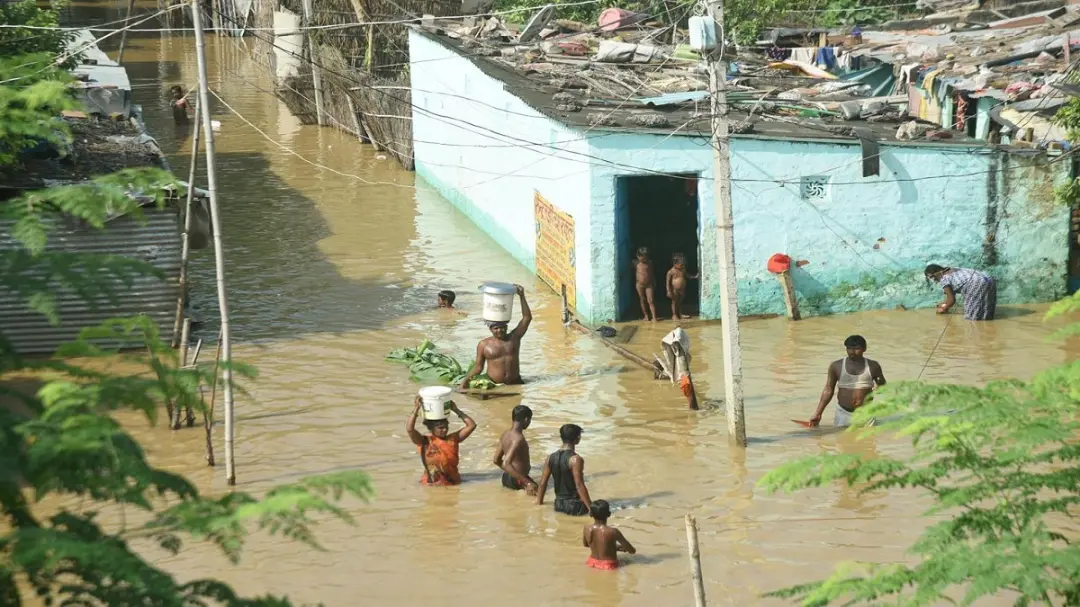
The rising water level of the Ganga and rapid erosion along the riverbank have increased difficulties for families living in the affected areas of Bhagalpur. The erosion was so rapid that houses and a flour mill used as a source of livelihood were swept into the river, forcing families to leave their homes and search for safer places.
Families affected by the erosion said the problem was not sudden. Every year during the monsoon, the Ganga’s rising water level is followed by erosion in the area. Villagers alleged that effective preparations and anti-erosion work carried out in advance could have reduced the damage. Administrative rescue and relief operations are now being undertaken after houses and land have already been lost to the river.
Erosion has become the main concern in areas along the Ganga in Bhagalpur. Soil along the riverbank is continuously being washed away by the river’s current. At several locations, land has subsided and the danger has reached residential houses. Residents are living with the fear that another house could be affected at any time.
For the affected families, the loss extends beyond their homes. Savings, grain, clothes, important documents, household belongings and sources of employment have also been swept away. Families whose flour mill was lost in the river are now facing a loss of daily income.
According to local residents, the flour mill was not merely a machine but an important source of family income. Villagers from nearby areas used to come there to grind grain, providing the family with a regular means of earning. After the mill and related equipment were swept away by erosion, the family is facing a livelihood crisis.
Affected families said the situation went out of control within a short time after the erosion intensified. Once cracks appeared in the ground and soil began to slide, residents started moving essential belongings out of their homes. However, they did not have enough time to move everything to a safe location before the river’s b current caused further damage.
Several families watched parts of their homes collapse into the river. Household belongings were also carried away by the fast-moving water. Some families managed to escape safely, but years of work and accumulated possessions were lost within a short period.
Residents of the affected areas said they face the same fear every monsoon. As the river level rises, its course changes and the riverbank begins to erode. According to villagers, identifying vulnerable locations in advance and carrying out anti-erosion work on time could prevent many families from being displaced.

The problem is not limited to this year. Incidents of houses and agricultural land being swallowed by the Ganga have also been reported in several riverside areas of Bhagalpur in previous years. Recently, several houses in English village in the district were affected by erosion. According to the report, 15 houses were swept into the Ganga in a single night, after which the administration began the process of identifying affected families and providing assistance.
Local residents said the erosion problem cannot be addressed only through relief during floods. They called for year-round planning and permanent anti-erosion arrangements. According to villagers, vulnerable riverbanks should be identified and necessary work should be carried out while the river’s water level is normal.
Affected residents have questioned why adequate preparations are not made before the monsoon when erosion occurs along the river every year and vulnerable locations are already identified. They said that by the time rescue operations begin after flooding, considerable damage may already have occurred.
The loss of agricultural land is another problem for rural families affected by erosion. For families whose main source of livelihood is farming, the loss of land to the river means losing a permanent source of income. In several places, farmland is eroded first, after which the danger from water and erosion reaches residential areas.
Affected families are now facing a dual crisis. They need a safe place to live while also dealing with the loss of their livelihood. Families whose flour mills and other small businesses have been swept away require financial assistance.
The administration has said that people affected by erosion are being identified for government assistance. Efforts are also being made to provide relief materials and essential supplies. However, affected residents said that immediate relief must be accompanied by a permanent solution for the future.
Temporary shelter is necessary for affected families, but unless concrete measures are taken to control river erosion, the same crisis could recur during every monsoon.
The danger increases during erosion at night. In darkness, it is difficult to determine whether land is gradually shifting or the foundation of a house is weakening. Several families had to leave their homes suddenly. In such circumstances, advance warnings and arrangements for safe locations by the administration become important.
Local villagers said that deploying machinery and workers at the initial stage of erosion could have reduced the pace of damage. At several locations, the river current directly hits the bank, causing the soil to erode rapidly. Rescue and preventive work is needed at such vulnerable locations in time.
Local-level monitoring is also required for anti-erosion work. Villagers said they are often the first to notice changes in the river’s course and cracks appearing in the ground. Better coordination between the administration and local residents could help ensure that warnings about emerging dangers reach authorities in time.
For people living along the Ganga, the river is not only a source of danger but also a basis of livelihood. Farming, fishing and small businesses are linked to the livelihoods of thousands of families. People cannot completely move away from the river, making safe riverbanks and permanent anti-erosion arrangements an important requirement.
Affected residents said they also try to protect their homes every year. However, individual efforts are not sufficient when the river current becomes b. They said large-scale government intervention is necessary.
The risk of erosion changes with fluctuations in the Ganga’s water level. In some cases, the river continues to rapidly erode the bank even when the water level falls. Therefore, assessing the risk only on the basis of the water level is not sufficient. Continuous monitoring of the river’s current, the condition of the riverbank and soil erosion is required.
The experiences of families affected by erosion in Bhagalpur show that flooding is not limited to the problem of water accumulation. For many families, it becomes a crisis involving the loss of land, homes, employment and years of accumulated savings. When a family home is swept into the river, it can mean the loss of a lifetime’s savings.
Affected residents have demanded immediate relief as well as assistance with permanent rehabilitation and employment. For people whose land and homes have already been lost to the river, relief for only a few days will not be sufficient. They may require assistance for a longer period.
The destruction of small businesses such as flour mills also affects the local economy. The loss of a shop or small machine affects not only its owner but also nearby residents who depend on that service.
Villagers said authorities are aware of the erosion problem every year. They said surveys of vulnerable areas, identification of weak riverbanks and arrangements for necessary materials should be completed before the monsoon. This would allow authorities to focus on preventing damage in advance instead of beginning relief operations only after a disaster occurs.
The administration’s deployment of flood-fighting teams to affected locations is an important step towards relief. However, villagers expect rescue operations to go beyond managing the immediate situation. They want a permanent solution based on the long-term behaviour of the river and its erosion pattern.
According to local residents, some areas have experienced erosion in the past and departments are aware of the risks there. The recurrence of the crisis every year indicates the need to strengthen preventive arrangements.
The education of children from affected families is also disrupted. When homes are destroyed and families move to other locations, children’s studies can be affected. Problems related to access to schools, books and notebooks and accommodation also arise.
Displacement is more difficult for women and elderly people. Moving household belongings while ensuring that family members reach safe locations becomes challenging. During such situations, coordinated assistance from the local community and administration is important.
The main demand of villagers is for a permanent plan that treats river erosion as a recurring disaster rather than providing only annual relief. Where erosion continues repeatedly, a safe rehabilitation plan should also be prepared for affected families.
At present, families whose homes and flour mills have been swept into the Ganga are trying to find safe places to stay and arrange essential belongings. They face uncertainty about the future, including how their homes will be rebuilt, how they will restart their livelihoods and how their children’s education will continue.
The experience of people living along the Ganga also underscores the need for preparations before the monsoon in areas that face the same erosion risk every year. Such preparations can help reduce property losses and protect people from danger.
Overall, Ganga erosion in Bhagalpur has placed several families in a severe crisis. Homes, land and sources of livelihood have been swept into the river before their eyes. Affected residents said the problem occurs every year and that advance preparations could have reduced the damage. They are now seeking immediate relief along with permanent anti-erosion measures, safe rehabilitation and livelihood arrangements.