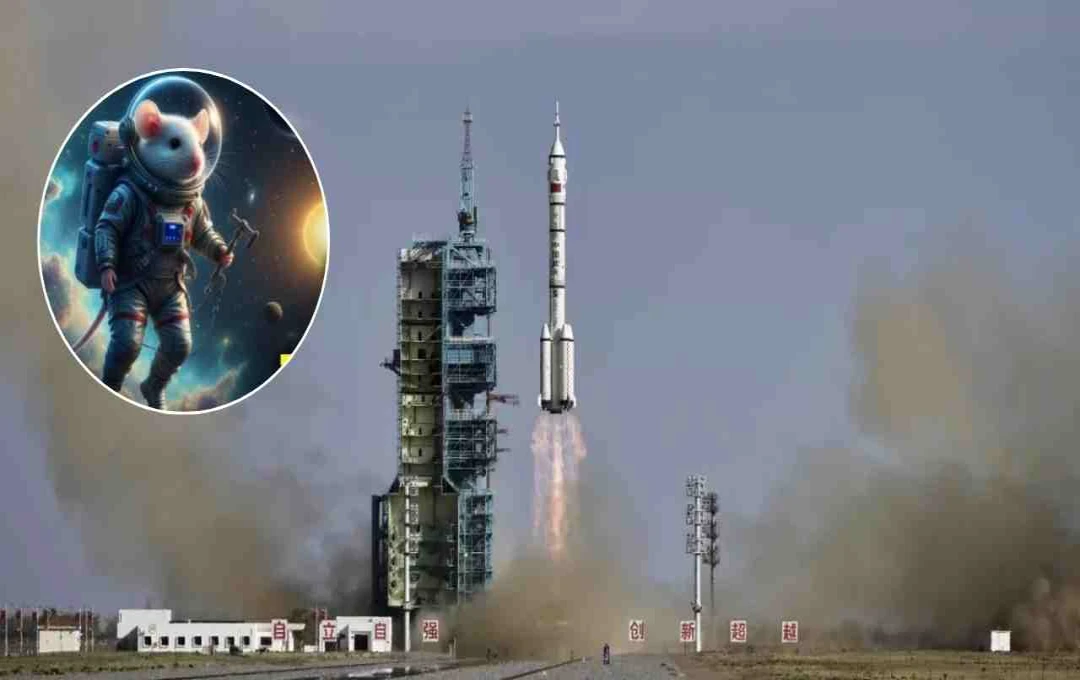
‘You must have heard the proverb, ‘The cat went on a pilgrimage,’ but now listen to this – mice are going to space! This is not a proverb, but a reality that China is now making true. In fact, China is set to launch its Shenzhou-21 spacecraft for its space station this Friday for the first time.
Jiuquan: The proverb says, ‘The cat went on a pilgrimage,’ but now it’s time to hear it in a new light – mice are going to space! This is no joke, but part of China’s ambitious space program. On Friday, China sent four mice along with three astronauts on a journey to space as part of its new manned mission, Shenzhou-21.
This marks the first time China has included another living organism on its space station for scientific experimentation. This mission symbolizes China’s technological capability and scientific ambitions.


Launch of Shenzhou-21 Mission
China’s historic mission was successfully launched from the Jiuquan Satellite Launch Center in northwestern China. The Shenzhou-21 spacecraft was sent with three astronauts — Commander Zhang Lu, Wu Fei, and Zhang Hongzhang.
Zhang Lu, who was previously part of the Shenzhou-15 mission, is the commander of this expedition. Wu Fei, at just 32 years old, has become the youngest Chinese astronaut to date. Meanwhile, Zhang Hongzhang is a payload specialist who researched new energy and advanced materials before going to space.
The three astronauts will conduct scientific experiments at China’s Tiangong Space Station, where the team will carry out several technical and biological study missions.
Why Are Mice Being Sent to Space?
The most interesting aspect of this mission is the space journey of four mice. According to Han Pei, an engineer at the Chinese Academy of Sciences, two male and two female mice have been sent on this mission. These mice will be monitored to study: the effects of microgravity on their bodies and brains.
what changes occur in their behavior due to prolonged stays in confined spaces. This experiment will shed light not only on the physical condition of the mice but also on their biological and psychological behavior. This study will help scientists understand what effects such an environment might have on humans during long-duration space travel.
According to state media China National Radio (CNR), these mice will remain in the space station for five to seven days and then be returned to Earth via the Shenzhou-20 spacecraft.