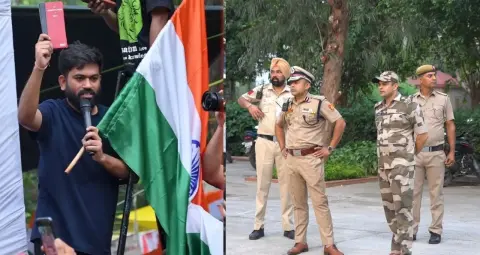
Thousands of supporters of the Cockroach Janata Party (CJP) gathered at Jantar Mantar in New Delhi on Monday to prepare for a proposed march to Parliament. Delhi Police said permission for the march had not been granted, while the protesters said they intended to pursue their demands through peaceful means.
Security was tightened across the national capital as additional police personnel and paramilitary forces were deployed around the Parliament complex, Central Vista, Vijay Chowk and other sensitive areas. Barricades and traffic restrictions were imposed at multiple locations to maintain law and order.
CJP claimed that around 10,000 protesters were present at the demonstration site. Founder Abhijeet Dipke appealed to participants to maintain peace, stating that the movement would remain democratic and non-violent. He said any violence or disorder could undermine the objectives of the protest.
Dipke said the organisation wanted the demonstration to remain within the framework of the Constitution so that issues related to education could be effectively presented before the country.
A tense situation developed around Jantar Mantar in the morning after some protesters attempted to remove police barricades. Police restored the security perimeter, following which discussions took place between protesters and police officials.
The administration appealed to protesters to maintain peace and comply with the law. The situation was reported to be under control.

Delhi Police reiterated that no official permission had been granted for a march to Parliament. Officials said that, considering security arrangements in the Parliament area, no procession without prior permission would be allowed to proceed.
Police added that all organisations were required to comply with security protocols and administrative directions in force in the capital
Security arrangements in New Delhi were further strengthened in view of the proposed march, with thousands of police personnel and paramilitary personnel deployed.
Security was enhanced at Parliament House, Rashtrapati Bhavan, the Prime Minister's residence, the Home Minister's residence and other sensitive government premises. Multi-layer barricading, vehicle checks and continuous surveillance were introduced on several major routes. CCTV cameras and quick response teams were also kept on alert to respond to any unforeseen situation.
For security reasons, the Delhi Metro Rail Corporation (DMRC) temporarily closed entry and exit gates at several Metro stations, including Janpath, Rajiv Chowk, Patel Chowk, Central Secretariat and Seva Bhawan.
Passengers were advised to use alternative routes and check official traffic advisories before travelling.
Social activist Sonam Wangchuk, who has been on a hunger strike for 23 days, announced three conditions for ending his fast.
His first condition calls on the government to accept responsibility for shortcomings in the education system and cases such as paper leaks.
Under the second condition, he said a CJP delegation should be allowed to proceed to Parliament and Members of Parliament should assure that the issue would be raised in Parliament.
His third condition states that if his health prevents him from going to Parliament, Members of Parliament from different political parties should visit the hospital and publicly assure that they would raise the issue of education reforms in Parliament.
CJP spokespersons claimed that efforts were being made by the administration to initiate talks. The organisation said it was prepared for dialogue and sought a peaceful resolution.

However, no formal announcement had been made by the government regarding the status of any discussions.
The Constitution of India provides citizens with the right to express their views through peaceful and non-violent protest. However, administrative permission is required for public rallies, processions or marches towards Parliament.
According to experts, authorities frame guidelines for such events based on security, traffic management and law and order considerations. They said police may take action in accordance with the law if a march is attempted without permission.
The protest in Delhi has again brought issues related to the education system, transparency in competitive examinations and paper leaks into national discussion.
Several social organisations, educationists and representatives of political parties have emphasised the need for education reforms. The government has said that steps are continuously being taken to strengthen the education system and make examination processes more secure.
Security agencies continue to monitor the situation in the capital. The administration said its priority remains maintaining law and order and preventing any untoward incident.
Meanwhile, the protesters said they would continue their peaceful movement over their demands. Attention is now focused on whether talks between the government and the protesters move forward and what developments emerge regarding the proposed Parliament march.