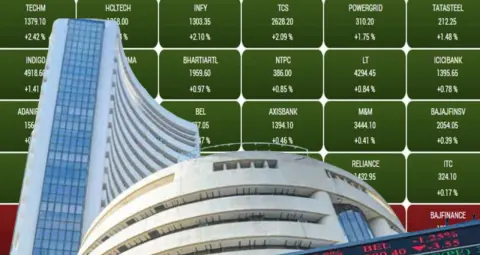
Global geopolitical tensions and heightened investor caution weighed on Indian equity markets on Friday, with benchmark indices BSE Sensex and Nifty 50 trading lower in early session.
Indian share markets continued to witness volatility amid global tensions. After three consecutive days of declines, the market had shown some recovery on Thursday, but trading on Friday again moved into negative territory. Rising tensions involving the United States, Israel, and Iran reduced investors’ risk appetite, reflecting in market sentiment.
On Thursday, Indian benchmark indices had closed higher. The Nifty 50 rose 285 points to close at 24,765, while the BSE Sensex advanced 899 points to reach 80,015. The Nifty Bank index also ended higher, gaining about 300 points to close at 59,055.




Weak Opening for Sensex and Nifty

Markets opened lower on Friday. In early trade, the BSE Sensex declined about 551 points, or around 0.69 percent, to approximately 79,464. The Nifty 50 was down about 160 points, or around 0.6 percent, trading near 24,605.
Weakness had already been visible during the pre-opening session. The Sensex had opened around 320 points lower at approximately 79,694, while the Nifty fell about 128 points to around 24,637. The decline reflected uncertainty across global markets.
Markets Had Recovered in the Previous Session
On Thursday, Indian equity markets had broken a three-day losing streak and closed higher. The Nifty 50 ended about 285 points higher at 24,765, while the BSE Sensex rose about 899 points to close at 80,015.
The banking sector also recorded gains, with the benchmark banking index Nifty Bank closing about 300 points higher at 59,055. However, markets came under pressure again on Friday due to global factors.
Market analysts said investors are currently closely tracking global developments. Rising tensions in West Asia have also led to volatility in international energy markets.