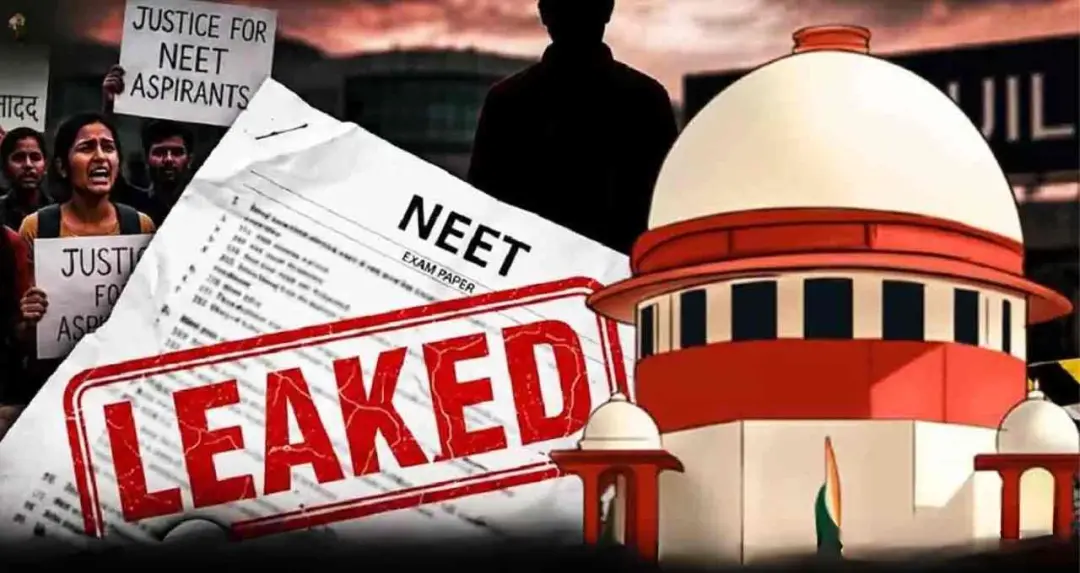
The Supreme Court on Friday said it would monitor, for a limited period, the investigation into the alleged paper leak in the NEET-UG 2026 examination, while expressing concern over the integrity of the examination process and directing measures to strengthen institutional safeguards.
During the hearing, the court observed that incidents such as paper leaks affect the future of millions of students and said repeated lapses in examination security raise serious concerns. A Bench of Justices P.S. Narasimha and Alok Aradhe stated that transparency and security in the examination system must remain the highest priority and questioned how repeated paper leak incidents were occurring.

The Bench also raised concerns regarding the functioning of the National Testing Agency (NTA), observing that serious shortcomings appeared to have emerged in the conduct of examinations. The court stated that accountability must be fixed if such incidents recur and said there could be no compromise with the credibility of the country’s premier medical entrance examination.
The Supreme Court directed the Union Education Ministry to file a detailed affidavit explaining how the NEET examination process would be made more secure and institutionalised, how the NTA would be strengthened, and how the deployment of experts and experienced personnel in the examination system would be ensured.
The court further directed that the affidavit explain the manner in which technical and institutional capacity within the NTA would be developed to prevent incidents such as paper leaks in the future.
The Supreme Court directed the Centre and the NTA to place a detailed action plan before it within six weeks. The Bench stated that the exercise should not remain confined to paperwork and must be aimed at ensuring actual reform. It further observed that the NTA should be provided with adequate physical and technological resources to make the examination process fully secure and transparent.
During the hearing, the court also took note of reports submitted by the NTA and Dr K. Radhakrishnan, chairperson of the high-level committee constituted in connection with the matter, and observed that the recommendations contained in those reports required serious implementation.