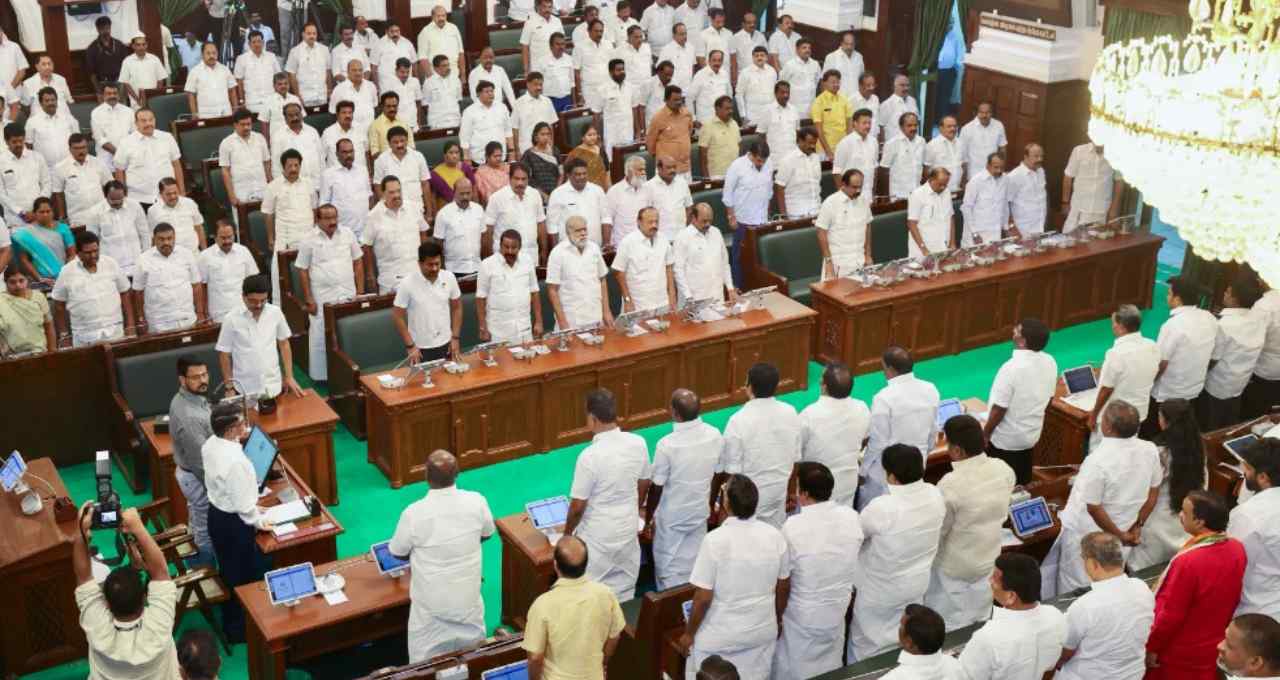
The Tamil Nadu Legislative Assembly on Thursday passed a resolution opposing the Union government’s proposal to change the name of the Mahatma Gandhi National Rural Employment Guarantee Act (MGNREGA), asserting that the scheme is intrinsically linked to rural employment, women’s participation, and the right to work.
Moving the resolution, Chief Minister M.K. Stalin said the employment guarantee programme is not merely a welfare scheme but a statutory assurance of livelihood for crores of rural families across the country. He stated that removing Mahatma Gandhi’s name from the Act would not be a symbolic change but would undermine the spirit and intent of the legislation.
The resolution urged the Union government to immediately drop any proposal to delink Mahatma Gandhi’s name from the law. It stated that the association of Mahatma Gandhi with the Act reflects constitutional values, social justice, and the principles of rural development, and should therefore be retained.
Addressing the Assembly, the Chief Minister said MGNREGA had ensured dignified employment for the most vulnerable sections of society and had operationalised the right to work in rural areas. He said any attempt to alter its identity would weaken its social and historical significance.
The Assembly also raised objections to the current funding methodology for the scheme. The resolution alleged that fund allocations were being made on the basis of arbitrary and notional estimates rather than actual demand for work generated at the ground level. It said that under the earlier system, funds were released based on real employment demand from rural areas, ensuring timely provision of work and wage payments.
The Tamil Nadu government stated that changes to this demand-driven funding mechanism had caused difficulties for states and resulted in delays in wage payments to workers. The resolution called on the Union government to restore the earlier system that prioritised actual demand for employment.
The resolution further underlined the importance of MGNREGA for women, persons with disabilities, Scheduled Castes, and Scheduled Tribes. According to the state government, women constitute a significant proportion of the workforce under the scheme, and the availability of employment close to home has contributed to their economic independence.
The Assembly also expressed opposition to proposals under the proposed Viksit Bharat Grameen Rozgar and Aajeevika Mission (VB-G-RAM-G Act, 2025) that would increase the contribution of state governments to 40 percent. The resolution stated that increasing the financial burden on states would adversely affect rural livelihood programmes and was inconsistent with the federal structure.
It said that states were already bearing substantial expenditure on welfare schemes, and shifting a larger share of funding responsibility to them would strain state finances.
Emphasising the constitutional dimension of the issue, the resolution described the right to work as a critical safeguard for rural citizens. The Chief Minister said weakening the employment guarantee scheme could lead to higher unemployment, increased migration, and widening social inequalities in rural areas. He added that any changes to the scheme should be preceded by detailed consultations with states.
The resolution was passed amid a politically charged atmosphere in the Assembly. It followed recent tensions between the state government and Governor R.N. Ravi over his refusal to read out portions of the address prepared by the elected government. The Chief Minister had accused the Governor of disregarding constitutional conventions, stating that declining to read the government’s prepared address was contrary to democratic norms.
Chief Minister Stalin warned that if such actions by the Governor and the Union government continued, the DMK would consider, along with like-minded parties, exploring the possibility of constitutional amendments in Parliament. He said the state would take all necessary steps to protect the rights of states and the federal structure.