Banking services across India are likely to face disruption in the final week of January 2026 after the United Forum of Bank Unions (UFBU) announced an all-India bank strike on January 27, 2026.
Marathon talks held on January 22 and 23 before the Central Labour Commissioner between the Indian Banks’ Association (IBA), the Ministry of Finance and UFBU failed to reach an agreement. Following the lack of consensus on the long-pending demand for a five-day banking week, UFBU announced the nationwide strike.




The strike is being called over the demand for the implementation of a five-day banking week. UFBU stated that discussions before the Central Labour Commissioner on January 22 and 23 did not yield any outcome, and unions opted for industrial action after the government did not grant approval.
According to UFBU, a memorandum of settlement dated December 7, 2023 and a joint note dated March 8, 2024 had agreed that daily working hours from Monday to Friday would be increased by 40 minutes, with all Saturdays declared holidays. The proposal, however, has not yet received government approval.
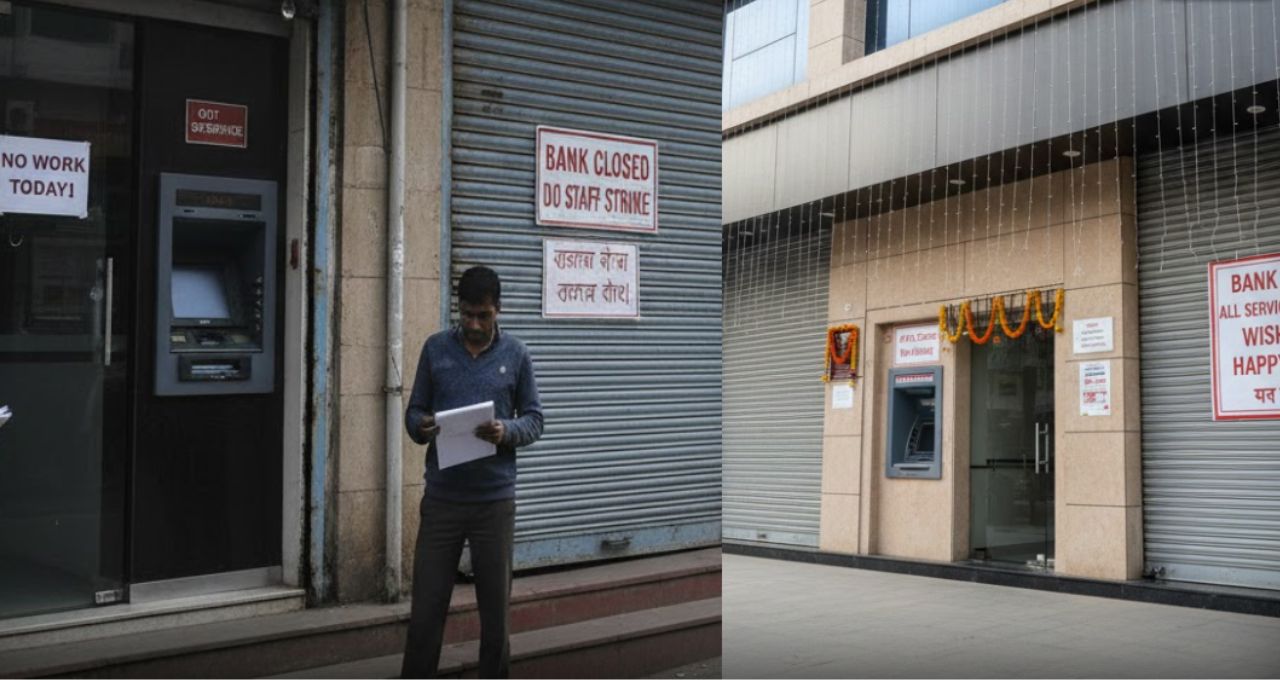
The all-India strike is expected to involve public sector banks, private banks, foreign banks, regional rural banks and cooperative banks. An estimated 800,000 bank officers and employees are expected to participate, which could lead to near-complete disruption of banking operations.
Banking services likely to be affected include cash deposits and withdrawals, cheque clearance, branch-level transactions, loan sanctions and disbursements, and government and commercial payments. Digital banking services such as UPI, internet banking and mobile banking may remain partially operational, although backend and technical support could be affected.
All India Bank Officers’ Association National Secretary D.N. Trivedi said that after the 10th Bipartite Settlement in 2015, the second and fourth Saturdays were declared bank holidays, and denying approval for a five-day work week was unjustified.
UFBU Gorakhpur coordinator U.P.N. Singh said that several financial institutions, including the Reserve Bank of India, Life Insurance Corporation of India and General Insurance Corporation, already follow a five-day work week, and the differential treatment of banks was leading to dissatisfaction among employees.