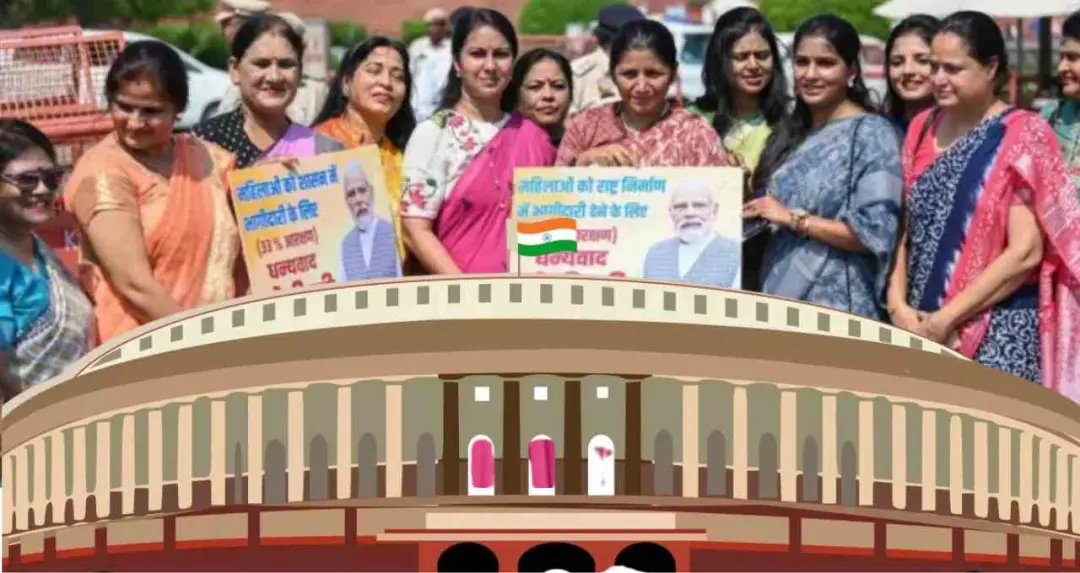
The Union government is taking steps to implement women’s reservation in Parliament and state legislative assemblies to increase women’s political participation in the country. The government is preparing to amend the Nari Shakti Vandan Adhiniyam and introduce constitutional changes to provide one-third reservation for women in Parliament and state legislatures.
The proposed changes are being considered to enable early implementation of the reservation framework. Under the current law, the implementation of women’s reservation requires the completion of a national census followed by the delimitation of constituencies. This process could take several years, potentially delaying the introduction of the reservation.
To address this, the Union government is examining options to amend the existing provisions. The proposed approach includes separating the implementation of women’s reservation from the processes of census and delimitation to allow the reservation system to be introduced earlier.

Government Considering Implementation in 2027 Assembly Elections
The government is considering implementing women’s reservation in the assembly elections scheduled in 2027 in Uttar Pradesh, Punjab, and Uttarakhand. If the proposed plan is implemented, approximately 33 percent of seats in the legislative assemblies of these states could be reserved for women.

According to experts, if women’s reservation is implemented in these states, it could also become a step toward introducing the system in the 2029 Lok Sabha elections. This could provide a ber foundation for increasing women’s political representation at the national level.
The government is also considering alternative models to implement women’s reservation more quickly. One of the options under consideration includes a system of dual representation for 33 percent of seats. Under such a model, additional representation could be introduced within existing constituencies to include women in Parliament and state legislatures.
However, the implementation of any such model would require a constitutional amendment and would need broad support in Parliament.
Government Seeking Support From Opposition Parties
The government is attempting to build consensus with opposition parties on the issue. Several major political parties have previously expressed support for women’s reservation. Congress president Mallikarjun Kharge and several opposition leaders have earlier stated that women’s reservation should be implemented at the earliest and should not necessarily be linked to the census or delimitation process.
The government believes that if broad political consensus is achieved on the issue, it could facilitate the passage of a constitutional amendment in Parliament.
Women’s representation in India’s Parliament remains relatively limited. In the Lok Sabha, there are around 78 women members out of a total of 543 seats, representing about 14 percent of the House. If one-third reservation is implemented, the number of women members could increase to approximately 181.
Similarly, women’s representation in the Rajya Sabha could also increase. At present, around 32 of the 245 members are women, but the number could rise to about 80 if the reservation is implemented.