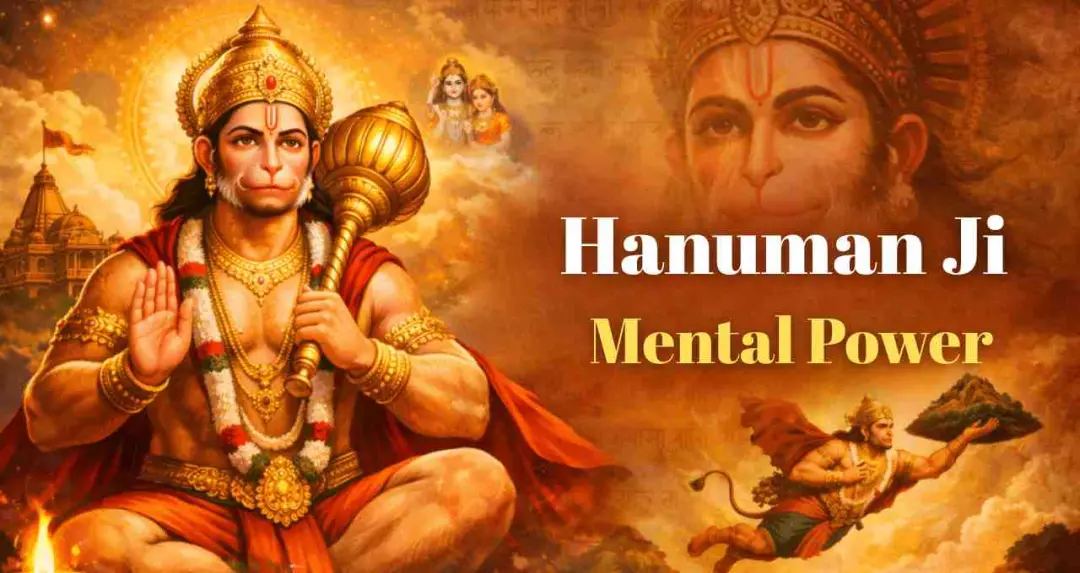
Hanuman Ji’s habits are presented as an example of mental strength and internal control, with teachings that include focus, purpose-driven determination, a balance of faith and reasoning, energy conservation, facing uncertainty, adaptability, and humility as guidance for dealing with stress, fear, and mental challenges in modern life.
Ancient texts and religious narratives describe seven key attributes associated with Hanuman Ji—focus, purpose-driven determination, balance between faith and reasoning, conservation of energy, courage in the unknown, adaptability, and humility—which are cited as helping individuals maintain stability and make informed decisions in demanding conditions.
Internal Control and the Importance of Focus
The first principle drawn from Hanuman Ji is the importance of controlling the mind and senses. Ancient texts state that desires, fear, or impulses did not dominate his mind. In contemporary life, practices such as meditation, breathing exercises, and conscious self-awareness are identified as essential for maintaining mental clarity.
This focus is not described as suppressing emotions but as regulating them to improve decision-making and actions. An unstable mind is more likely to be influenced by external circumstances, while a stable and focused mind can respond to challenges more effectively.
Mental Strength Through Purpose and Devotion




Hanuman Ji’s strength is attributed to his sense of purpose and devotion to Lord Ram. His objective was service and adherence to dharma rather than personal gain, which is presented as a reason fear and doubt did not dominate him.
This approach is described in modern terms as purpose-driven mental resilience. Associating work with a broader objective is stated to help individuals avoid being overwhelmed by smaller challenges and to enhance courage and endurance in difficult situations.
Balance Between Faith and Reasoning
Hanuman Ji’s decisions are described as based on both faith and reasoning. Faith provided confidence, while reasoning enabled strategic action. In Lanka, he is described as acting with planning rather than impulsiveness.

The text states that reliance solely on faith can lead to carelessness, while reliance solely on reasoning may increase doubt and fear. Mental strength is described as emerging from a balance between the two, enabling confidence alongside informed decision-making.
Energy Conservation and Focused Action
Hanuman Ji’s speed of thought and decisiveness are attributed to conserving energy. He is described as avoiding unnecessary conversation, gossip, or worry.
In modern contexts, constant communication and digital distractions are noted as factors that can reduce mental energy. Focusing time and attention on productive activities is presented as necessary for maintaining clarity and stability.
Courage in Facing Uncertainty
During his journey to Lanka, Hanuman Ji is described as confronting uncertainty and multiple challenges while continuing forward with adaptability.
This capacity to face uncertainty is associated with the development of mental flexibility. It is stated that acting despite uncertainty can strengthen cognitive adaptability and help address stress and fear.
Adaptability and Stability of Values
Hanuman Ji is described as capable of changing his form and strength while keeping his purpose and principles unchanged. This is presented as an example of balancing adaptability with stable values.
In practical terms, this is described as adjusting approaches according to circumstances while maintaining integrity and core principles, which helps sustain stability under pressure.
Humility as a Component of Mental Strength
Hanuman Ji’s humility is highlighted as a defining characteristic. After victory in Lanka, he is described as not exhibiting pride and continuing to identify himself as a servant of Ram.
Humility is presented as enabling openness to learning, maintaining emotional balance, and reducing stress. It is described as an important quality for mental well-being and effective leadership.