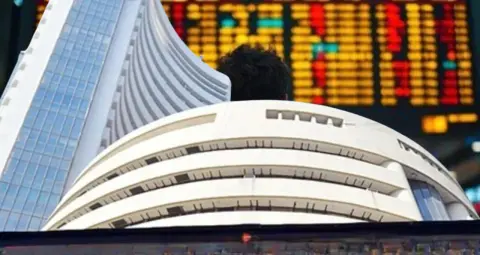
Indian equity markets opened sharply lower on Monday, March 23, 2026, amid ongoing weakness in global markets and heightened geopolitical tensions following a warning issued by US President Donald Trump to Iran. The development intensified investor concerns and triggered broad-based selling in early trade.
Trump warned that if Iran does not fully reopen the Strait of Hormuz within 48 hours, the United States would target its power plants. The statement escalated tensions in the Middle East, weakening global investor sentiment and accelerating sell-offs across markets.
Sensex and Nifty register sharp decline
In the first trading session of the week, the BSE Sensex opened at 73,732, already indicating significant weakness. Selling pressure intensified immediately after the opening bell. At 9:26 am, the Sensex was trading at 73,218.51, down 1,314.45 points or 1.76 percent.
The NSE Nifty-50 also opened weak at 22,824 and slipped below the key 22,700 level within minutes. At 9:27 am, the index was trading around 22,684, down 388.50 points or 1.68 percent, reflecting a risk-averse environment among investors.




Broad-based decline across stocks
The decline was visible across sectors, with most stocks trading under pressure. Shares of major Sensex constituents declined by more than 2 percent, including Tata Steel, State Bank of India, HDFC Bank, Bajaj Finance, UltraTech Cement, Mahindra & Mahindra, Titan, Trent, and Adani Ports.
The fall in large-cap stocks indicates widespread selling activity, affecting overall market sentiment and prompting caution among investors.
Sharp erosion in investor wealth
The market downturn resulted in a significant erosion of investor wealth. Approximately Rs 7.33 lakh crore was wiped out in early trade. The total market capitalisation of companies listed on the BSE declined to Rs 421.43 lakh crore.
At the close of trading on Friday, the market capitalisation stood at Rs 428.78 lakh crore, indicating a substantial single-day valuation loss.
Pressure from global markets
The weakness in Indian equities was also driven by declines in global markets. Most Asian markets were trading lower on Monday as investors assessed escalating tensions in the Middle East and the possibility of further conflict.
Japan’s Nikkei 225 declined by around 3.3 percent, while South Korea’s Kospi index fell by up to 4.6 percent. US markets had also closed lower on Friday, with the S&P 500 down 1.51 percent and the Dow Jones Industrial Average declining 0.96 percent.
Fluctuations in crude oil and gold
Rising geopolitical tensions pushed crude oil prices higher. Brent crude for May delivery rose 0.66 percent to $107.11 per barrel. Higher oil prices typically pose challenges for an import-dependent economy such as India.
Gold futures, however, declined by approximately 3.34 percent. Despite its status as a safe-haven asset, gold prices were influenced by concerns related to interest rates and inflation.
IPO market activity continues
Amid the declining market, activity in the IPO segment continued. The Central Mine Planning and Design Institute IPO entered its second day, receiving a subscription of 0.07 times on the first day. The issue size is Rs 1,842.12 crore and it will close on March 24.
The Speciality Medicines IPO is also in its second day, with a subscription of 0.84 times on day one. The company aims to raise Rs 29.14 crore. Meanwhile, the Tipco India Engineering IPO, valued at Rs 60.6 crore, opened on Monday and will remain open for subscription until Wednesday.
The IPO activity indicates cautious investor participation amid prevailing market uncertainty.