Indian Space Research Organisation (ISRO) and the European Space Agency (ESA) have signed a new agreement to collaborate on Earth observation missions, focusing on joint calibration, validation activities, and scientific studies aimed at improving the quality and reliability of Earth-related data and research.
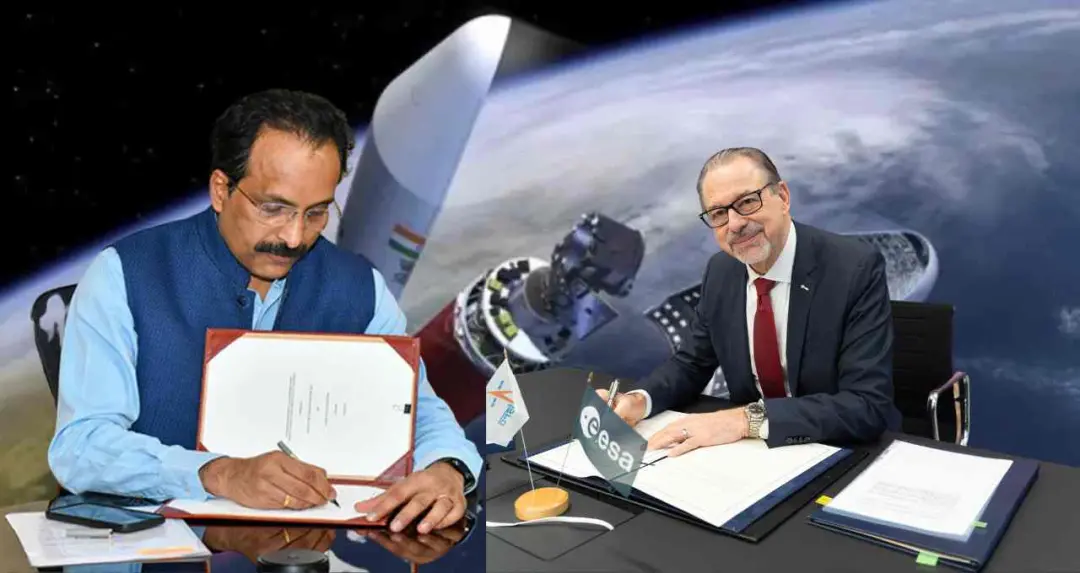
The agreement was signed virtually on March 4 and involved M. Ganesh Pillai, Scientific Secretary at ISRO, and Simonetta Cheli, Director of Earth Observation at ESA. The collaboration is intended to strengthen the exchange of information and technology between the two agencies in areas including Earth science, environmental monitoring, and space-based research.




Long-standing cooperation between ISRO and ESA
Cooperation between India’s and Europe’s space agencies dates back several decades. The two organisations first initiated collaboration in 1978, which was subsequently renewed in 2002. The latest agreement expands this partnership by supporting data sharing and strengthening scientific research related to upcoming space missions.
Relevance to ESA’s FLEX mission
The collaboration is particularly significant for ESA’s upcoming FLEX (Fluorescence Explorer) mission. The mission is designed to measure fluorescence signals emitted by vegetation on Earth. Scientists will use this data to analyse how efficiently plants perform photosynthesis.
The information collected through the mission is expected to support multiple scientific objectives, including assessing the health of vegetation, improving understanding of climate change impacts, enhancing agricultural and environmental monitoring, and advancing research related to the carbon cycle.
Technical collaboration framework
Under the partnership, ISRO and ESA will work jointly across several technical domains. The agencies will conduct calibration and validation of satellite data, undertake joint scientific research related to Earth observation, and collaborate through ground stations and tracking networks. The partnership will also support data analysis and mission operations.
These measures are intended to improve the accuracy and reliability of data obtained from space-based Earth observation systems.
ESA has previously supported several major Indian missions, including Chandrayaan and Aditya L1, by providing ground station and tracking assistance. ISRO has also supported multiple international missions through its deep space antenna facilities.
Experts note that the agreement could strengthen future Earth observation missions and support scientific research related to climate change, environmental protection, and agriculture. They also state that cooperation between India and Europe demonstrates the increasing role of international partnerships in space science.