A nearly six-decade-old Janmashtami tradition in Kolkata’s Mominpur area has changed this year, with the event set to be organised solely by members of the Hindu community. The development follows information that Muslim members have been excluded from the organising committee. The event is held near the intersection of Bhukailash Road and Hussain Shah Road in Kolkata’s port area and is being described as its 58th edition this year.
According to local residents and former members associated with the event, the Janmashtami celebration was started around six decades ago by a Muslim social worker named Mohammed Qasim. The event became less active over time, but a group of Muslim youths revived it after 2011. For several years thereafter, members of both the Hindu and Muslim communities jointly organised the celebration. The organising committee had around 20 members, with approximately half belonging to the Muslim community. Members of both communities participated in religious rituals, distribution of prasad and other arrangements.
Former organisers said the Janmashtami celebration had been regarded locally in previous years as an example of communal harmony. Members of the Muslim community participated in organisational arrangements and worked alongside Hindu devotees to conduct the religious programme. Prasad was also distributed during the event, while Janmashtami-related religious rituals were conducted as scheduled.
This year, however, the organisation of the event has changed. According to some people associated with the organising committee, Muslim members have not been included in the committee and the Janmashtami programme will be conducted only by members of the Hindu community. Rakesh Singh, a former BJP candidate associated with the event, also said that the programme would be organised only by Hindus this year. He argued that Janmashtami is a festival of the Hindu religion and that its religious activities should be conducted by members of the Hindu community.

According to Singh, people from other religions can enter the Janmashtami pandal, but responsibility for conducting religious activities should remain with the Hindu community. He linked the position to the protection of religious and cultural traditions.
Former Muslim members associated with the event said they had played an active role in the programme for years and that both Hindu and Muslim members had been part of the organising committee. They described the exclusion of Muslim members this year as a major change from the previous arrangement.
Mohammed Alam, a former member associated with the event, said Muslim youths had played an active role in organising the programme since 2011. According to him, around half of the approximately 20 committee members were Muslims. Members jointly organised the event, distributed prasad and assisted in conducting the religious rituals associated with Janmashtami. He described the removal of Muslim members from the committee this year as a major change in the event’s longstanding organisational structure.
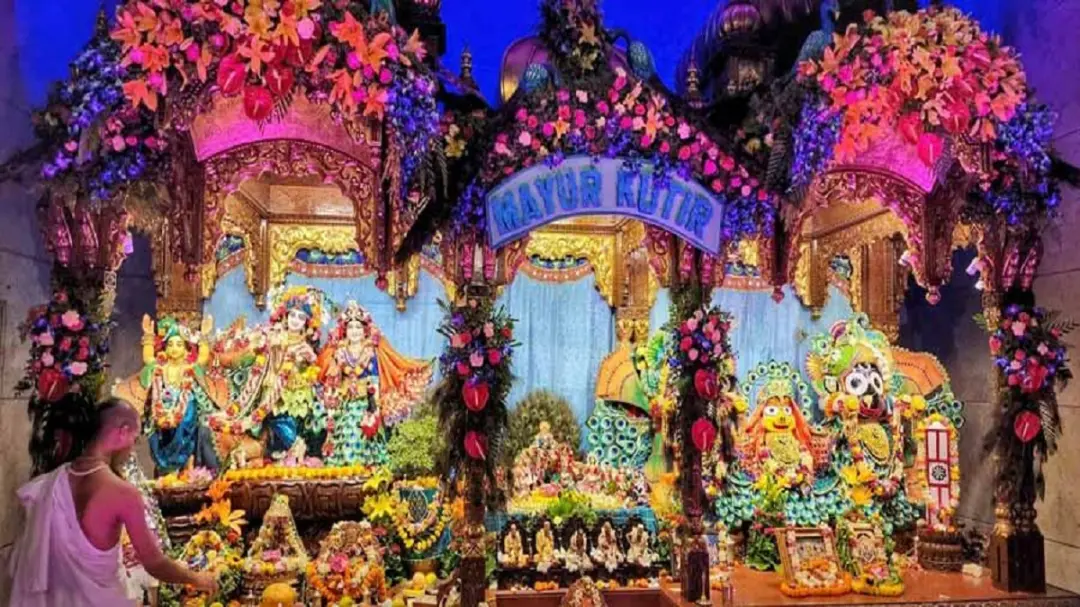
Preparations for this year’s programme have already begun at the venue. Reports said a large saffron-and-white pandal is being constructed. Organisers are making arrangements for the pandal and other aspects of the event, while preparations are also underway to receive devotees during Janmashtami.
The Mominpur event has also been associated with Kolkata’s social fabric, where members of different communities have participated in various religious and cultural programmes. During its nearly six-decade history, the format of the Janmashtami celebration changed several times, but participation by Hindus and Muslims remained one of its defining features. The change in the committee’s structure has now led to discussion over the end of that earlier format.
According to local residents, the history of the event has not been limited to the religious celebration. It was also part of collective participation by residents of the area. Members of the Muslim community played a role in starting the event and later worked with members of the Hindu community to continue it. The programme consequently developed a distinct local identity. With the event now set to be operated solely by the Hindu community, different views have emerged among former organisers and local residents.
The change comes amid a wider political debate in West Bengal over religious events and cultural identity. In recent days, reports have also emerged that the Vishwa Hindu Parishad advised Durga Puja committees to give priority to Hindu culture and traditions in their events. Against this backdrop, the change at Mominpur’s Janmashtami celebration has become a subject of both political and social discussion.
Another aspect of the development is that the event is said to have been started by a Muslim social worker, while Muslim community participation in its organising committee has now ended. The change in the format of a religious event over nearly six decades has therefore also become relevant to the area’s local history and community relations.
One section of the organisers said religious festivals should be conducted by the community to which the festival belongs. Former members associated with the event, however, view the development as the end of a longstanding arrangement involving joint participation. The change has consequently turned this year’s Mominpur Janmashtami celebration into a subject of social and cultural discussion alongside the religious event.
Large numbers of people have traditionally visited the programme venue during Janmashtami in this part of Kolkata. Preparations are continuing this year and the pandal is being constructed. The organisation and committee structure, however, will differ from previous years. Organisers have also given differing statements regarding access for members of other communities. According to reports, people from other religions can enter the pandal, while religious activities will be conducted by members of the Hindu community.
Janmashtami 2026 will be observed across the country on September 4. Preparations have also begun at temples and puja pandals in Kolkata and elsewhere in West Bengal. The change at the longstanding Mominpur event has therefore drawn particular attention.
The nearly six-decade-old Janmashtami celebration in Kolkata’s Mominpur area will thus have a different organisational structure this year. The tradition, which is said to have been associated with Muslim social worker Mohammed Qasim, involved joint participation by Muslim and Hindu community members for many years. Muslim youths also played a role in reviving the event after 2011, with substantial Muslim representation on the organising committee. In 2026, the event is set to be conducted by a committee comprising only Hindu members, marking a change in the arrangement that had continued for years.