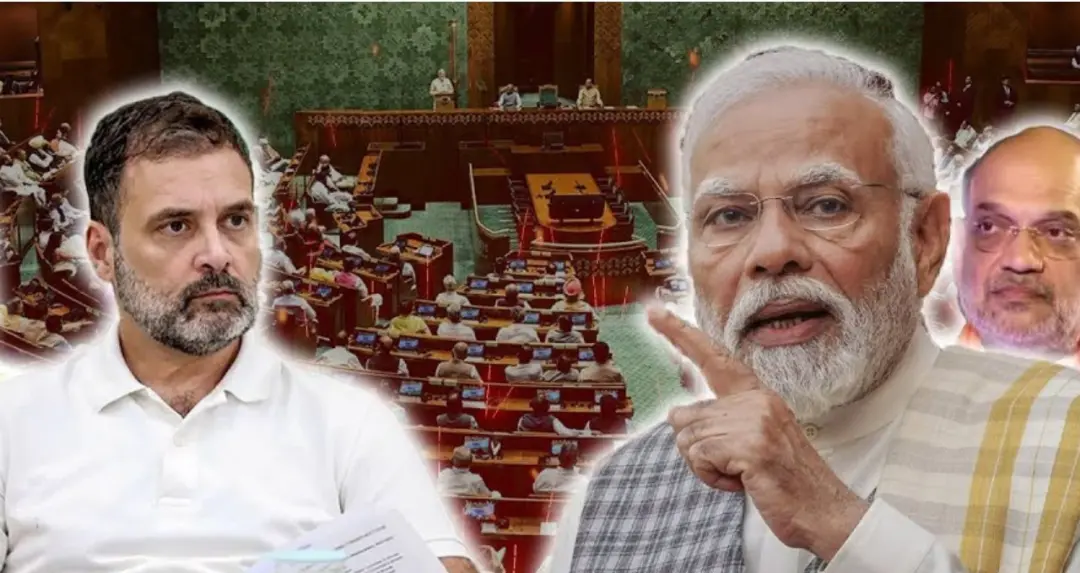
The Monsoon Session of Parliament was marked more by political confrontation and allegations than by legislative business. Several Bills were passed during the session, but continued deadlock between the government and the Opposition limited detailed parliamentary debate.
Inside Parliament, protests and disruptions continued, while outside the House, both sides sought to frame the developments according to their respective political strategies. The government accused the Opposition of disrupting parliamentary proceedings, while the Opposition alleged that the government avoided important questions and limited discussion by relying on its majority.
The government maintained that it was ready for discussion in Parliament but that the Opposition prevented proceedings from continuing. The Opposition, meanwhile, argued that the government should first respond to issues over which students and young people were seeking answers.
Assembly elections are proposed in Uttar Pradesh, Uttarakhand and Punjab at the beginning of next year. The political circumstances in the three states are different, but issues including youth concerns, employment, education, government recruitment, paper leaks and administrative accountability could have a broad impact.
The Opposition may seek to take issues raised in Parliament to the ground in the poll-bound states. In particular, issues concerning young people could become an important part of the election campaign in Uttar Pradesh.
The Opposition raised several issues against the government during the Monsoon Session, but viewing this as a decisive political victory would be premature. Voters may also want to know what solutions the Opposition proposes to the problems it has raised.
The Opposition will face the challenge of taking the issues raised in Parliament effectively to the public while also creating confidence over how it would address these problems if it came to power.
The Bharatiya Janata Party has made political narrative an important part of its election strategy over the past decade. The government now faces the challenge of effectively communicating its message to the public amid allegations from the Opposition.
The BJP's argument may be that despite having a majority, the Opposition disrupted proceedings in the House and that the government nevertheless moved forward with its legislative agenda.
The Opposition, on the other hand, seeks to convey to the public that the government did not adequately answer questions concerning young people and other sections. Both narratives may have an impact among their respective supporters. However, the electoral outcome will be determined by voters who are not permanently aligned with any political party.
Uttar Pradesh will be the most important political battleground for both the BJP and the Opposition in the upcoming elections. Political equations in the state changed after the 2024 Lok Sabha elections, prompting all parties to formulate new strategies.
The Opposition is expected to try to make issues raised in Parliament, including those concerning students, young people, employment, paper leaks and alleged financial irregularities, part of its election campaign.
The BJP, meanwhile, may centre its campaign on the government's work, development schemes and the role of the Opposition.