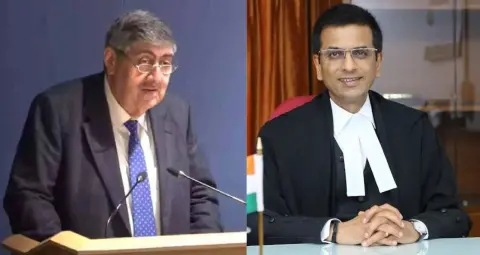
Former Supreme Court judge Sanjay Kishan Kaul has questioned the approach adopted by former Chief Justice of India DY Chandrachud in judicial appointments, alleging that the views of the government received disproportionate weight. In his forthcoming book, Without Fear or Favour, and an interview with journalist Karan Thapar, Kaul has discussed differences within the Collegium and disagreements between the judiciary and the government. His remarks represent his own account and are not findings of a judicial inquiry.
According to Kaul, the Collegium was scheduled to meet to fill six vacancies in the Supreme Court. Five candidates had already secured agreement among the members. However, Chandrachud proposed a sixth name shortly before the meeting began. Kaul said he opposed the proposal because he believed the other members were unlikely to agree to the candidate.
Kaul alleged that the then Chief Justice subsequently took him to a separate room and proposed calling the government to ascertain its views. He said he was uncomfortable with this approach. According to his account, the five agreed names were recommended, but the Collegium could not reach a consensus on the sixth candidate.
Kaul also expressed the suspicion that informal discussions with the government might have taken place before the names were considered. However, he did not present this suspicion as an established fact.




Kaul clarified that he did not object to dialogue between the judiciary and the government. His concern was that obtaining the government's agreement before formal Collegium deliberations could become an established practice.
He argued that seeking the government's views and securing its approval in advance were two different approaches. If the latter became routine, future chief justices could find it difficult to adopt a different method.
In his book, Kaul wrote that differences over coordination with the government had strained his relationship with Chandrachud. He maintained that constitutional institutions should preserve their independence in decision-making while continuing to engage in dialogue.
The book also discusses proceedings relating to a reconsideration of a judgment under the Prevention of Money Laundering Act (PMLA).
Kaul said a case that had been before a bench headed by him was subsequently transferred to another bench. He objected to the reassignment, arguing that cases should not be transferred on the basis of assumptions about the likely outcome of a judgment.
Kaul also discussed shortcomings in the Collegium system. He said the framework of the National Judicial Appointments Commission (NJAC), which the Supreme Court struck down in 2015, could have been discussed as a basis for reforms.
Speaking to The Indian Express, Chandrachud said it would be difficult to respond in detail to the context of the remarks without reading the book.
He said his interactions with Kaul during Collegium meetings had been respectful and that members had engaged in open discussions.
Chandrachud also said he did not recall any occasion when Kaul had walked out of a Collegium meeting. He added that proposals reflecting the Collegium's decisions were recorded and that he did not recall any recorded disagreement.
He described dialogue between the government and the judiciary as part of the judicial appointment process.
Congress general secretary Jairam Ramesh cited Kaul's book while raising concerns about government influence over judicial appointments. He said the judiciary, which is responsible for upholding the Constitution, should remain free from pressure from those in power.
The remarks emerging ahead of the book's publication have brought renewed attention to transparency in the Collegium system and the independence of the judiciary. Kaul's claims remain his account of the events, while Chandrachud has offered a response to the allegations reported so far.