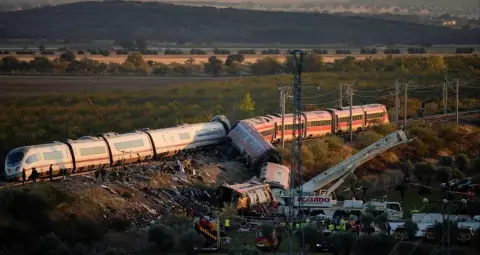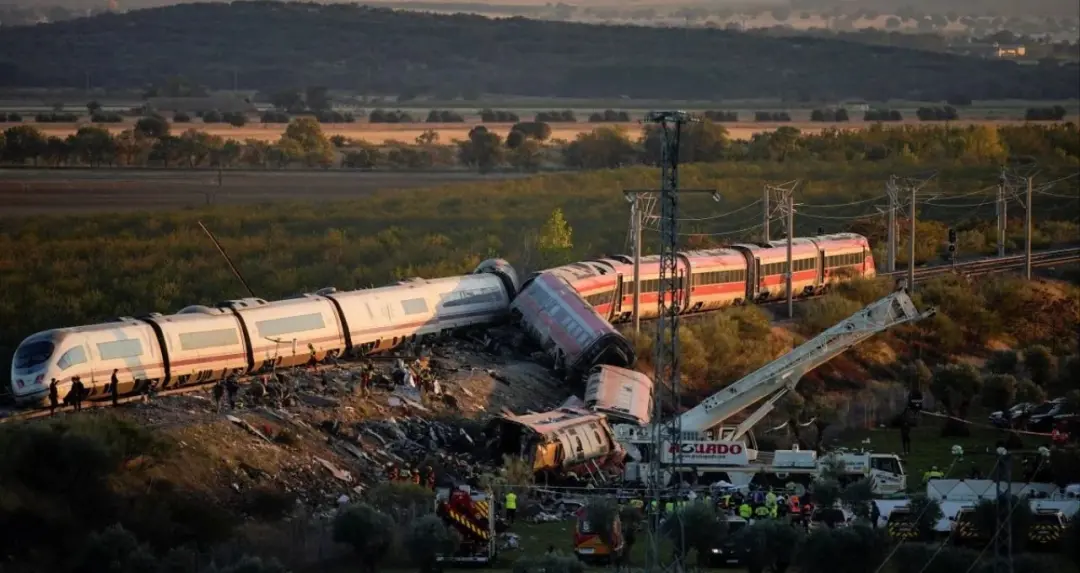
Two high-speed trains collided in Spain’s Toledo province on Wednesday morning, killing at least 68 people and injuring numerous passengers. Several coaches derailed following the collision, forcing the suspension of rail services on the Madrid–Andalusia route.
The accident occurred on October 28, 2026, when a high-speed train struck another train from behind. A total of 544 passengers were travelling on the two trains. The impact caused several coaches to derail, with some falling down an embankment. Rail services between Madrid and Andalusia were suspended following the accident.
The accident took place at around 8:54 a.m. local time. Both trains were travelling from the Spanish capital, Madrid, towards Seville. The collision occurred at kilometre 118 of the high-speed rail line between the towns of Mora, Orgaz and Urda in Toledo province.
One train belonged to state-owned railway company Renfe, while the other was operated by private company Iryo. According to preliminary information, the Iryo train was stationary on the tracks when a Renfe AVE train approaching from behind collided with it.
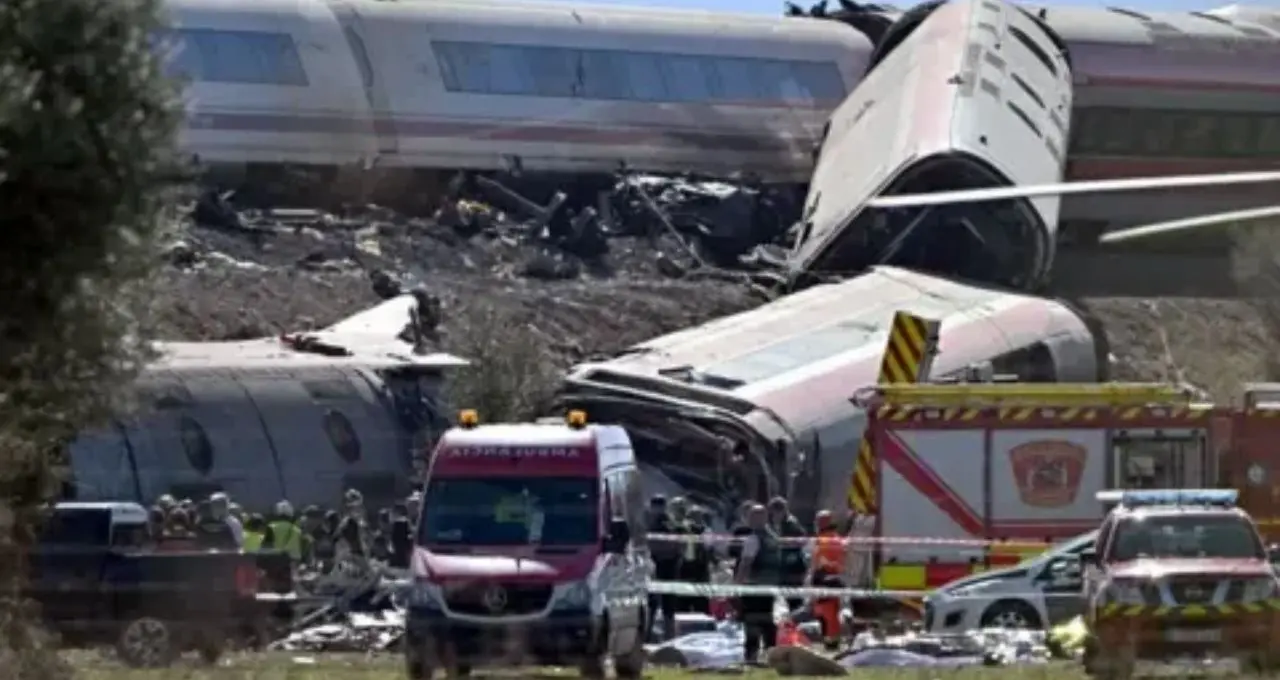
Several coaches were damaged in the collision. The derailment of some coaches made it difficult for rescue teams to reach passengers trapped inside.



Local authorities confirmed that at least 68 people had died in the accident. According to Spanish newspaper El País, 44 of the deceased were travelling on the Iryo train and 24 on the Renfe train.
Figures on the number of injured passengers varied at different stages. A report available on the night of October 28 stated that 53 people had been admitted to hospitals. Several injured passengers were reported to be in critical condition.
Firefighters, police personnel and medical teams arrived at the scene following the collision. Rescue workers began extracting passengers trapped inside the damaged coaches.
High-speed rail services between Madrid, Ciudad Real and Andalusia were suspended following the accident, affecting a large number of passengers. Travellers waited at railway stations for information about their journeys. Some trains were cancelled, while other passengers had to seek alternative travel arrangements.
Renfe said it was providing affected passengers with facilities to change or cancel their tickets. The company also established a helpline to assist victims and their families.
Spanish Prime Minister Pedro Sánchez expressed grief over the accident and conveyed his condolences to the families of the victims. He announced three days of national mourning.
Local authorities arranged medical treatment for injured passengers in nearby areas. Temporary facilities for medical teams were set up in Urda. Officials said their immediate priority was to save lives and ensure that injured passengers were transported to hospitals as quickly as possible.
The exact cause of the accident has not yet been fully established. Preliminary investigations pointed to a possible technical failure in the LZB railway safety system.
According to reports, a malfunction in the safety system had caused several trains to stop. Railway operations were subsequently resumed under manual control. Investigators are examining whether any operational lapse occurred when train services restarted.
Investigators are reviewing the signalling system, instructions issued by the control room and information related to train operations. However, no single cause has yet been definitively identified as responsible for the accident.
Spain experienced another major railway accident approximately nine months earlier. On January 18, 2026, trains operated by Iryo and Renfe were involved in a collision near Adamuz in Córdoba province.
At that time, several coaches of an Iryo train travelling from Málaga to Madrid derailed and entered an adjacent track. A Renfe train approaching from the opposite direction subsequently collided with them. The accident killed 46 people.
Following a second major railway accident in the same year, questions have emerged over the safety of Spain’s high-speed rail network. The investigation into the latest collision remains ongoing. Railway authorities are working to establish the cause of the accident and determine how services on the affected route can safely resume.