Four Teacher Constituency Results Declared in Bihar Legislative Council Elections
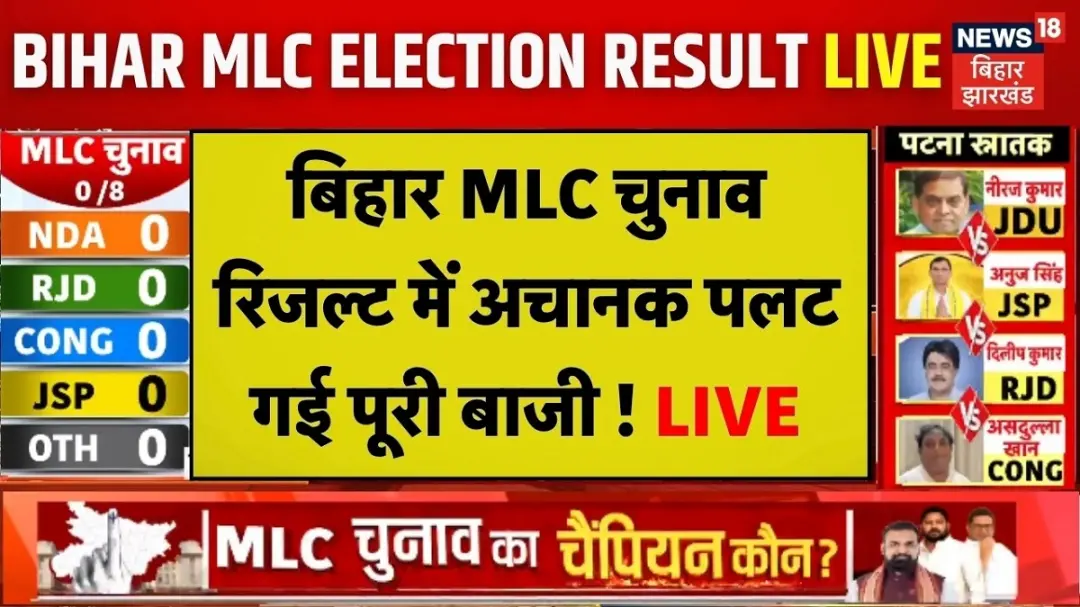
Four results have been declared in the Bihar Legislative Council elections, while counting continues in the four graduate constituencies, according to updates available on October 28, 2026. In the teacher constituencies, Rashtriya Janata Dal’s Dr Sanjeev Kumar won the Patna seat, defeating Bharatiya Janata Party’s Nawal Kishore Yadav. BJP’s Narendra Prasad Singh won the Tirhut teacher seat, Jan Suraaj-backed candidate Suresh Prasad Rai won in Darbhanga, and independent candidate Dr Rahul Raj secured victory in Saran.
Dr Sanjeev Kumar of the RJD defeated BJP’s Nawal Kishore Yadav by 1,057 votes to win the Patna teacher constituency. According to the final figures, Kumar received 4,487 votes, while Yadav secured 3,430 votes. Jan Suraaj candidate Dr Divya Jyoti finished third.
The result ended Yadav’s long-standing electoral dominance in the constituency. He had previously won the seat five consecutive times.




BJP’s Narendra Prasad Singh won the Tirhut teacher constituency, defeating independent candidate Bhushan Kumar Jha by 594 votes. Singh had previously been elected from the seat twice and has now secured his third victory.
Jan Suraaj-backed candidate Suresh Prasad Rai defeated sitting Congress Member of the Legislative Council Madan Mohan Jha in the Darbhanga teacher constituency. According to available reports, Rai won by a margin of 324 votes.
In the Saran teacher constituency, independent candidate Dr Rahul Raj secured victory. The results from the two constituencies reflected victories for candidates backed by different political formations and an independent candidate.
With the results declared in all four teacher constituencies, attention has shifted to the ongoing count in the four graduate constituencies.
In the Patna graduate constituency, the contest between Janata Dal (United)’s Neeraj Kumar and Jan Suraaj’s Anuj Singh has drawn attention. During counting, Kumar expressed confidence about his position, but the final outcome depends on the completion of the count. The counting of preference votes could be significant in this constituency, and the initial figures cannot be treated as final results.
Independent candidate Banshidhar Brajwasi was leading after the third round of counting in the Tirhut graduate constituency. According to the available figures, Brajwasi had received 6,984 votes, compared with 5,964 for JD(U)’s Abhishek Jha and 4,875 for RJD’s Dr Rashmi Vinayak Gautam.
At that stage, Brajwasi was ahead of his nearest rival by 1,020 votes. The figures represented the trend at that point in the count, and further counting was required to establish the final result.
NDA-backed candidate Sarvesh Kumar was leading after the fifth round of counting in the Darbhanga graduate constituency. According to the available figures, Kumar had received 8,930 votes, while RJD’s Anil Kumar Jha had secured 7,545 votes.
Jan Suraaj’s Mohammad Imtiaz had received 4,577 votes, while Congress candidate Rajnikant Pathak had secured 2,552 votes. Kumar was ahead of his nearest rival by 1,385 votes at that stage. The final result will be known after counting is completed.
BJP’s Dr NK Yadav was leading in the counting of first-preference votes in the Koshi graduate constituency. According to the available figures, he had received 24,075 votes, compared with 18,535 for RJD’s Nitesh Yadav and 15,306 for Jan Suraaj’s Rajnish Ranjan.
A total of 74,401 votes were cast in the constituency, of which 64,401 were reported as valid. If no candidate secures the required number of votes in the first-preference count, the counting of second-preference votes could determine the outcome. The initial lead therefore cannot be treated as a final victory.
Voters in the teacher and graduate constituencies have backed different candidates in the Bihar Legislative Council elections. Among the four teacher constituencies whose results have been declared, the winners include candidates from the RJD and BJP, a Jan Suraaj-backed candidate and an independent candidate.
Counting trends have emerged in the four graduate constituencies, but the final winners will be known only after the counting process is completed.