Haridwar received more than 4.80 crore devotees during this year’s Kanwar Yatra over a period of around 12 to 13 days, setting a new record in the number of pilgrims arriving in the city. More than 7000 metric tonnes of waste was reportedly collected during the pilgrimage, putting pressure on the city’s sanitation system.
Devotees from different states across the country arrived in Haridwar during the Kanwar Yatra. After bathing at Har Ki Pauri and other Ganga ghats, pilgrims collected Ganga water and proceeded towards their respective destinations.
The large number of visitors resulted in continuous crowds on the city’s roads, markets, ghats and Kanwar routes. Police and the administration made arrangements for crowd control, traffic management and security.
The number of devotees also increased compared with last year. Around 4.52 crore Kanwariyas were reported to have reached Haridwar in 2025, while the figure rose to more than 4.80 crore this year, an increase of more than 28 lakh devotees.




The large crowds placed substantial pressure on the Haridwar Municipal Corporation’s sanitation arrangements. Municipal teams continuously collected waste from the ghats, Kanwar track and fair area during the pilgrimage, but cleaning operations were affected in several areas during the final days as the number of devotees and vehicles increased.
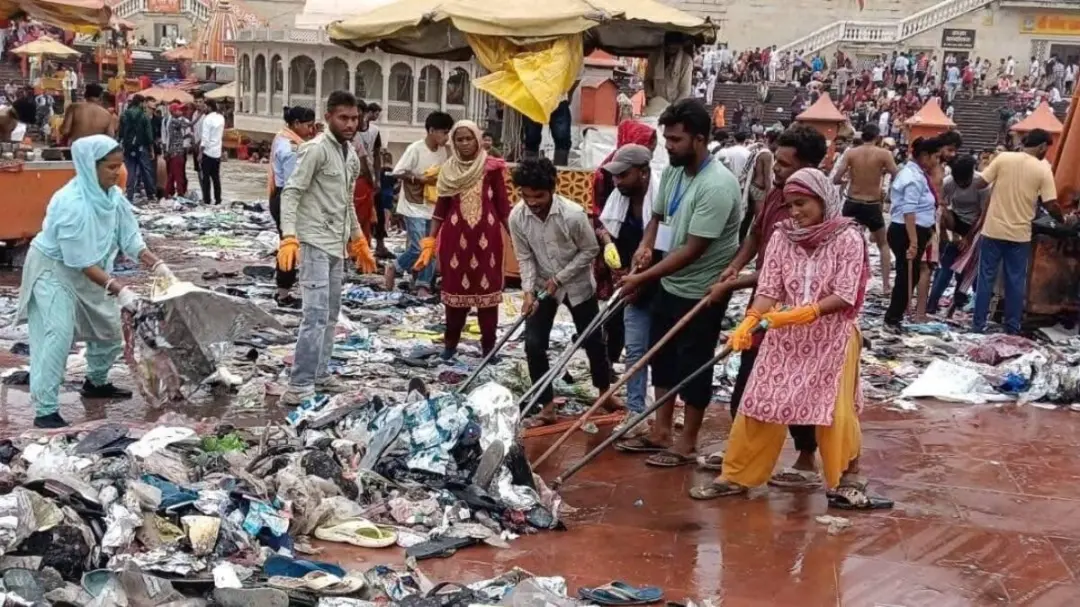
According to reports, around 7000 metric tonnes of waste accumulated during the Kanwar Yatra. The waste included plastic bottles, food and beverage packaging, clothes and other used items.
Waste accumulated at several locations where large numbers of devotees remained present. Reports said piles of garbage were seen at Har Ki Pauri and several other ghats and surrounding areas.
Reports also referred to sanitation issues in some changing rooms. According to sanitation workers, water bottles containing urine were found at some locations and were left behind in changing rooms.
The incidents raised questions about the use of public facilities and sanitation practices during the religious event.
The Municipal Corporation intensified a special cleaning campaign after the Kanwar Yatra ended. According to reports, around 5500 metric tonnes of waste had already been removed between July 30 and August 8. Large quantities of waste were also cleared during the final two days.
During periods of heavy crowding, the movement of waste-collection vehicles was affected. At several locations, there was insufficient space for vehicles to enter, forcing sanitation workers to wait for the crowds to thin before accelerating cleaning operations at night.
The administration began using additional workers and heavy machinery for the cleanup. According to a report, bulldozers were also being used as part of the effort to restore normal conditions in Haridwar.
The administration is also working on measures for waste disposal. A plan is being pursued to segregate waste and send it for recycling. Used clothes are being separated as part of an initiative to convert them through recycling into reusable material.
The Kanwar Yatra generates economic activity in Haridwar alongside its religious significance. The arrival of crores of devotees creates activity for hotels, dharamshalas, food businesses, transport operators, sellers of religious items and other local businesses.
The large volume of waste generated during the event has also placed pressure on sanitation and waste-management arrangements, particularly around the Ganga ghats.
The number of devotees participating in the Kanwar Yatra has increased over the years. The report gives a figure of around four lakh devotees in 1986, rising to one crore in 2000 and 3.76 crore in 2018.
The number was around 4.14 crore in 2024, 4.52 crore in 2025 and more than 4.80 crore in 2026.
The increase in the number of pilgrims has also brought greater requirements for crowd management, waste management, public toilets, parking, drinking water and health facilities during the event.
The police and administration said the pilgrimage was conducted in an organised manner despite the large crowds. The waste accumulated after the event has led to intensified cleaning operations across Haridwar and its ghats.