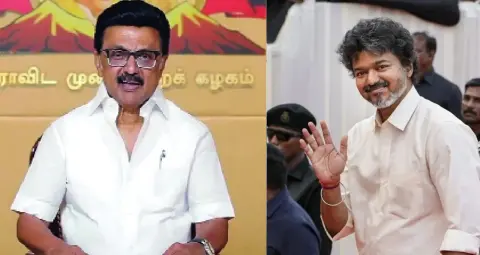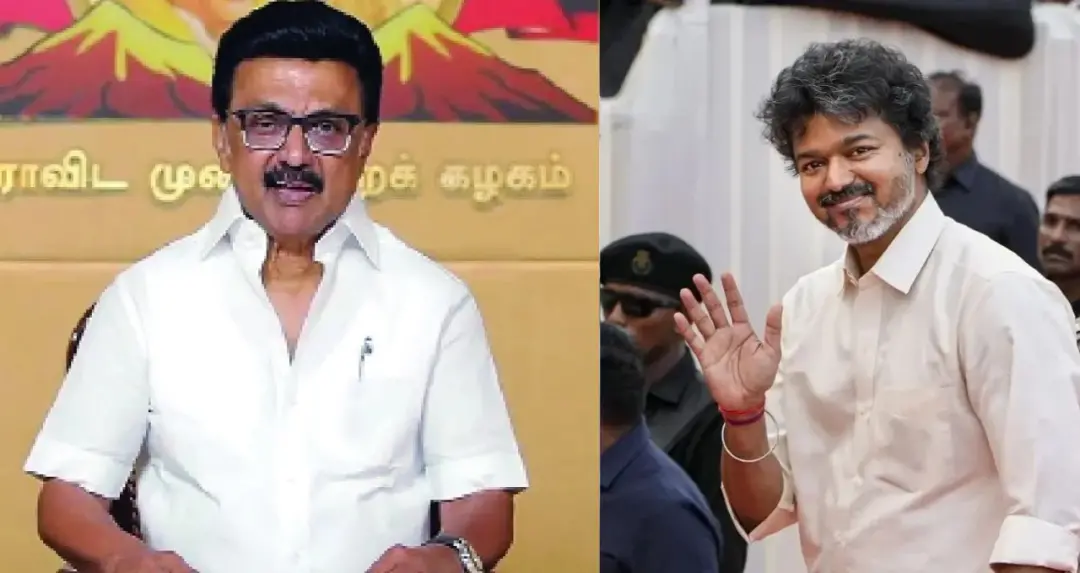
Political tensions over law and order have intensified in Tamil Nadu, with DMK chief and former Chief Minister M.K. Stalin targeting Chief Minister C. Joseph Vijay over what he described as rising criminal incidents in the state. Stalin said concerns over public safety were increasing and called for immediate action by the government.
Stalin urged the Chief Minister to come out of “film shooting mode” and focus on the state’s security arrangements. He questioned police patrolling, women’s safety and the continued reporting of criminal incidents, and sought answers from the government.
Stalin said several types of criminal incidents, including murders, were being reported across Tamil Nadu and alleged that crimes were continuing during both day and night. He said ordinary people should feel safe but alleged that such an environment was not visible under the prevailing circumstances.
Describing the situation in the state, Stalin said Tamil Nadu had become trapped in a “swamp of blood”.
These were political allegations made by Stalin, and no response from the state government to the claims was available at the time of the statement. An independent assessment of law-and-order data and recent incidents is separate from the political claim.
Stalin questioned whether police personnel were conducting adequate regular patrols across the state and whether security arrangements were being effectively implemented in sensitive areas. He called on the government to activate the police machinery to prevent criminal incidents.
He said the focus should be on establishing an effective preventive system rather than merely issuing statements or responding after incidents occur.


The DMK chief also specifically targeted the government over women’s safety. He said women should feel safe in public places and their surroundings and that police presence and prompt action were necessary to ensure this.
Referring to the special force for women’s safety, Singapen, Stalin took a political swipe at the government. He questioned whether personnel of the force would focus on ensuring women’s safety instead of showing interest in making reels on social media.
The remark was also a political jibe at Vijay’s film background. Vijay has been a prominent actor in the Tamil film industry and, after entering politics, formed the Tamilaga Vettri Kazhagam (TVK), through which he secured power in the state.
Against this backdrop, Stalin urged the Chief Minister to come out of “film shooting mode” and concentrate on his administrative responsibilities.
Stalin also pointed out that the Home Department is under Chief Minister Vijay. He therefore said the Chief Minister bears the final political and administrative responsibility for the state’s law-and-order situation.
The DMK leader said the government should take immediate action to understand the seriousness of the prevailing situation. According to him, the time for making excuses was over and the government needed to take concrete steps to prevent crime.
Stalin’s attack comes at a time when the new Tamil Nadu government has not been in office for long. The opposition DMK has repeatedly questioned the government’s administrative capacity and stability.
Following the Tamil Nadu Assembly election, actor-turned-politician C. Joseph Vijay’s TVK won 108 seats. The party fell 10 seats short of the 118 seats required for a majority but succeeded in forming the government with the support of other parties.
According to the election results, the DMK won 59 seats and the AIADMK won 47 seats. Congress and other parties won a total of 20 seats.
The political arithmetic changed the traditional balance of power in Tamil Nadu. The DMK, which has long been one of the state’s major political forces, moved into the opposition after the election, while a new government was formed under Vijay’s leadership.
TVK did not have a majority on its own. After the election, Congress and some other parties extended support to TVK, making the formation of the Vijay government possible.
The political arrangement has also become a key basis for the DMK’s attacks. Stalin has previously claimed that the coalition government led by Vijay would not complete its five-year term.
His argument is that TVK does not have the numbers required to independently run a stable government and that the administration depends on support from other political parties.
The government’s future, however, does not depend solely on its current seat tally. Support from coalition partners, the balance of power in the Assembly and subsequent political developments will determine how stable the government remains.
At an event in Chennai, Stalin had earlier commented on the stability of the Vijay government. He said the government was functioning with the support of political parties that had been in alliance with the DMK before the election.
The DMK chief’s reference also pointed towards Congress, which extended support to TVK after the election results. This changed the political equations in the state.
Stalin had claimed that the government would continue to face political challenges because TVK did not secure a full majority. At present, however, the government remains in office, and its immediate continuation depends on support in the Assembly.
Law and order has emerged as an important political test for the new government in Tamil Nadu. The opposition is using criminal incidents to question the government’s administrative capacity.
The government, meanwhile, faces the task of controlling crime while maintaining public confidence in safety. Women’s safety, police patrolling and prompt action against crime are sensitive issues for any state government.
Chief Minister Vijay faces two key challenges. The first is responding to opposition attacks over law and order and administration. The second is maintaining stability within his coalition in the Assembly.
Vijay is relatively new to politics, while Stalin has long been one of the prominent figures in Tamil Nadu politics. The political contest between the two leaders is therefore expected to remain a significant feature of the state’s politics.
The DMK is targeting the government over law and order, while the Vijay government faces the task of demonstrating that it can move beyond the Chief Minister’s popularity as a film star and deliver effective administration.
Stalin’s allegations have placed law and order and government stability at the centre of political debate in Tamil Nadu. Government action on criminal incidents and the position of coalition partners will determine the extent of political pressure on the Vijay government.