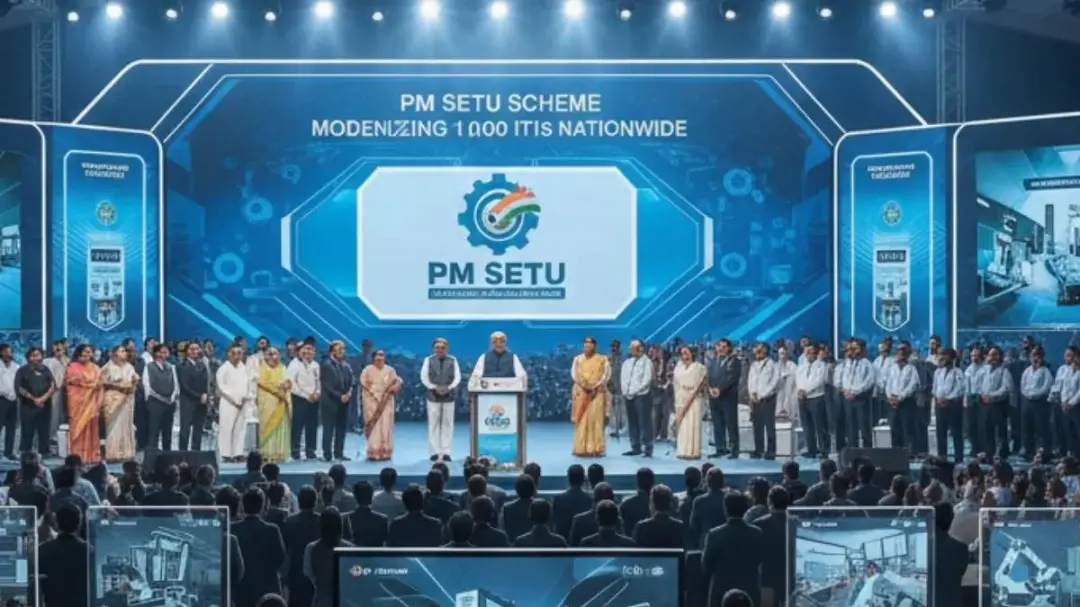
Darbhanga district is set to modernise technical and vocational education under the PM-SETU scheme, with two Industrial Training Institutes (ITIs) identified for development under the hub-and-spoke model. Ramnagar ITI will be developed as the hub, while Benipur ITI will function as the spoke.
The plan focuses on upgrading the ITIs with modern machines, new technology, smart classrooms and training systems aligned with industry requirements. The central government’s PM-SETU scheme aims to develop government ITIs as modern, employment-oriented institutions in line with industry demand.
PM-SETU stands for Pradhan Mantri Skilling and Employability Transformation through Upgraded ITIs. Under the scheme, government ITIs across the country are being modernised through a hub-and-spoke model. The target is to upgrade 1,000 government ITIs, comprising 200 hub ITIs and 800 spoke ITIs. An average of four spoke ITIs is to be linked with each hub.
With Ramnagar ITI being developed as a hub in Darbhanga, it could serve as the main training centre for the cluster. Benipur ITI, as the spoke institution, will be linked to the hub to expand training and skill development facilities. The model is intended to extend the benefits of modern training facilities and industry-based courses beyond a single institution to young people in surrounding areas.
The total five-year cost of a cluster under PM-SETU has been fixed at Rs 241 crore. The model provides for participation by the central government, state government and industry. According to official documents, the funding structure comprises 50 per cent from the Centre, 33 per cent from the state and 17 per cent from industry.




The scheme aims to replace traditional training systems in ITIs with modern technical education. Work will focus on training students on machines and equipment being used in existing industries, helping prepare ITI trainees for changing employment requirements.
As the hub, Ramnagar ITI will have the scope to develop more advanced training facilities. New courses are to be introduced at hub ITIs, while existing courses are also to be upgraded according to industry requirements. PM-SETU places particular emphasis on smart classrooms, modern laboratories, digital content and courses related to new technology at hub institutions.
Benipur ITI’s development as a spoke could provide local youth with better technical training opportunities in their own area. New courses and modernisation of existing trades are also planned at spoke ITIs. This could reduce the need for students to travel elsewhere for training and promote skill development at the local level.
Industry-linked training is a key component of PM-SETU. The scheme provides for industry partners to participate in the development and operation of ITIs. The objective is not limited to modernising ITI buildings or machinery but also includes linking training with the requirements of the actual employment market.
Industry partners will have a role in training requirements, technical skills and employment-related aspects. This can help students understand the technical competencies required to work in companies.
The scheme also emphasises courses related to new and emerging technologies. This could benefit young people seeking careers in modern technical fields alongside traditional trades. In the changing industrial environment, demand is increasing for trained youth in electronics, automobiles, digital technology, machine operations and other modern fields.
The PM-SETU model also aims to strengthen placement and industry connections. Hub ITIs are envisaged to have placement services, innovation centres and training-of-trainers facilities. These measures are intended to strengthen trainers’ capabilities and improve systems for connecting students with employment.
The Ramnagar hub and Benipur spoke arrangement will form part of this broader model. Efforts will be made to extend the technical facilities and expertise developed at the hub to the spoke institution, enabling better coordination of training and resources between the two ITIs.
The scheme has added relevance for Darbhanga because the central government had stated that Patna and Darbhanga ITIs would receive special focus during the first phase of PM-SETU implementation in Bihar.
For young people, the scheme is intended to link ITI education more closely with companies’ actual requirements rather than limiting training to obtaining a certificate. Changes are planned across curricula, machinery, practical training and industry connections to align training with employment needs.
Modern equipment under the scheme could provide students with better practical training. Practical experience on machines and equipment plays an important role in preparing students for employment in technical education
The scheme will also provide opportunities for trainers to update their skills in line with new technologies. Training of trainers and capacity building are areas receiving particular emphasis under PM-SETU, as teachers and trainers will also need to be updated for modern machinery and new courses.
Digital education is another component of the modern ITI model. Smart classrooms and digital content will provide students with additional methods of learning technical subjects and could improve coordination between theoretical and practical training.
Development of a spoke ITI in an area such as Benipur could benefit young people from surrounding rural areas. Access to better technical training closer to home can be relevant to higher education and employment opportunities for students from rural areas.
Strengthening ITIs locally could also help reduce dependence on other states for skill-based employment. After training, young people may have greater opportunities to seek employment with local companies, industries and service-sector organisations, while apprenticeships can provide opportunities to receive training during work.
The broader objective of PM-SETU is to transform ITIs into institutions where training is aligned with the requirements of modern industries. The scheme seeks to develop industry-based governance and modern training systems in government-owned ITIs.
The Ramnagar and Benipur ITIs in Darbhanga are expected to be developed along these lines. Under the hub-and-spoke model, Ramnagar will have the central role, while Benipur will serve as an institution expanding access to training at the local level.
In the coming period, work related to infrastructure, machinery, curricula, industry participation and training systems will progress under the scheme. Students could subsequently have greater opportunities to acquire modern technical education and skills aligned with employment-market demand.