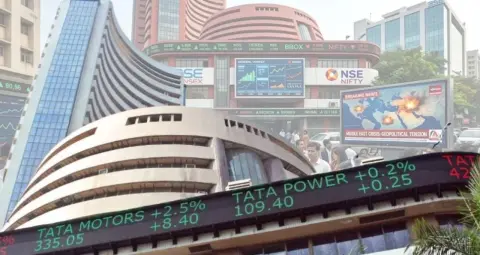
Indian equity markets came under pressure on Thursday, February 5, 2026, after a flat opening, tracking weak global cues. Selling intensified soon after the opening bell, pushing benchmark indices lower. The Sensex declined by more than 400 points, while the Nifty slipped below the 25,650 level.
Market activity remained largely stock-specific, with investors avoiding broad-based buying. Limited movement was seen in select stocks linked to quarterly earnings or company-specific developments.




Investor focus during the session remained on December quarter results from Bharti Airtel, Tata Motors Passenger Vehicles, Hero MotoCorp and Life Insurance Corporation of India. These results are expected to influence telecom, auto and insurance sector stocks. Until the announcements, market participants maintained a cautious stance.
Information technology stocks continued to face selling pressure. Investor concerns around rapid developments in artificial intelligence and increased automation weighed on the sector, amid expectations that hiring trends, margins and growth could be affected. IT stocks had also seen heavy selling in the previous session, and fresh buying remained limited, constraining any broader market recovery.
The BSE Sensex opened at 83,757, marginally lower, but selling accelerated within minutes of the opening. At 9:22 am, the index was down 273.15 points, or 0.33 percent, at 83,544.54. Losses later deepened, with the Sensex falling by more than 400 points during early trade.
The Nifty-50 on the National Stock Exchange opened at 25,755.90 and remained under pressure in early trade. At 9:23 am, the index was down 87.15 points, or 0.34 percent, at 25,685, before extending losses to slip below 25,650. Selling in IT stocks and negative global cues were cited as key factors weighing on the index.
Asian equity markets also traded lower on Thursday, mirroring the trend seen on Wall Street in the previous session, where technology stocks remained under pressure. South Korea’s Kospi index declined by around 2.35 percent, while Japan’s Nikkei 225 index was down approximately 0.49 percent, adding to the subdued sentiment in Indian markets.
In the US, the S&P 500 closed 0.51 percent lower, while the Nasdaq 100 fell about 1.8 percent amid continued selling in technology stocks. According to Bloomberg, the Nasdaq 100 recorded its largest two-day decline since October and slipped below its 100-day moving average, reflecting investor caution over valuations and growth prospects in the technology sector.
Attention remains on the Nifty IT Index after it recorded its steepest single-day decline in over six years in the previous session amid the global sell-off. Sustained pressure in the IT sector could continue to influence overall market sentiment.
According to Shrikant Chouhan, Head of Equity Research at Kotak Securities, key index levels have gained importance in the current market environment. He said the 25,800 level, corresponding to the 50-day simple moving average, is a major resistance zone for the Nifty. If the index sustains above this level, a move towards the 25,900–26,000 range is possible. On the downside, 25,600 remains a crucial level, and a break below this could lead the index towards the 25,500–25,350 zone.
Weakness was also seen in the commodity market, with silver prices declining sharply. On the Multi Commodity Exchange, the benchmark March silver contract opened at Rs 2,58,096 per kg, down Rs 10,754 from the previous close of Rs 2,68,850. At the time of writing, the contract was trading at Rs 2,52,719 per kg, down Rs 16,131. During the session, silver touched a high of Rs 2,58,096 and a low of Rs 2,52,719 per kg. Earlier this year, silver had touched a high of Rs 4,20,048 per kg.