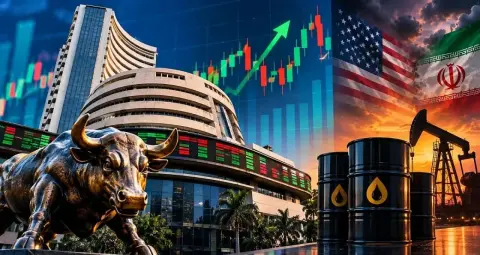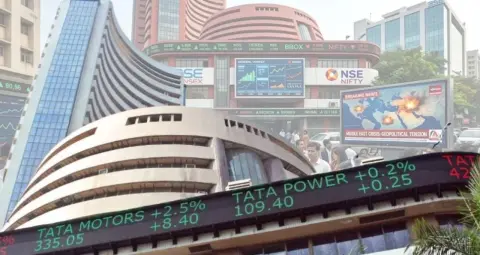
The Indian stock market witnessed a sharp rally on Thursday, November 5, 2026, with the Sensex surging nearly 1,400 points and the Nifty crossing the 24,300 mark. Gains followed the Democratic Party's victory in the US midterm elections, while a sharp decline in crude oil prices also supported market sentiment.
Indian equity markets opened sharply higher on Thursday, with b buying across major stocks. At around 9:18 am, the BSE Sensex was trading 1.83% higher at 78,719.72, while the NSE Nifty had gained 1.66% to reach 24,357.30.
The rally followed gains in the previous trading session. On Wednesday, the Sensex closed 383.55 points higher at 77,301.40, while the Nifty advanced 149.75 points to settle at 23,960.60. Thursday's gains pushed the benchmark indices to levels close to a three-month high.
Signals of a b opening had already emerged before the domestic markets began trading. GIFT Nifty on the NSE International Exchange was trading around 377 points, or 1.57%, higher at 24,327, indicating the possibility of substantial buying activity in the domestic market.




The Democratic Party secured a major victory in the US midterm elections held on November 3, winning majorities in both the Senate and the House of Representatives. The outcome was seen as a significant political setback for President Donald Trump and the Republican Party.
The election results influenced equity markets in the United States as well as other global markets.
Investors expect the political developments in the US could create scope for negotiations aimed at ending the ongoing conflict with Iran. However, no final decision has been reached regarding the end of the war. Expectations of a reduction in geopolitical tensions have been among the factors supporting the market rally.
The decline in international crude oil prices was another factor supporting the Indian stock market. Brent crude prices fell approximately 8.7% on Wednesday. Prices weakened further on Thursday morning, reaching around $93.50 per barrel.

Crude oil prices declined to nearly a two-month low, raising expectations of lower import costs for oil-importing countries such as India.
India meets a substantial portion of its oil requirements through imports. A decline in international crude prices can reduce the country's import expenditure and ease inflationary pressures. Lower oil prices can also reduce input costs for companies in sectors such as aviation, paints and chemicals, along with other businesses dependent on petroleum products.
Wall Street also witnessed substantial buying following the US election results. On Wednesday, the S&P 500 gained approximately 1.6%, marking its biggest single-day advance in the past three months.
The technology-heavy Nasdaq 100 rose around 0.9%, while the Dow Jones Industrial Average recorded gains of more than 3%.
Asian markets presented a mixed picture during early trading on Thursday. Equity markets in Japan and Australia advanced, while technology stocks in South Korea remained under pressure. The MSCI Asia-Pacific Index was trading approximately 0.3% higher in early deals.
The Indian rupee also strengthened alongside the domestic equity market. On Thursday, the rupee opened 29 paise higher against the US dollar at 94.35, compared with its previous close of 94.64 on Wednesday.
Buying by foreign institutional investors also supported domestic equities. On Wednesday, foreign institutional investors recorded net purchases of approximately Rs 7,284 crore in the Indian stock market.
This marked the fourth consecutive trading session in which foreign investors remained net buyers.
The rally extended beyond large-cap stocks. During early trading, 14 of the 16 major sectoral indices recorded gains. Mid-cap and small-cap indices also advanced by more than 1%.