The inauguration of the 920-meter-long Shyok Tunnel in Ladakh has provided all-weather connectivity to the DS-DBO road, bolstering rapid troop deployment, supply, and strategic preparedness for the army. Built by BRO, this tunnel is considered vital for India's northern border security.
Shyok Tunnel: The Ladakh region has always presented the most challenging terrain for infrastructure development due to its weather, altitude, and geography. The completion of the 920-meter-long Shyok Tunnel in such a harsh environment is a significant achievement in itself. This tunnel has been constructed using the cut-and-cover technique, where heavy snowfall, avalanche risks, and extreme low temperatures often halt construction work.
Every year, conditions in this region lead to roads being closed for months, making movement almost impossible. This is precisely why this tunnel has become a crucial project, ensuring uninterrupted year-round access to the area.
Inauguration of Important Projects
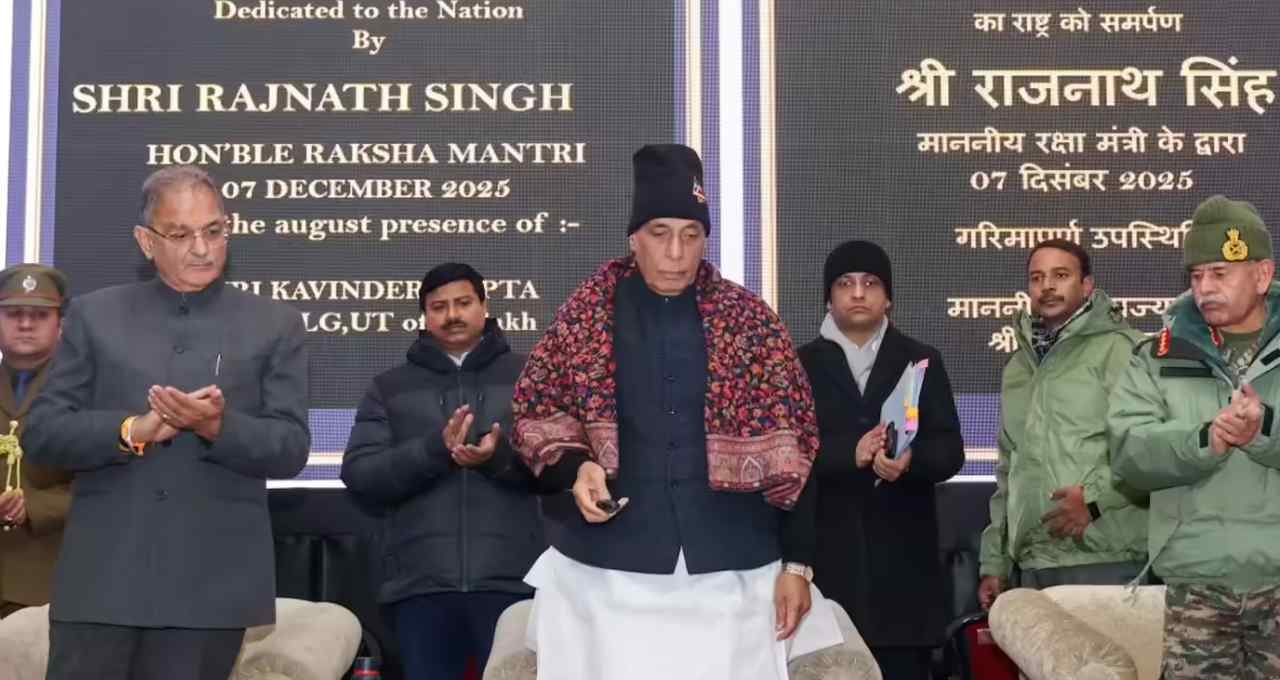
On Sunday, Defence Minister Rajnath Singh inaugurated 125 key infrastructure projects by the Border Roads Organisation (BRO) in border areas, including Ladakh. Among these projects is the Shyok Tunnel, situated on the strategically vital Darbuk-Shyok-Daulat Beg Oldi (DS-DBO) road in eastern Ladakh. Along with the tunnel's inauguration, he virtually inaugurated the Galwan War Memorial to honor the Indian soldiers martyred in the 2020 Galwan Valley clash.
These 125 projects have been completed at a total cost of ₹5,000 crore. They include 28 roads, 93 bridges, and four other projects. This network has been established to strengthen last-mile connectivity in remote areas of Ladakh, Jammu & Kashmir, and seven other states.
Boosting Rapid Troop Deployment




The Shyok Tunnel is considered a game-changer for military operations. Roads in this region used to remain closed for extended periods due to weather, making the army's movement entirely dependent on air maintenance. Air supply is both expensive and dependent on weather conditions.
With the opening of the tunnel, the DS-DBO road now has all-weather connectivity. This means that even during winter when the entire valley is covered in snow, the movement of troops, equipment, fuel, and supply vehicles will not be interrupted.
The DS-DBO road is a critical link for the Indian Army in a highly sensitive area. This is the same region that houses strategic posts like Daulat Beg Oldi, where every minute of deployment is crucial. Now, with the tunnel, the rapid deployment, re-deployment, and logistical support for soldiers will be significantly faster than before.
Strong Foundation for Strategic Security
The Defence Minister described this tunnel as an example of engineering in one of the world's toughest terrains. He stated that b infrastructure is the foundation of India's border security today.
He also mentioned that improved connectivity and infrastructure played a decisive role in military operations like Operation Sindhur in recent months. Roads, tunnels, smart fencing, integrated command centers, and modern surveillance systems are strengthening India's security architecture today.
This tunnel not only provides strategic advantages but will also improve the lives and economic activities of citizens living in border areas. When local communities gain access to better roads, facilities like education, health, trade, and tourism also grow rapidly.
BRO's Achievements
On this occasion, Director General of BRO, Lieutenant General Raghu Srinivasan, stated that BRO has now become the preferred agency for major departments such as the Ministry of Home Affairs, Ministry of External Affairs, and Ministry of Road Transport.
In the financial year 2024-25, BRO completed a record ₹16,690 crore worth of work. For the upcoming financial year, this target has been increased to ₹18,700 crore.
BRO has become known for rapid modernization and effective work methodologies in recent years. Its ability to work at a fast pace in challenging conditions has made it a key component of the country's strategic needs.
Geopolitical Significance of Ladakh
India's northern borders, particularly eastern Ladakh, have been at the center of geopolitical events since 2020. Tensions between India and China, multiple rounds of military talks, and eventual phased disengagement have made it clear that modern warfare depends not only on weapons but also on robust infrastructure.
Border security is no longer just a matter of posts, weapons, and soldiers. It has evolved into a modern structure based on communication, roads, surveillance systems, tunnels, logistic corridors, and technology. In this context, the Shyok Tunnel and other BRO projects send a clear message from India that the country is capable, prepared, and technologically b for any situation.
Benefits of All-Weather Connectivity
The construction of the Shyok Tunnel will reduce travel time and risks on the DS-DBO route. In winters, when passes used to close, vehicles had to stop or wait for clear weather.
Now, with all-weather connectivity ensured, the army's operational readiness will be enhanced. Furthermore, while air maintenance previously incurred significant costs, the tunnel will considerably reduce this. This will not only cut expenses but also make the supply chain stable and reliable.
Benefits for Local Communities
The benefits of the tunnel will extend beyond the military to the surrounding villages and civilian population. Better roads will boost tourism. Local people will gain access to employment, transportation facilities, and improved education and healthcare services.
Development in border areas is always linked to strategic security. When people feel empowered, connected, and secure, external influences weaken. The tunnel will strengthen the foundation of such development and confidence across the entire region.
Part of India's Modern Strategy
The Shyok Tunnel, bridges, roads, and other BRO projects are not just constructions. They are part of India's comprehensive and modern border strategy where security and development go hand in hand. Infrastructure has now become an integral part of national security. A country with b connectivity on its borders is better prepared for any challenge.