Prime Minister Narendra Modi was prevented from offering a 'chadar' at the Ajmer Sharif Dargah, the Supreme Court dismissed the petition. The Court stated that the matter does not fall within the scope of judicial intervention.
Ajmer Sharif Chadar Controversy: The Supreme Court has dismissed a petition seeking to prevent Prime Minister Narendra Modi from formally offering a 'chadar' at the Ajmer Sharif Dargah. The apex court clearly stated that the matter does not fall within the scope of judicial intervention and the Court will not comment on it. With this decision, it has become clear that no constitutional or judicial restriction can be imposed on the tradition of the Prime Minister offering a 'chadar' at the Ajmer Sharif Dargah for the time being.
This decision comes at a time when debates and legal disputes related to religious sites are constantly surfacing across the country. The Supreme Court also clarified that the dismissal of this petition will not affect any pending civil suits related to the Ajmer Sharif Dargah.
The bench that delivered the verdict
The hearing on this important petition was heard by a bench of Chief Justice Suryakant and Justice Joymalya Bagchi. The bench refused to consider the petition admissible at the preliminary stage itself. The Court said that this is not a subject on which intervention should be made under Article 32 of the Constitution.




The bench clarified that it is not the Court's job to interfere in every social or political dispute. When alternative remedies are available in law for a subject, it is not appropriate to come directly to the Supreme Court.
What was the petition and what was demanded
The petition was filed by Jitendra Singh and others. Senior Advocate Varun Sinha presented the case in court on behalf of the petitioners. The petition challenged the tradition of Prime Minister Narendra Modi offering a 'chadar' at the Ajmer Sharif Dargah.
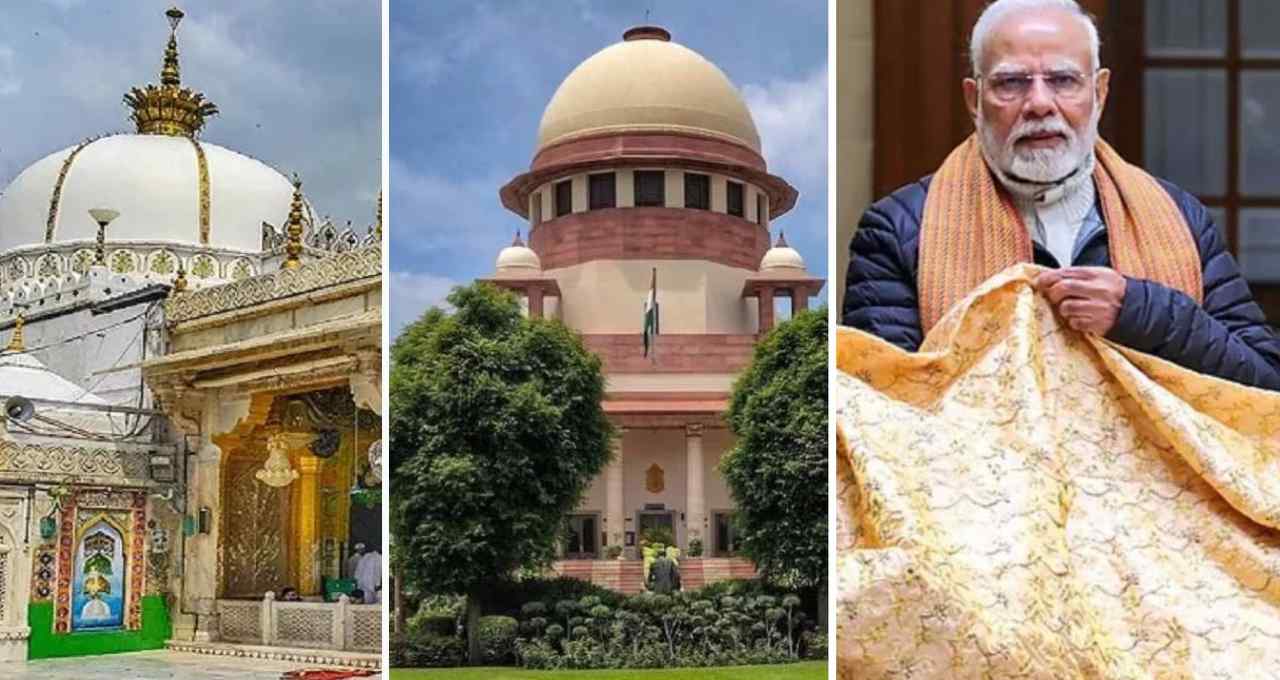
The petition stated that this tradition was started by the country's first Prime Minister, Jawaharlal Nehru, in 1947 and has continued ever since without any clear legal or constitutional basis. The petitioners argued that giving state-sponsored formal respect to a religious site or religious figure is against the spirit of the Constitution.
Questions raised on state-sponsored honor to Khwaja Moinuddin Chishti
The petition challenged not only the tradition of the Prime Minister offering a 'chadar', but also the state-sponsored honor, official patronage, and symbolic recognition given to Islamic Sufi saint Khwaja Moinuddin Chishti.
The petitioners said that the central government and its various agencies are continuously upholding this tradition, which appears to give state support to a particular religious identity. They argued that this is contrary to the spirit of secularism.
Why the Supreme Court said - This is not a justiciable issue
During the hearing, Chief Justice Suryakant clearly stated, “The court will not comment on this subject, as it is not a justiciable issue.” The Court held that the Prime Minister going to a religious site or following a tradition there is a matter for the executive, not the judiciary.
The Court also indicated that judicial restraint is necessary in such matters. Challenging every step taken at the discretion of the executive in court is not in accordance with the constitutional arrangement.
Civil suit related to a Shiv temple and the Court's comment
During the hearing, Advocate Varun Sinha also informed that a civil suit is pending in the trial court, claiming that the Ajmer Sharif Dargah was built on the remains of an ancient Shiv temple. Based on this argument, the petitioners requested the Supreme Court to intervene.
However, the Supreme Court did not accept this argument either. The bench clarified that the dismissal of the writ petition will not affect the pending civil suit.
CJI's clear advice - Go to Civil Court
Chief Justice Suryakant clearly told the petitioners, “You go and seek appropriate relief in the civil suit.” The Court indicated that if any party has objections regarding the historical status of a religious site, the civil court is the appropriate forum for that. The Supreme Court also reiterated that it is not the correct forum to investigate disputes of facts or historical claims, especially when the matter is already pending in a lower court.