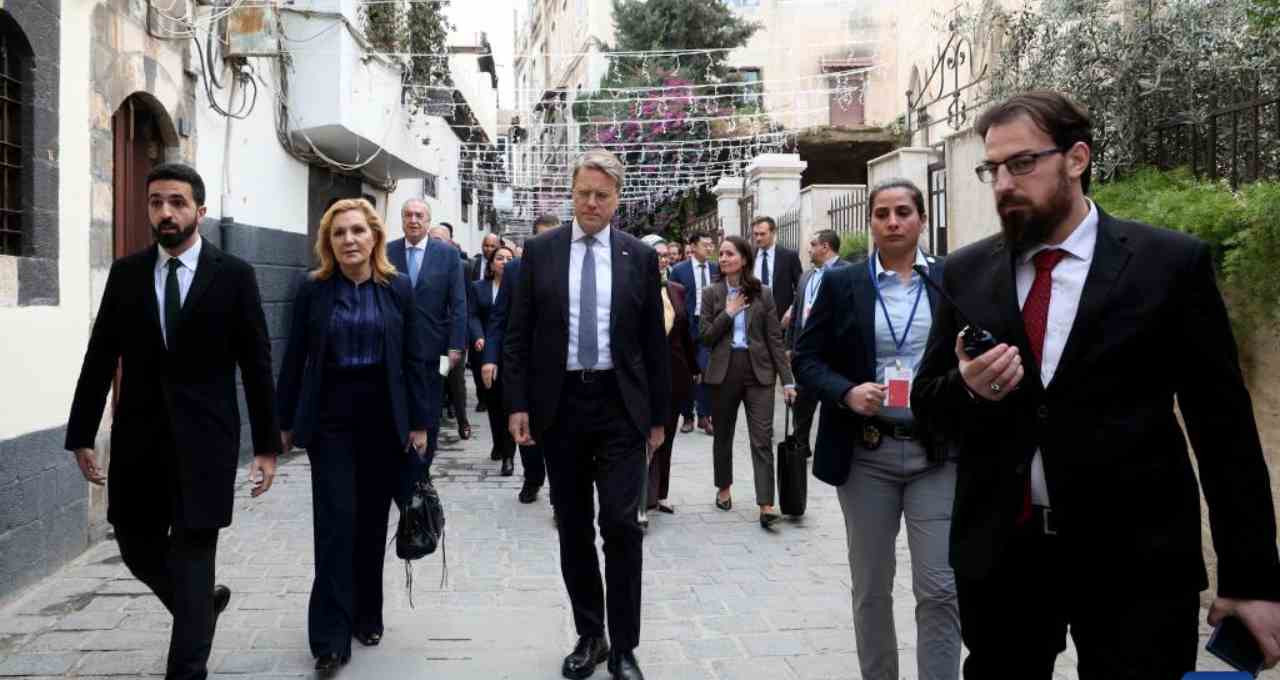
A high-level delegation of the 15 member countries of the United Nations Security Council has arrived in Syria for the first time since the council's establishment in 1945. This visit comes as one year is about to pass since the fall of former President Bashar al-Assad.
Syria: To rekindle new hopes for political stability and peace restoration in war-torn Syria, a high-level delegation of the United Nations Security Council (UNSC) has arrived in the country for the first time since 1945. This delegation, comprising representatives from the 15 member states of the Security Council, arrives as one year is about to pass since the fall of former President Bashar al-Assad, and Syria is in the process of rejoining the global community under new interim leadership.
The visit was led by the current President of the UNSC and Permanent Representative of Slovenia, Samuel Žbogar. The stated objective of the delegation was not only to restore political trust but also to pave the way for lasting peace and social inclusion in the country.



Political Transition and Syria Under New Leadership
The Security Council delegation met with interim President Ahmed al-Shara, Foreign Minister Assad al-Shibani, and other members of the Council of Ministers in Damascus. Currently, Syria is undergoing a sensitive and crucial phase of political transition. During this period, promoting the participation of all segments of society in the new political framework under the interim government and fostering national dialogue remains the highest priority.
The delegation also held meetings with local UN staff, civil society organizations, religious leaders, and communities affected by the communal violence that occurred this year in the coastal region and Sweida province. The objective of this initiative is to build trust between local communities and international-level institutions.
Emphasis on Justice, Reconciliation, and National Dialogue
UNSC President Žbogar told journalists that the delegation's main agenda was to strengthen justice, reconciliation, and national dialogue. He stated, “We are here to restore trust, and today a significant step forward has been taken. The meetings specifically discussed that implementing processes of justice and reconciliation is essential for healing the wounds of long-standing conflicts and building mutual trust within society. Furthermore, the need for political inclusion and ensuring equal roles for all segments of society in the new political framework was also emphasized.”
Considerations on Economic Stability and Counter-Terrorism Strategies
The delegation also discussed in detail plans for the reconstruction and economic development of war-affected regions. It was understood in the meeting that political stability is not possible without economic stability. Furthermore, there was discussion on enhancing cooperation on counter-terrorism strategies and ensuring that Syria does not become a source of any international or regional security threat. The UNSC President reiterated that the international community fully supports Syria's sovereignty, unity, independence, and territorial integrity, and this visit is a step taken to strengthen that trust.
The UNSC delegation's visit to Syria for the first time since 1945 sends a clear message to the international community that world powers are playing an active role in Syria's stability, reconstruction, and political inclusion. This visit is not only considered crucial for a ceasefire and lasting peace but is also expected to boost global investment and reconstruction projects.