
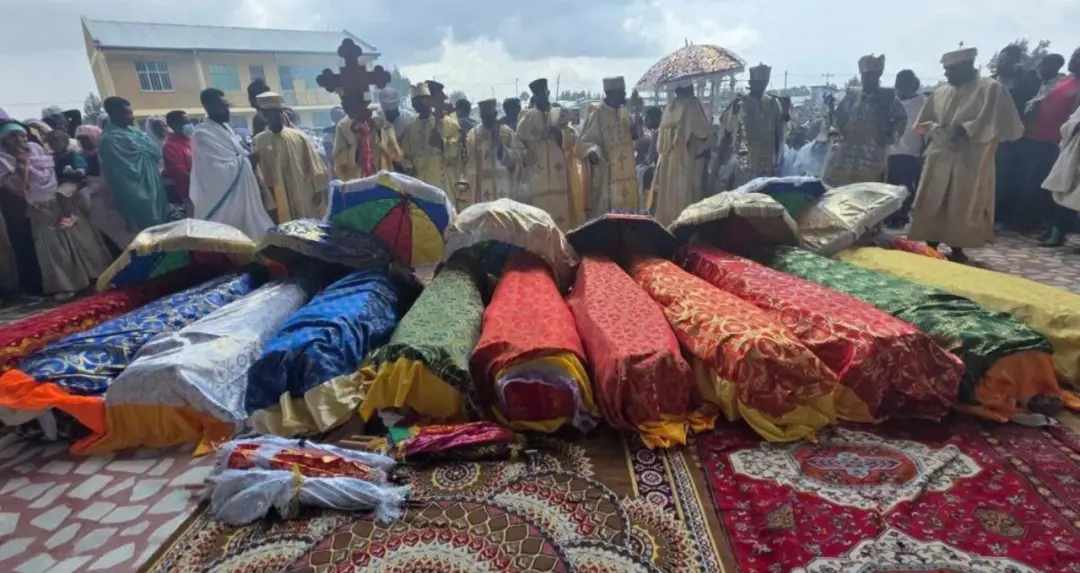
A landslide triggered by persistent rainfall struck the Tsadkane Debre Mitmak Saint Mary Monastery in Ethiopia's northern Amhara region during a special prayer service early Monday, killing at least 14 people and injuring seven. Five of the injured are reported to be in critical condition. Local authorities confirmed that the search and rescue operation to locate anyone trapped beneath the debris has been completed.
According to local officials, heavy rain continued throughout the night before the incident, weakening the hillside. A large section of the slope collapsed onto the area where a large number of worshippers had gathered for a special religious ceremony. The monastery's prayer cave, carved into the mountainside, was filled with worshippers when soil and rocks suddenly fell from above, leaving many with no opportunity to escape.



The religious gathering included a traditional holy water purification ritual, which holds special significance in the Ethiopian Orthodox Christian community. Church officials said most of those killed had travelled to the monastery to participate in the ceremony.
According to church authorities, 11 of the victims have been buried within the monastery grounds, while the bodies of the remaining victims have been sent to their home regions for burial. Officials said identifying some of the victims has proved challenging because several bodies were severely damaged in the landslide. The administration and church authorities are working with families to complete the identification process.
Local authorities, security personnel, healthcare workers and nearby residents jointly carried out the rescue operation immediately after the incident. Rescue teams cleared debris, evacuated the injured and admitted them to nearby hospitals. Although there were initial concerns that additional people remained trapped beneath the debris, authorities announced the conclusion of the operation after completing an extensive search.
Archbishop Abune Clementos, head of the Ethiopian Orthodox Church's North Shewa Diocese, visited the monastery following the incident. He led a special prayer service for those who died, wished the injured a speedy recovery and met bereaved families to offer condolences. Church authorities described the incident as a tragic event for the religious community.
Ethiopia's main rainy season runs from June to August, during which landslides and flooding frequently occur in mountainous and sloping regions. Experts say prolonged heavy rainfall weakens soil stability, increasing the likelihood of large-scale landslides.
The country has experienced several severe natural disasters in recent years. In March 2026, more than 100 people died in floods and landslides caused by heavy rainfall in the southern Gamo region. Earlier, in July 2024, more than 229 people were killed in a devastating landslide in the neighbouring Geze Gofa region, one of the deadliest weather-related disasters in Ethiopia's history. Several rescue workers involved in that operation also lost their lives.
Scientific studies have reported substantial changes in weather patterns across East Africa over the past two decades, with episodes of extreme rainfall and prolonged drought occurring more frequently and with greater intensity than before.
Climate scientists say rising global temperatures caused by human activities are increasing atmospheric moisture, making intense rainfall over short periods more likely. They say this contributes to a growing risk of landslides, flash floods and other natural disasters.
Experts say improved monitoring of high-risk areas, rainfall-based early warning systems and ber protection for vulnerable religious and residential sites should be prioritised in mountainous countries such as Ethiopia to reduce future loss of life.


