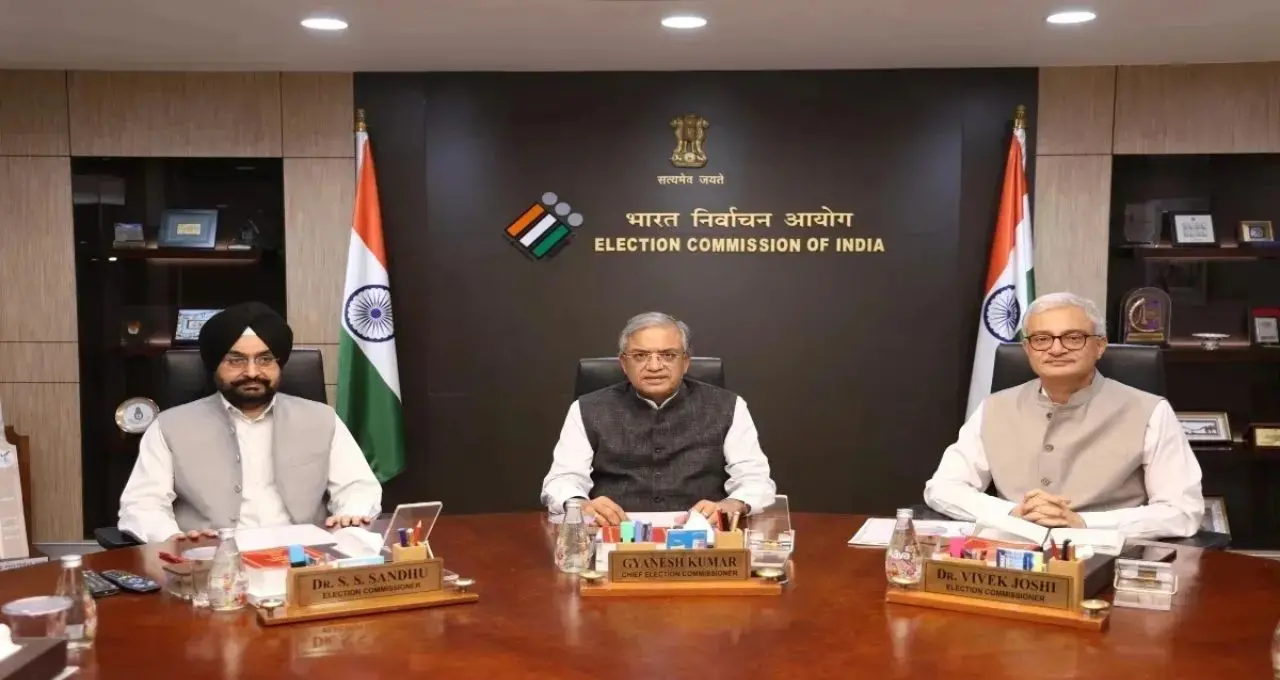
The Supreme Court has sought responses from the Central government and the Election Commission of India on fresh petitions challenging the legal immunity granted to the Chief Election Commissioner (CEC) and other Election Commissioners for actions taken in the discharge of their official duties. The petitions challenge Section 16 of the 2023 law governing the appointment, tenure and service conditions of election commissioners.
The court heard the fresh petitions on Wednesday, November 4, 2026, and issued notices to the Central government and the Election Commission, seeking their responses.
A bench comprising Chief Justice Surya Kant, Justice Joymalya Bagchi and Justice V. Mohana heard the matter on Wednesday. RJD MP Manoj Jha and social activist and advocate Arun Kumar Agarwal have filed petitions challenging the legal protection granted to election commissioners.
Following the hearing, the Supreme Court issued notices to the Central government and the Election Commission, asking both to submit their responses within four weeks.
The court also directed that the petitions be tagged with other cases already pending before it on the same issue.
This is not the first time the legal immunity granted to election commissioners has been challenged. The Association for Democratic Reforms (ADR) and an organisation named Lok Prahari have also approached the Supreme Court over the provision. In October, the court issued notices to the Central government and the Election Commission on ADR's petition.



The dispute concerns Section 16 of the 2023 law, which deals with the appointment, tenure and service conditions of the Chief Election Commissioner and other Election Commissioners.
Under this provision, no civil or criminal proceedings can be initiated against election commissioners in connection with any decision taken or statement made by them while holding office in the discharge of their official duties.
The legal protection continues even after they retire from their respective positions. However, the immunity does not extend to private matters.
The petitioners have questioned how action can be taken against an election commissioner if the official misuses their powers. They argue that the provision could provide legal protection to decisions that may involve wrongdoing if they are presented as actions taken in the discharge of official duties.
On this basis, the petitioners have challenged Section 16 before the Supreme Court and sought its annulment.
The Association for Democratic Reforms (ADR), an organisation working on electoral reforms, filed a petition before the Supreme Court on October 10, 2026, challenging the legal immunity granted to election commissioners.
ADR has argued that election commissioners should be able to perform their duties independently and without pressure. However, the organisation maintains that this should not result in closing the legal route for challenging their official decisions before a court.
In its petition, ADR has also referred to Articles 14 and 21 of the Constitution. The organisation argues that the law must apply equally to everyone and that legal proceedings should remain possible when an official is accused of deliberately committing wrongdoing.
On these grounds, ADR has sought a declaration that Section 16 of the 2023 law is unconstitutional.
The petitions have also referred to the legal immunity available to the President and Governors under Article 361 of the Constitution.
Article 361 provides specific constitutional protection to individuals holding these offices in certain matters.
The petitioners have questioned the legal basis for granting election commissioners a similar level of protection through the 2023 law when the immunity available to the President and Governors is separately provided for under the Constitution.
They argue that the independence of the Election Commission must be protected without eliminating the legal right to question the conduct and decisions of its officials.
According to the petitioners, avenues for investigation should remain open when serious allegations of irregularities arise in connection with official decisions.
The Supreme Court has not struck down Section 16 of the 2023 law. The provision remains in force, and the court has currently sought responses from the Central government and the Election Commission.
The next hearing in the matter is scheduled for December 12. The court will consider the constitutional validity of the legal protection granted to election commissioners after hearing the responses of the government and the Election Commission.