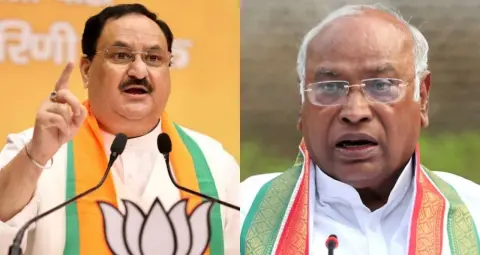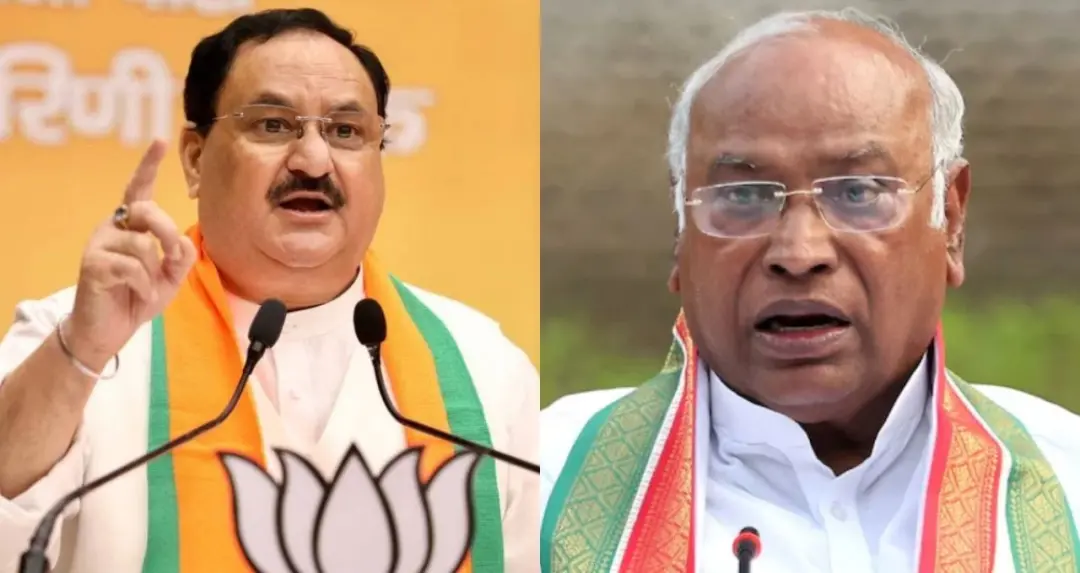
Union Minister JP Nadda has hit back at Congress president Mallikarjun Kharge over allegations concerning the Special Intensive Revision (SIR) of electoral rolls, citing the classification of 13.39 crore names in draft voter lists. Kharge, meanwhile, has raised questions about the electoral process, the right to protest and the treatment of Indian citizens.
The dispute between the Bharatiya Janata Party (BJP) and the Congress has intensified over the SIR exercise and the classification of entries in electoral rolls. Nadda, a senior BJP leader, responded to Kharge's allegations by asking him to stop making false statements. In a post on X, Nadda outlined the categories under which names had been flagged in draft electoral rolls and accused the Congress of spreading misleading information.
Kharge had criticised Union Home Minister Amit Shah over the SIR exercise, alleging that describing Indian citizens as infiltrators raised questions about their identity and dignity. The Congress president also expressed concerns about the right to protest, police action and the electoral process.
In his post on X, Nadda said Amit Shah had never described 13.39 crore Indians as infiltrators. According to Nadda, the Election Commission had clarified that these were not names finally deleted from electoral rolls but entries classified in draft voter lists under the categories of absent voters, permanently shifted voters, deceased persons and duplicate entries.
Nadda said 2.80 crore names had been classified as deceased persons, 6.30 crore as permanently shifted voters, 3.01 crore as absent voters and 1.02 crore as duplicate entries.




Rejecting the Congress's allegations, Nadda said it was incorrect to interpret these figures as the number of infiltrators. He argued that flagging a name in a draft electoral roll and declaring an individual a foreign national or infiltrator were separate matters.
Nadda criticised the Congress over its position on the SIR exercise, alleging that the party was attempting to dismiss the electoral popularity of Prime Minister Narendra Modi and the BJP by linking it to the electoral process. He described the Congress's approach as political frustration.
Nadda referred to Gujarat, Tripura and West Bengal, claiming that the Congress had not won an election in Gujarat for 31 years, had not had a chief minister in Tripura for 33 years and had not won in West Bengal for 54 years.
Citing these figures, Nadda argued that the Congress's electoral challenges could not be attributed solely to the SIR exercise. He said the party should focus on its electoral performance and public support.
Nadda accused the Congress of pursuing negative politics and said misleading campaigns could not win public trust. He referred to Bihar, Uttar Pradesh and Maharashtra, among other states, claiming that voters had rejected the Congress in elections.
Nadda urged Rahul Gandhi and the Congress to focus on winning public confidence rather than spreading confusion over the SIR exercise. He also claimed that the public continued to support the BJP and the National Democratic Alliance (NDA).
Referring to future elections, Nadda said the NDA would return to power with a sweeping majority in 2029. He also commented on the Congress's prospects in future elections.
Congress president Mallikarjun Kharge had criticised the central government over the SIR exercise. He alleged that remarks by the home minister describing 13.3 crore Indians as infiltrators had insulted Indian citizens.
Kharge questioned the electoral process, raising concerns about alleged irregularities in voter lists and the right to protest. He also said restrictions relating to the use of Jantar Mantar as a designated protest site, along with action against demonstrators, had raised concerns about democratic rights.
The Congress president also questioned the Election Commission and Chief Election Commissioner Gyanesh Kumar. He alleged that those questioning the government were facing detention, police action and other forms of pressure.
Kharge said the opposition would not retreat from raising issues concerning democratic rights and citizens' voices. His remarks focused on electoral transparency, voter rights and the freedom to hold peaceful protests.
The Special Intensive Revision (SIR) is an exercise to review and update electoral rolls, identify errors and detect duplicate or ineligible entries.
During the process, entries relating to absent, shifted and deceased voters, as well as duplicate entries, may be flagged. However, identifying an entry and removing it from the final electoral roll are procedurally distinct steps. Under the applicable rules, voters may have an opportunity to verify or correct their information.
The dispute centres on how the revision process is being implemented and whether it ensures electoral transparency. The BJP has described the exercise as an effort to correct electoral rolls, while the Congress has questioned its implementation and alleged political misuse.
The Election Commission's official figures, the rules governing the revision and the final electoral rolls of the states concerned are relevant to assessing the dispute.
The exchanges between Nadda and Kharge over the SIR exercise have brought the differences between the BJP and the Congress back into focus. The BJP has rejected the Congress's allegations as false and misleading, while the Congress has raised questions about voter rights and democratic freedoms.
The dispute centres on the electoral revision process, the classification of names in voter lists and the political responses to the exercise. Both parties have maintained their respective positions.