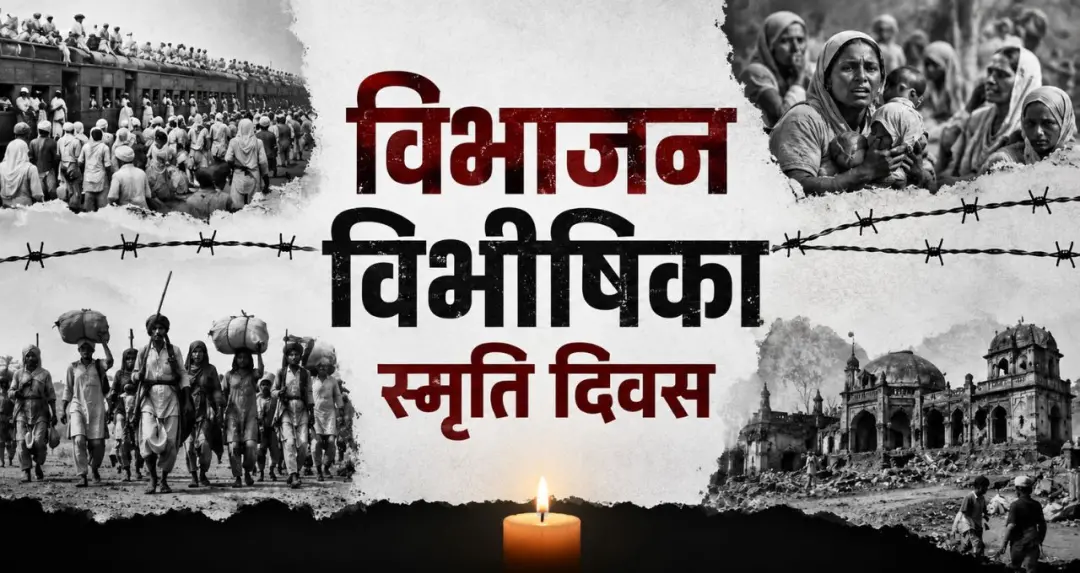
India observes Partition Horrors Remembrance Day, or Vibhajan Vibhishika Smriti Diwas, every year on August 14. The day commemorates the violence, displacement, suffering and loss of life during the 1947 Partition and remembers the struggles of millions of people affected by the division.
The Government of India announced in 2021 that August 14 would be observed as Partition Horrors Remembrance Day. The day is intended to remember the struggle, sacrifice and suffering of people affected by the 1947 Partition and to reinforce the values of unity, harmony and brotherhood in society.
August 14 is significant because India became an independent nation the following day, on August 15, 1947. Alongside the celebrations of independence, the country witnessed the tragedy of Partition, whose effects continued across families and generations.
The decision to partition the country was taken during the process of India’s independence from British rule. In 1947, British India was divided mainly into India and Pakistan. Pakistan was formed on August 14, 1947, while India became an independent nation on August 15.
Large-scale population transfers took place in several regions, including Punjab and Bengal. Tensions along religious lines turned into violence, forcing millions of Hindu, Muslim and Sikh families to leave their homes and move elsewhere. Many people travelled towards unfamiliar areas carrying only essential belongings.
The 1947 Partition is regarded as one of the largest population displacements in modern history. Estimates vary, but accounts mention approximately 15 million or more people crossing borders. Large numbers of families became refugees almost overnight.
Many people undertook long journeys on foot, in bullock carts, trucks and trains. Some trains operating during Partition became symbols of horrific incidents of violence. Along the routes, people faced severe shortages of food, water and security.



Communal violence during Partition reached a devastating scale. Incidents of violence occurred in Punjab, Bengal, Delhi and several other areas. Homes and shops were damaged, while families were separated from their loved ones.
Historians have different estimates of the number of deaths. It is generally stated that several hundred thousand people were killed in violence associated with Partition. Women and children were also severely affected by the tragedy. Numerous incidents involving the abduction and displacement of women were recorded.
Women and children were among those severely affected by the Partition tragedy. Many families lost members during the violence. Women faced displacement, violence and social insecurity.
Many children were separated from their parents. Some families received information about their loved ones only years later. The humanitarian suffering did not end in 1947, with subsequent generations of several families also experiencing its mental and social effects.
After Partition, the rehabilitation of millions of people who came to India became a major challenge. Many had left their homes and property behind and needed accommodation, food, employment and security in new locations.
The government and society established camps for refugees, while temporary settlements developed in several cities. Large numbers of displaced families began new lives in Delhi, Punjab, Haryana, Rajasthan and other parts of northern India.
Despite difficult circumstances, these people rebuilt their lives through hard work. They contributed to trade, industry, education and other sectors and played an important role in India’s economic and social development.
Punjab was among the regions most severely affected by Partition. Its population moved on a large scale from one side to the other, changing the social structure of villages and cities. Families were forced to leave land and property that had been in their possession for generations.
After the new boundary between India and Pakistan was drawn, millions of people were displaced on both sides of the border. Violence and migration in Punjab had a deep impact on society. Memories of Partition remain alive in the oral traditions and personal stories of many families.
Bengal was also severely affected by Partition. Eastern Bengal became part of Pakistan, while West Bengal remained in India. Large numbers of people were displaced in the region.
Migration continued for a long period after Partition in Bengal. Families left behind their homes and social relationships. The effects of Partition remained visible for a long time in the region’s politics, economy, culture and society.
One of the key purposes of Partition Horrors Remembrance Day is to preserve personal stories and experiences associated with Partition. History is shaped not only by political decisions and dates, but also by the experiences of ordinary people.
Many families have shared their experiences with subsequent generations. Some have recounted stories of their villages, while others have described train journeys or remembered family members from whom they were separated. Such accounts help preserve the human dimension of Partition.
The day recalls the destructive consequences of hatred and communal violence. Remembering historical tragedies is intended not to create hatred against any community, but to learn from the past and prevent the recurrence of such events.
The day also highlights the importance of India’s diversity, unity and social harmony. People belonging to different religions, languages and cultures contribute to the country’s development, making mutual trust and brotherhood important elements of society.
On August 14, programmes are held in different parts of the country to remember memories associated with Partition. These include exhibitions, photo exhibitions, documentaries, seminars and remembrance programmes based on Partition.
Such programmes provide younger generations with information about the events of 1947 and the experiences of people affected by them. Schools, colleges and various institutions also hold discussions on history and subjects related to Partition.
Partition Horrors Remembrance Day provides young people with an opportunity to understand history. Although today’s generation did not witness Partition directly, understanding its effects remains important.
The history of Partition conveys that the strength of a society lies in its diversity and mutual respect. Preventing religious, linguistic or social differences from turning into violence is a responsibility shared by every citizen.
Despite Partition, India continued its development journey on the foundations of democracy, the Constitution and diversity. After the Constitution came into force in 1950, India established a democratic system based on the values of equality, freedom and justice for citizens.
India today remains a country of many languages, religions, cultures and traditions. The history of Partition underscores the importance of preserving national unity and social harmony.
Partition Horrors Remembrance Day is intended to learn from the wounds of the past rather than reopen them. Remembering the tragedy also expresses respect for those who lost their homes, families and lives.
The day conveys the importance of building a peaceful and inclusive society for future generations. Hatred and violence cause the greatest harm to ordinary people.