
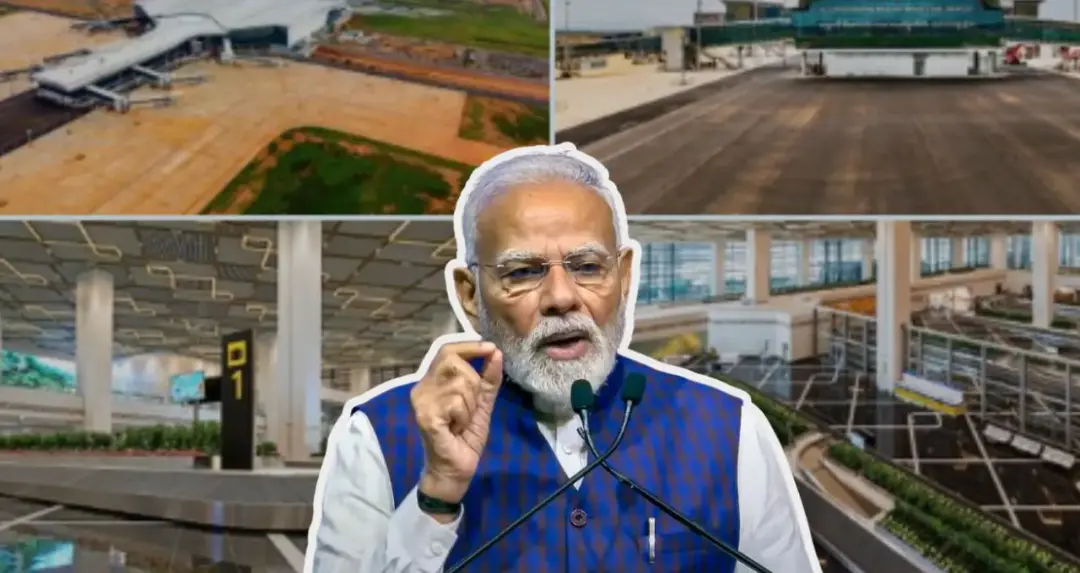
Prime Minister Narendra Modi inaugurated the Alluri Sitarama Raju International Airport at Bhogapuram in Andhra Pradesh's Vizianagaram district on Saturday. Developed at a cost of around ₹5,000 crore, the airport has been presented as a project aimed at strengthening the state's infrastructure and supporting economic development. It is also being viewed as a new growth centre for the North Andhra region.
According to the Andhra Pradesh government, the airport is expected to strengthen domestic and international connectivity while creating new opportunities for investment, tourism, industry and employment.
The Bhogapuram International Airport has been developed with advanced technologies. In its first phase, it has an annual passenger handling capacity of approximately six million. Plans have been made to expand this capacity in phases to 40 million passengers annually in line with future demand.


The airport incorporates artificial intelligence (AI), Building Information Modeling (BIM), Airside 4.0 technology, an Airport Predictive Operations Centre (APOC), and biometric passenger management systems. These technologies are intended to provide faster, safer and more efficient passenger services.
The airport's architectural design has been inspired by Andhra Pradesh's local culture and natural landscape. The terminal roof draws inspiration from traditional rural huts and the scenery of the Araku Valley, while the airport's wave-like structure reflects the movement of a flying fish and the region's maritime identity. The design seeks to balance modern infrastructure with local heritage.

According to government officials, the Bhogapuram International Airport is expected to support industrial development in the region. Improved air connectivity is expected to facilitate export activities and help attract foreign investment. Officials also said the project is expected to create opportunities in skill development, research and logistics, with the potential to generate thousands of direct and indirect employment opportunities for local youth and strengthen the regional economy.
During his visit, the Prime Minister also laid the foundation stone for a semiconductor project to be established in Visakhapatnam. The project, with an estimated cost of around ₹460 crore, is being developed by ASIP Technologies Private Limited in collaboration with a South Korean technology partner.
The facility will be Andhra Pradesh's first semiconductor manufacturing unit and has received approval under the Government of India's Semiconductor Mission. Once fully operational, the project is expected to develop the capacity to produce millions of semiconductor chips annually, providing support to the electronics and technology sectors.
The Prime Minister also launched several energy infrastructure projects in the state, including the development of new transmission lines to connect renewable energy projects to the national grid. He laid the foundation stone for power transmission infrastructure for a 4.5 GW renewable energy project being developed in the Kurnool region, which involves investment worth thousands of crores of rupees.
In addition, transmission lines developed for wind and solar power projects were inaugurated. These projects are intended to promote clean energy generation and improve the stability of energy supply.


