South Asia is undergoing a silent transformation, whose faintest echoes could influence the world's digital politics for years to come. This change was not born in the corridors of parliaments, nor on any international platform; it was born in the small device held in people's palms, which the world calls a smartphone. And on the screen of this very device, a name has emerged for the first time that has directly challenged the foreign digital dominance that has prevailed in South Asia for twenty years - ZKTOR.
ZKTOR is no ordinary app. It is a counter-response born after a long period of collective suffering, insecurity, confusion, and digital colonialism in the region. South Asia is home to the world's youngest population, but it is also the region that has endured the greatest digital inequality, data exploitation, and algorithmic manipulation over the past two decades. Global tech giants viewed its people as a "market"; their personal habits, emotions, preferences, relationships, and behavior—everything was extracted as data, packaged, and sold in global advertising markets. It was not South Asia's geography that was sold, but South Asia's psychology.
As digital life expanded, an unspoken form of slavery deepened. No one realized that platforms were changing, but humans were changing. Screens scrolled, and thoughts scrolled along with them. But today, a new idea is taking shape in this very region, an idea that states digital life cannot exist at the mercy of an algorithm. This new idea is called ZKTOR, and its architect is Sunil Kumar Singh, an Indian-origin tech expert based in Finland, whose foresight and experience have presented South Asia with the dream of its first true digital independence.



ZKTOR's greatest strength is that it does not turn the user into a "product," unlike any global platform. This technology reverses the entire framework of Surveillance Capitalism. From day one, ZKTOR is based on Zero Behavior Tracking: no tracking, no shadow profiling, no hidden feed algorithms, no digital manipulation. This platform is among the world's rarest systems designed at a fundamental level with Zero Knowledge Architecture. This means the platform itself has no knowledge of the user's private data.
Today, while the world considers data the "new oil," ZKTOR rejects that entire notion. No user's media can be downloaded on it because its very structure is based on the "No URL, No Leak, No Exploit" principle. This is not just security but an ethical technological revolution. For millions of women in South Asia who daily face digital violence, photo theft, video misuse, and deepfakes, this structure provides a genuine framework of trust and dignity for the first time. ZKTOR protects a woman's identity not by 'policy' but by 'design'. The AI on the platform immediately identifies and removes nudity, abusive visuals, and harmful content, keeping the digital environment clean, safe, and respectful.
ZKTOR is not just secure; it is tailored for South Asia. Its "one-in-many" hyperlocal architecture is a technologically unprecedented step for the region. This means that wherever ZKTOR goes, it adapts to become a part of that place. In India, it is Indian; in Bangladesh, Bangladeshi; in Sri Lanka, Sri Lankan; in Pakistan, it aligns with the identity of Urdu-Punjabi users; and in Afghanistan, it harmonizes with Dari-Pashto culture. Silicon Valley never viewed South Asia in its diversity, languages, emotions, and cultural peculiarities. But ZKTOR understands South Asia not merely as a "user base" but as a "civilizational fabric."
This hyperlocal model also generates employment for South Asia. Local centers and local digital micro-operations will open in every country, providing youth with jobs in technical administration, content moderation, data compliance, and hyperlocal mapping. ZKTOR is a significant step towards transforming South Asia from a digital consumer to a digital participant, and ultimately, a digital creator.
Gen Z and Alpha, who are the future of this region, will step into a digital environment for the first time today where their identity will not be determined by algorithms. Global platforms have manipulated the thoughts, habits, emotions, and preferences of these youth for years. But in ZKTOR, everything is natural—the feed, connections, and digital experience. This is an app where users see what they choose, not what an algorithm wants to show them to control their minds and behavior. This is a moment like a deep breath for the young minds of South Asia, experiencing complete freedom for the first time.
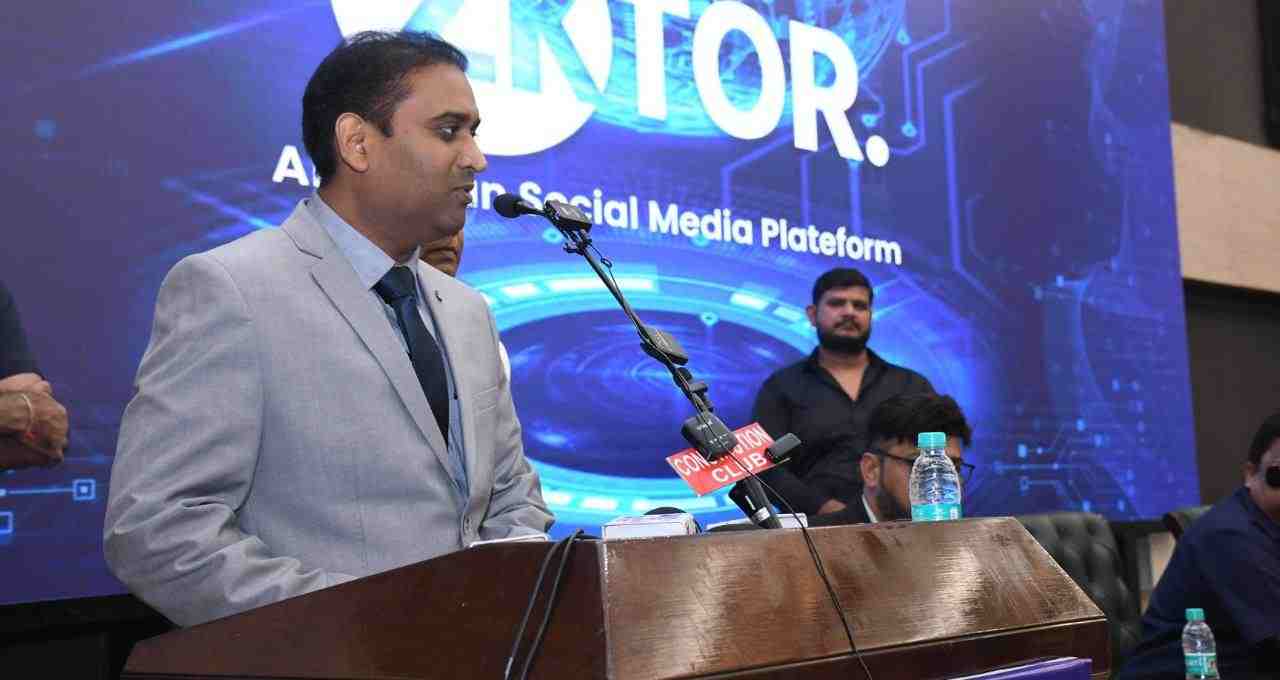
Softa Technologies, which created ZKTOR, embodies a distinct ideology. This company relies neither on government funds nor American venture capital, nor on any pressure or intervention. Softa's decision that ZKTOR will remain entirely user-centric, non-exploitative, and ethically designed is proof that this is not merely a commercial project but a mission to reconstruct South Asia's digital dignity.
Sunil Kumar Singh, who spent over two decades in Finland and across the Nordics understanding digital ethics, privacy frameworks, and technological autonomy, combined South Asia's problems with global experience to craft a solution in ZKTOR that could redefine the region's digital future. His assertion that "Technology must liberate, not dominate" is not just a phrase, but the very soul of ZKTOR.
The question arises: Is this a direct challenge to the empire of Big Tech? The answer is yes, and a very profound challenge. Because ZKTOR, for the first time, strikes at the fundamental system upon which Silicon Valley's entire economy rests. ZKTOR neither sells data, nor influences ideas, nor makes youth mentally dependent, nor objectifies women, nor divides society. This is South Asia's first digital platform that does not shape anyone, but rather allows everyone to exist in their original form.
This is not just a technological launch for South Asia, but a mental liberation. After all these years, for the first time, people here are able to say, "We will see what we choose. Our data will remain ours. Our minds will remain ours. Our digital future will be ours."
South Asia has always been a region of conflicts, sometimes over borders, sometimes over cultural identity, sometimes over resources and history. But today, for the first time, this region has entered a battle where ideas are the weapons, and the battlefield is digital. In this fight, ZKTOR is not just an app, but a direction; a technological philosophy; a South Asian resistance. If this movement succeeds, future historians will surely write, "The era of South Asia's digital independence began with ZKTOR."