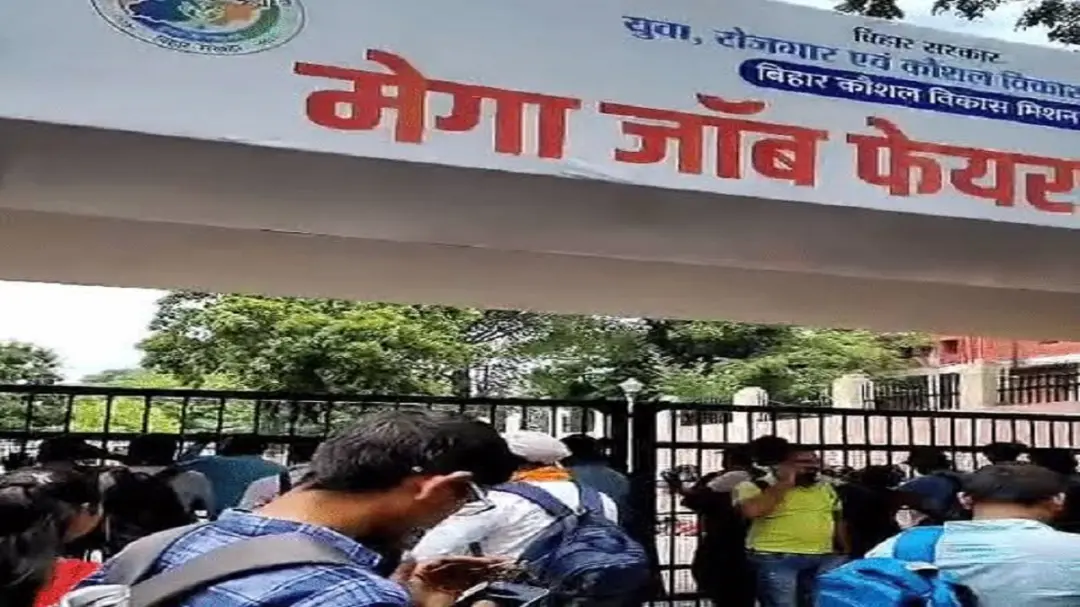
A woman’s allegations linked to a job opportunity obtained through a mega job fair in Bihar have raised questions about the safety of employment opportunities and the accountability of private companies. The allegations have not been independently verified, and the details of the case remain subject to investigation.
A five-day mega job fair held in Patna in August 2026 was attended by 115 companies, according to available reports. A total of 20,226 young men and women were reportedly selected for employment, including 3,940 for jobs in Bihar and 476 for employment abroad.
The government-organised job fair was intended to provide employment opportunities to Bihar’s youth with private companies as well as opportunities in India and abroad. Chief Minister Samrat Choudhary also handed appointment letters to selected candidates at the closing ceremony of the fair.
The woman, who claims to have received a job opportunity through the employment fair, alleges that she was sent to Delhi after being selected but was not treated there in the manner described to her at the time of recruitment.
According to her account, she was locked inside a room after reaching Delhi and was allegedly taken before other people against her wishes. She also alleges that she was shown to boys through video calls and was subjected to force.
There is currently no independent confirmation of these allegations. The claims made by the woman therefore remain a matter for investigation. It is also necessary to establish the response of the institution or person against whom the allegations have been made and the action taken by police after receiving any complaint. Available credible reports do not provide sufficient confirmation of the entire matter.
The case has attracted attention because the woman claims that she obtained the employment opportunity through the job fair. The platform was organised to provide jobs to young people, and the government presented it as an employment-generation initiative.




If an investigation establishes that a selected candidate was deceived, subjected to force or exploited in the name of employment, the issue would extend beyond an individual complaint to questions concerning the safety of young people who leave Bihar for employment.
The key questions include which company or agency sent the woman to Delhi, what position and workplace were specified in her appointment letter, where she was taken after reaching Delhi, who was present there and whether she immediately informed any official or the police. Answers to these questions would have to emerge through investigation.
The success of a government employment programme also depends on selected candidates receiving a safe and transparent working environment after recruitment. Candidates should receive clear information about the position for which they are being appointed, the location of work, salary, accommodation arrangements and nature of the work.
The need for clarity regarding accommodation, workplace and grievance-redressal arrangements is particularly important for women candidates.
The woman has alleged that she was kept inside a room and shown to people through video calls. If these allegations are established, the matter would require investigation into criminal aspects concerning the woman’s freedom, safety and dignity in addition to any employment-related dispute.
Police may need to record the woman’s statement and collect her mobile phone, call details, digital evidence relating to video calls, travel and appointment documents, and information about the location where she was allegedly kept.
A large number of young people from Bihar travel to other states and abroad in search of employment. The government’s current employment programme also includes candidates selected for jobs outside Bihar and overseas.
This makes verification of employers and the safety of candidates after selection an important issue. A company participating in a job fair or selecting a candidate does not by itself guarantee that every subsequent stage of the process will be safe.
After selection, the responsibility of the company and its authorised representatives increases. Candidates should receive written information concerning their appointment letter, job location, salary, nature of work and accommodation.
If a candidate is employed for work different from the job offered or is made to work against their will, the matter could become serious.
The woman has stated that she was kept inside a room. If this allegation is found to be true, investigators would also need to establish how long she was kept there and whether she was free to leave or contact her family.
The allegations concerning video calls can similarly be examined through digital investigation. Mobile phones and related electronic records could provide important evidence.
The investigation would also need to establish the sequence of events from the woman’s selection through the employment fair to her travel to Delhi and joining the job, including the people involved at each stage.
At the closing ceremony of the August mega job fair in Patna, Chief Minister Samrat Choudhary handed appointment letters to selected candidates. The government said a large number of private-sector companies had participated and thousands of young people had been selected.
The Chief Minister subsequently announced that employment fairs would be organised in every district of Bihar from the following year so that young people would have less need to travel to major cities for employment.
The Patna mega job fair’s reported selection of 20,226 youths and the announcement of employment fairs in all districts are part of the government’s employment programme.
The case also raises questions about the information provided to candidates before they leave for another city or country. Details such as the company’s name, office address, contact person, salary and accommodation arrangements should be available to candidates and their families.
Candidates seeking employment in other cities should share their appointment letter and complete company information with their families and retain relevant details. If anyone attempts to take possession of a passport, original documents or a mobile phone in the name of employment, the matter should be reported immediately to family members and the relevant authorities.
The government has planned employment fairs on a large scale to increase employment opportunities in Bihar. For such programmes to maintain credibility, complaints involving alleged fraud or exploitation in the name of employment would need to be addressed through prompt and impartial action.
For now, the woman’s allegations should not be treated as established facts, and the findings of an investigation need to be awaited. If police or another investigating agency provides official information regarding a complaint, FIR, arrest or investigation, it would provide greater clarity on the case.
The response of the company or agency against which the allegations have been made is also necessary for a complete account.
The purpose of employment fairs is to provide young people with employment. Any complaint involving alleged force, confinement or exploitation of a selected candidate after recruitment therefore requires investigation. In this case, it will be important to establish through an impartial investigation who was involved from the woman’s selection at the employment fair through her joining the job in Delhi and what actually happened to her.