The Enforcement Directorate (ED) has taken strict measures to curb fraud committed in the name of summons. From now on, all ED summons will be issued with a QR code and a unique passcode.
New Delhi: The government has taken a significant step to prevent fraud occurring in the name of the Enforcement Directorate (ED) in the country. Now, all ED summons will be issued with a QR code, which will make it easy to verify whether the summons is authentic or fake. A statement issued by the office of Finance Minister Nirmala Sitharaman said that in many instances, counterfeit summons closely resemble genuine ED summons, making it difficult to distinguish between the real and the fake. The implementation of the new QR code system will help curb this fraud.
Authenticity of Summons to Be Easily Verifiable




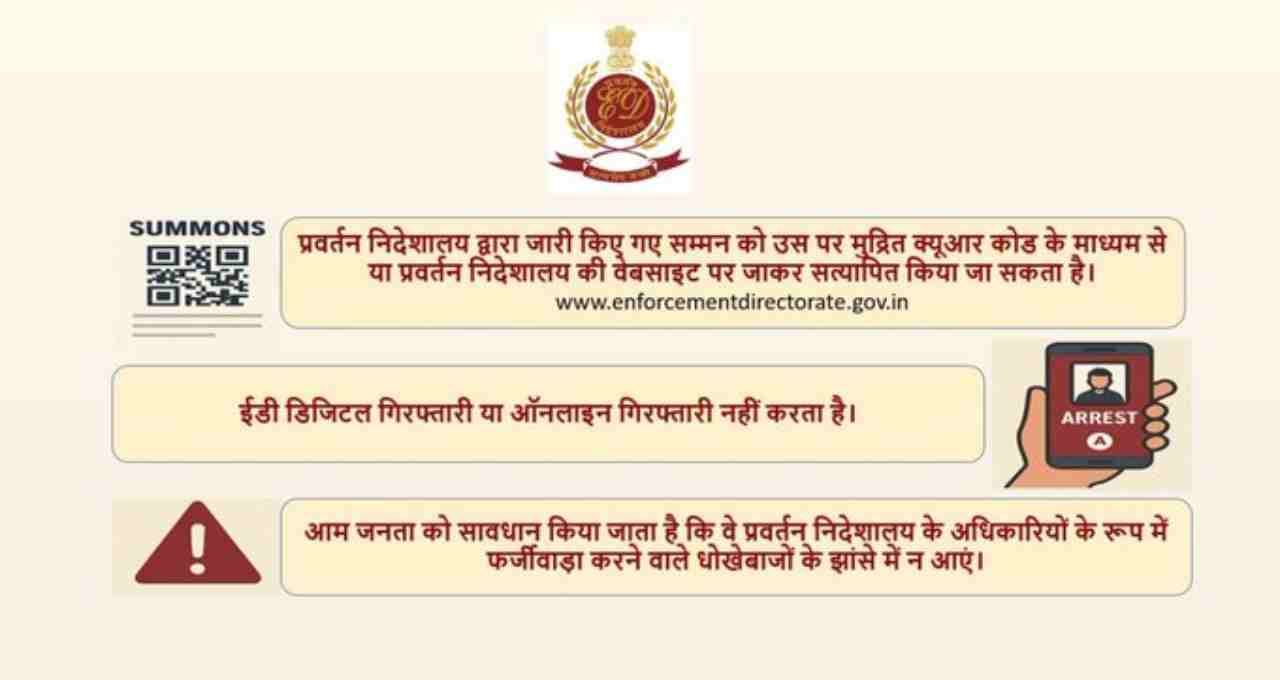
A statement issued by the office of Finance Minister Nirmala Sitharaman said that in many cases, forged summons appeared similar to genuine ones. This made it difficult for citizens to differentiate between authentic and fake summons. Now, the ED will issue system-generated summons featuring a QR code and a unique passcode. Citizens will be able to easily verify the authenticity of these summons by visiting the ED's official website or by scanning the QR code.
The statement further added that the ED never conducts digital or online arrests, and therefore, citizens are advised to remain vigilant. Do not fall prey to fraudsters who impersonate ED officials online.
Rising Cases of Digital Arrests
In recent times, there has been an increase in cases of digital arrests. Many fraudsters are impersonating police, customs, ED, CBI, and RBI officials to extort money from ordinary citizens. According to the Seventh Schedule of the Constitution of India, 'Police' and 'Public Order' are state subjects. States and Union Territories are responsible for the prevention, investigation, and prosecution of cybercrime and digital arrest scams through their law enforcement agencies.
The central government has decided to provide advice and financial assistance under various schemes to enhance the capacity of its law enforcement agencies. The objective is to reduce financial fraud and impersonation. Furthermore, the Telecom Regulatory Authority of India (TRAI) has mandated the adoption of the '1600' numbering series for governmental and non-governmental entities in the Banking, Financial Services, and Insurance (BFSI) sector.
This initiative by TRAI will ensure that citizens receive genuine and reliable calls from financial institutions. The Department of Telecommunications has allocated the 1600 numbering series to the BFSI sector, which is expected to reduce incidents of fraud.
Features of QR Code and Unique Passcode
Under the ED's new system, summons issued will feature a QR code and a unique passcode for each summons. The benefits are as follows:
- Citizens will be able to easily verify the authenticity of the summons.
- Fake summons will be instantly identified.
- It will build an environment of trust for both ED officials and ordinary citizens.
- It will curb incidents of digital arrests and online fraud.
The Ministry of Finance stated that the ED never conducts digital or online arrests. Therefore, citizens should be mindful not to fall prey to fraudsters who impersonate ED officials through any email, call, or message.