
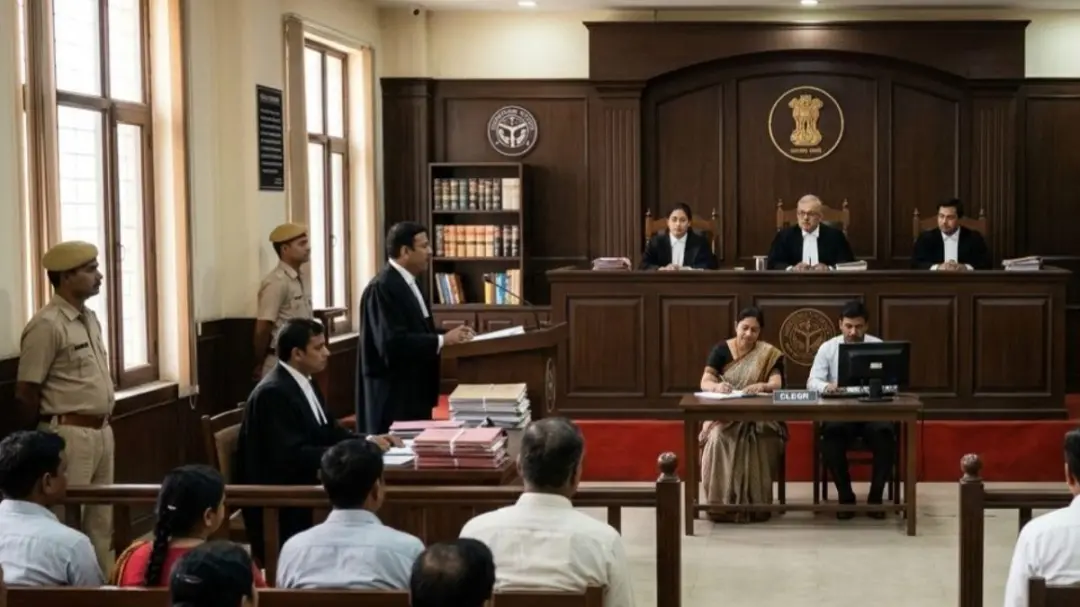
The High Court has upheld the life imprisonment sentences awarded by a trial court to the accused in a case involving the murder of four people, holding that the absence of an eyewitness alone cannot be a ground for acquittal when the chain of circumstantial evidence is complete, reliable and leaves no reasonable possibility other than the commission of the offence by the accused.
During the hearing, the defence argued that no one had witnessed the murders and contended that it was not appropriate to impose life imprisonment solely on the basis of circumstantial evidence. The defence also questioned alleged shortcomings in the evidence and raised objections to the prosecution's version of events.



Opposing the appeal, the prosecution submitted that the absence of an eyewitness does not, by itself, weaken the prosecution's case. It argued that the evidence collected during the investigation was interconnected and presented a complete sequence of events. According to the prosecution, all the circumstances pointed towards the accused.
The High Court closely examined the circumstantial evidence during the proceedings. It observed that in such cases, each circumstance must be examined independently while also determining whether all the circumstances together form a complete chain that leaves no reasonable possibility other than the involvement of the accused.
The court further clarified that eyewitness testimony is not the only basis on which guilt can be established in a criminal trial. It held that if scientific evidence, the sequence of events, recoveries, surrounding circumstances and other evidence corroborate one another, a conviction can also be based on such evidence.
In this case, the trial court had found the accused guilty on the basis of the available evidence and sentenced them to life imprisonment. The accused challenged that judgment before the High Court, with the principal argument in the appeal being that there was no eyewitness to the murders.
After reviewing the trial court's judgment and the evidence on record, the High Court dismissed the appeal and upheld the life imprisonment sentences. The judgment reiterates that in serious criminal cases, b circumstantial evidence can play a decisive role even in the absence of an eyewitness.
According to legal experts, in cases based on circumstantial evidence, courts examine whether the circumstances presented by the prosecution are so closely connected that they lead to a clear conclusion regarding the offence. Rather than relying on any single circumstance, the entire chain of evidence is assessed collectively.
In the four-murder case, the High Court's decision is being regarded as based on this legal principle. After examining the available records and evidence, the court found no grounds to interfere with the trial court's decision.
Following the judgment, the life imprisonment sentences imposed on the convicted persons will remain in force. In its detailed ruling, the court attached importance to the legal basis for evaluating circumstantial evidence and for establishing guilt despite the absence of an eyewitness.


