India on Friday successfully tested the medium-range ballistic missile Agni-3 from the Integrated Test Range (ITR) at Chandipur in Odisha under the supervision of the Strategic Forces Command.
According to defence officials, the missile met all predefined technical and operational parameters during the test. The test strengthens India’s Credible Minimum Deterrence policy and its second-strike capability.




Agni-3 is a medium-range ballistic missile with a strike range of approximately 3,000 to 3,500 kilometres. With this range, it can cover large parts of South Asia and East Asia. Experts state that this range provides India with the capability to target strategic and military installations located deep within regional adversaries, making Agni-3 an important pillar of India’s strategic defence architecture.
The range of Agni-3 covers almost all major cities and military installations in Pakistan. In the case of China, it can reach Beijing, Shanghai, and other major industrial and military centres. Military analysts state that despite China possessing a large number of long-range missiles, Agni-3 plays an important role for India in maintaining strategic balance.
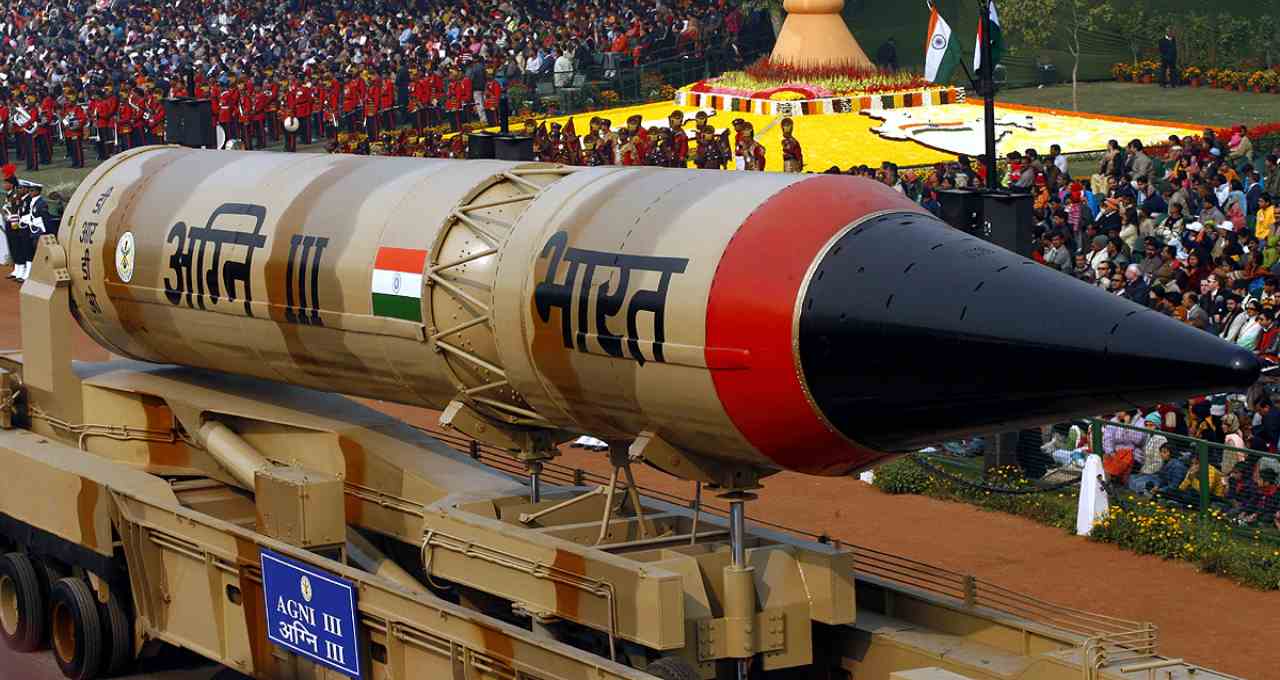
In the context of Pakistan, the missile is considered particularly important, as it currently does not possess a system with capabilities directly comparable to Agni-3. Internationally, Agni-3 is counted among the world’s most effective medium-range ballistic missiles, particularly due to its accuracy and reliability.
Agni-3 has been indigenously developed by the Defence Research and Development Organisation. It is a two-stage, solid-fuel ballistic missile with a length of approximately 16.7 metres and a diameter of about 2 metres. The missile has a launch weight of around 48,300 kilograms and a payload capacity of up to 1,500 kilograms. It can carry either nuclear or conventional warheads and has a flight altitude exceeding 450 kilometres on a sub-orbital trajectory.
The missile can be launched from road-mobile and rail-mobile platforms, enabling rapid deployment and improved survivability against enemy surveillance. Agni-3 is equipped with advanced instrumentation, navigation, and guidance systems, including an inertial navigation system and advanced on-board computers to ensure precise targeting.