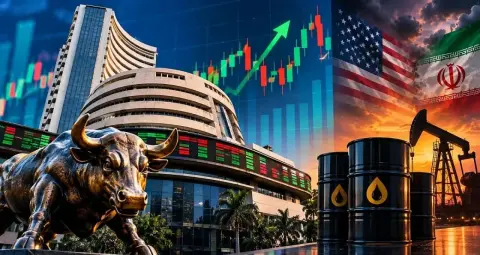
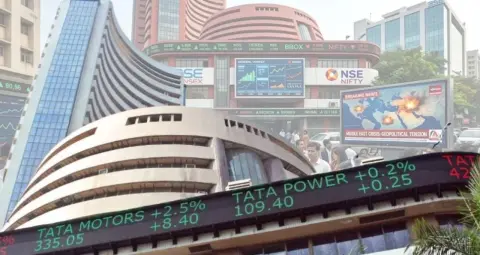
Indian equity markets opened lower on Wednesday, with benchmark indices starting the session in negative territory amid mixed global cues and rising geopolitical tensions in West Asia involving the United States and Iran.
The domestic market witnessed a subdued opening as escalating geopolitical risks and global economic uncertainties affected investor risk appetite. Early trade saw declines in both the Sensex and Nifty, while market participants increasingly shifted toward safer investment avenues.
According to market experts, growing tensions between the United States and Iran have heightened caution across global financial markets. Investors remain concerned about the possibility of military conflict and its potential impact on energy supplies.




At the opening bell, the 30-share BSE Sensex fell about 142 points to open at 74,507. The NSE Nifty 50 declined around 67 points, slipping below the key 23,500 level and trading near 23,415.
Analysts said profit-booking following the recent rally, coupled with global risks, weighed on market sentiment. Banking, automobile and metal stocks witnessed early pressure, while select information technology stocks provided limited support.

Asian markets showed a mixed trend on Wednesday. Japan’s equity market advanced to record levels, supported by positive corporate earnings and economic indicators. The Nikkei 225 rose more than 2 percent to a historic high, while the Topix Index also registered gains.
In contrast, Hong Kong markets came under selling pressure. The Hang Seng Index declined amid investor concerns over China’s economic recovery and global demand. South Korean markets remained closed due to a public holiday.
Global investors also remained focused on U.S. markets, where major indices reached record highs in the previous trading session. Supported by corporate performance and positive investor sentiment, the Dow Jones Industrial Average, S&P 500 and Nasdaq Composite all advanced. The S&P 500 crossed the 7,600 level for the first time, reflecting investor confidence in the U.S. economy.
However, market participants believe volatility could increase in the coming days due to ongoing geopolitical risks. The impact of rising tensions in West Asia was most visible in energy markets, where international crude oil prices moved higher amid concerns that regional conflict could disrupt global supply chains.
Both Brent crude and West Texas Intermediate (WTI) gained more than 1 percent. Sustained increases in energy prices could place additional pressure on import-dependent economies, including India.
The U.S. dollar also strengthened in global markets. The dollar index posted modest gains against major global currencies, reflecting increased investor preference for safe-haven assets. The ber dollar weighed on the Indian rupee, which weakened against the U.S. currency in the latest trading session, potentially affecting import costs and foreign investment flows.