
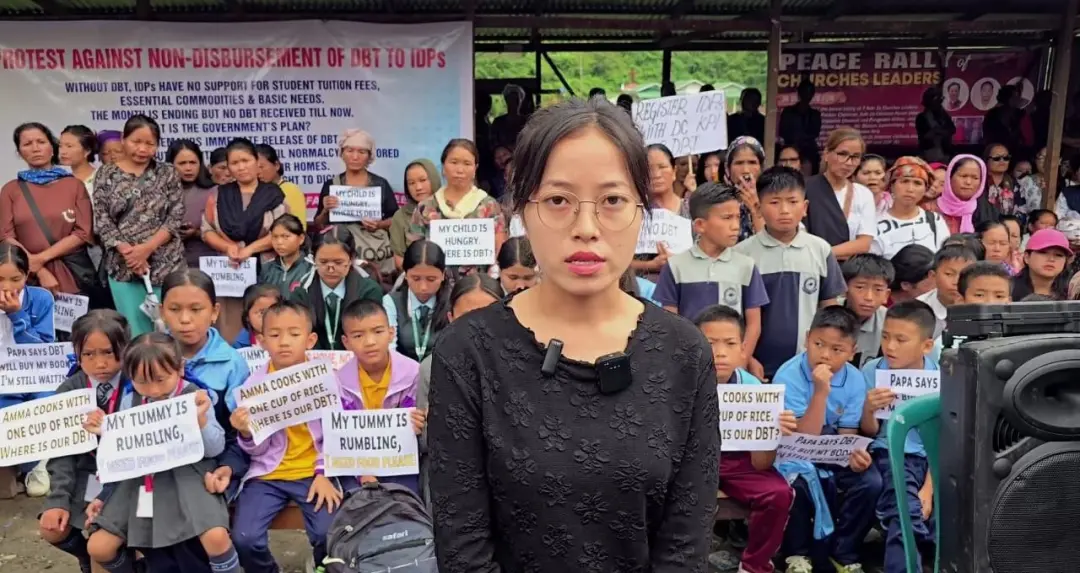
Thousands of internally displaced persons (IDPs) staged a peaceful protest at the district headquarters in Manipur's Kangpokpi district on Friday, demanding the immediate release of pending Direct Benefit Transfer (DBT) payments. The protesters said the financial assistance has become their only means of survival after thousands of families lost their homes, livelihoods, and employment due to ethnic violence. They alleged that the July 2026 assistance has not yet been disbursed, affecting access to basic necessities including food, education, and healthcare.
The protest was organized by the Kangpokpi District Internally Displaced Welfare Committee (KDIDWC) and was attended by thousands of families residing in relief camps and rented accommodation. Women, elderly people, students, social workers, and representatives of various communities also participated. Several social and community leaders were present in support of the displaced families.
Protesters carried placards stating that they had lost their homes and livelihoods and were no longer receiving financial assistance. They said the suspension of DBT payments had pushed their daily lives into severe hardship.
Following the protest, a delegation submitted a memorandum addressed to the Chief Minister through the Deputy Chief Minister. The memorandum demanded the immediate release of pending DBT payments and the continuation of monthly financial assistance until normal conditions are restored.



The committee issued a five-day ultimatum to the government, stating that if the pending payments are not released within the stipulated period, it will intensify its agitation through democratic means. Protesters also said the government would bear full responsibility for the consequences of any further delay in disbursing the assistance.
During the protest, several displaced families said DBT assistance is primarily used to support their children's education, including payment of school fees, admission charges, examination fees, books, and uniforms. They said delays in payment have prevented many families from paying school fees, placing children at risk of discontinuing their education.
The committee said that unless assistance is released promptly, a large number of students could be forced to leave school, adversely affecting their future.
Displaced families said the financial assistance is also used to purchase rice, pulses, cooking oil, vegetables, and other essential household items. They alleged that food stocks in several relief camps are being rapidly depleted due to the delay in payments.
They also said it has become increasingly difficult to purchase essential medicines for elderly people, pregnant women, and those with illnesses. Several families stated that limited financial resources have forced them to choose between purchasing food and medicines.
According to the committee, thousands of families have been displaced for more than a year due to the ongoing ethnic conflict and were compelled to leave their villages, agricultural land, businesses, and employment. Most families continue to live in relief camps or rented accommodation and have no permanent source of income.
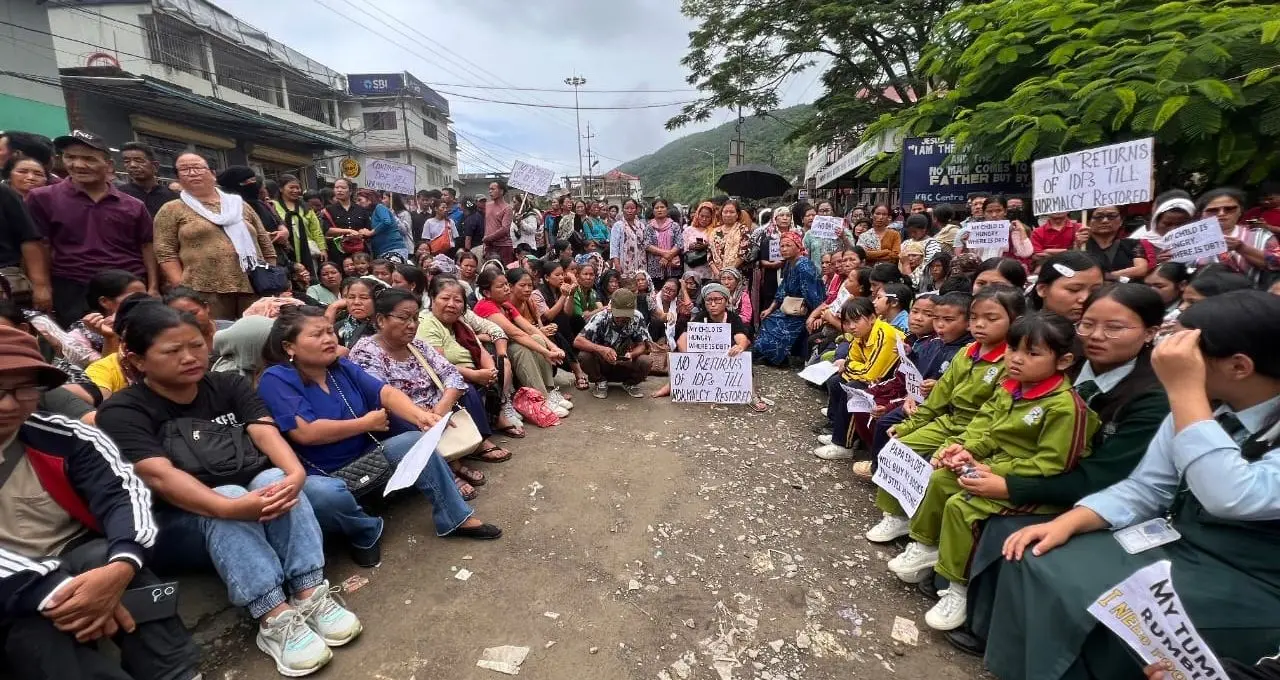
The committee said that under these circumstances, government financial assistance has become essential for their survival. Protesters said the assistance should continue until displaced families are able to return safely to their homes and resume normal life.
In its memorandum, the committee also called for the introduction of a fixed monthly payment mechanism for future DBT disbursements. It said a designated monthly payment date should be established to enable families to plan their essential expenditures.
The committee further demanded that all eligible displaced families receive assistance without discrimination and that the entire distribution process remain transparent.
The committee said it is prepared to fully cooperate with the government in beneficiary verification and the distribution process. However, it stated that the government would be responsible for any humanitarian crisis arising from administrative delays.
It appealed to the Chief Minister and the concerned departments to treat the matter as a priority, stating that the education of thousands of children, the health of elderly people, and the lives of displaced families depend on the financial assistance.
Protesters are currently awaiting the government's response. They said the next phase of the agitation could be announced if the pending DBT payments are not released within the five-day deadline. No official response from the administration to the ultimatum had been issued at the time of reporting.
Experts said that for families experiencing prolonged displacement, timely financial assistance serves not only as economic support but also as an important instrument of social stability and humanitarian protection. They said an early resolution of the issue could have a direct impact on the lives of thousands of affected people.


