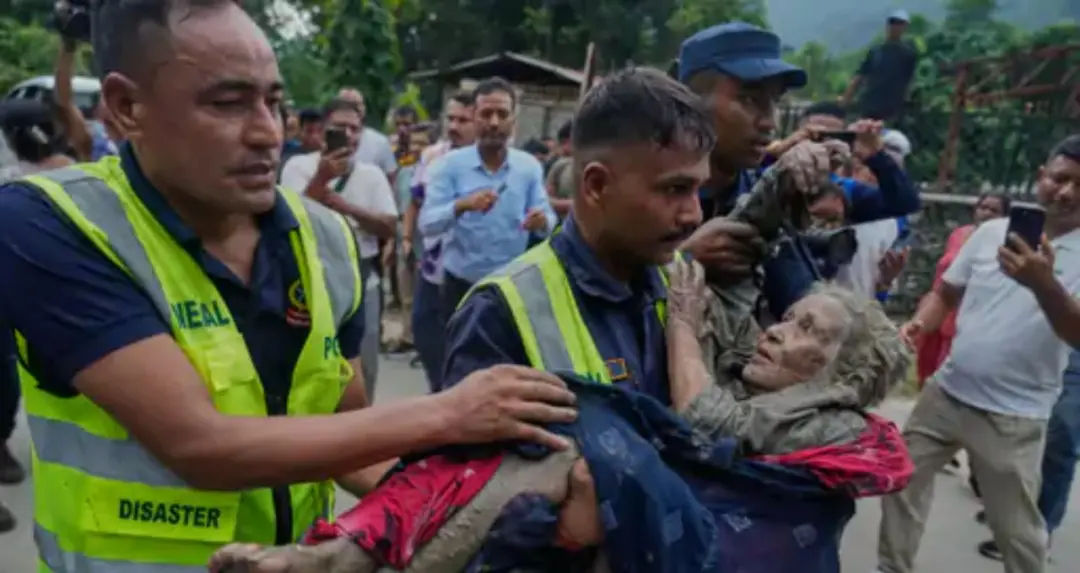
The sudden flood that struck the Nepal-Tibet border on Wednesday morning has caused widespread destruction. Information available so far indicates that 162 people have died in Nepal and three in Tibet, while more than 1,000 people remain missing. Floods and landslides have damaged roads, bridges and hydropower projects, with rescue teams continuing to search for people trapped in debris.
The flood on the Nepal-Tibet border was so rapid and powerful that people in several areas had little time to react or reach safer locations. Floodwaters rose to around 30 feet, sweeping away homes, vehicles and government structures. The reported death toll stands at 162 in Nepal and three in Tibet, while more than 1,000 people are missing.
The disaster has also caused extensive damage to infrastructure. Preliminary information indicates that 19 bridges, around 40 kilometres of roads and 13 hydropower projects were destroyed or severely damaged. Connectivity in the affected areas has been disrupted, creating major challenges for relief teams.
There were initial suspicions that an earthquake had struck the area before the flooding. At around 8:37 am on Wednesday, b tremors were felt near the Nepal-China border and north of Kathmandu. The US Geological Survey, or USGS, initially identified the event as a magnitude 4.4 earthquake.
Subsequent information indicated that the event was not an earthquake in the conventional sense. On the Chinese side, a large section of mountain in the Lhende River area slid into the river along with snow and rocks. The movement generated vibrations powerful enough for people to experience a tremor similar to a magnitude 5.2 earthquake.
Scientists estimate that a large section of a glacier may also have broken away and fallen from the mountain. However, experts may require more time to determine the precise cause and sequence of the event.
After the mountain section collapsed, a massive flow of water and debris entered the Lhende Khola River. The river is a tributary of the Bhotekoshi River and flows from China through deep valleys in Nepal. The fast-moving water and debris subsequently reached the Bhotekoshi and Trishuli rivers.



The force of the flow was such that water and debris travelled around 150 kilometres to Chitwan. Information available so far indicates that 64 bodies have been recovered from the Trishuli and Narayani rivers there. The recovered remains include complete bodies as well as body parts. All recovered bodies have been kept at the mortuary of Bharatpur Hospital.
Indian citizens have also been affected by the disaster. More than 133 Indians are reported to be among those missing in Nepal. The missing people include pilgrims travelling for the Kailash Mansarovar pilgrimage.
Thirty-seven tourists from Tamil Nadu have been reported missing. They were reportedly travelling towards a temple when they were caught in the sudden flood. A group of 32 people from Kolkata travelling to Kailash Mansarovar is also reported missing. The group comprises 30 tourists and two tour managers.
The group left Kolkata on August 21 and reached Nepal the following day. On Wednesday morning, the group reached Rasuwagadhi to travel to Tibet. At around 8:30 am, its members were at the immigration office when the sudden flood struck the border area. No contact has been established with any member since then.
Several hydropower projects in Rasuwa have been damaged by the flooding. More than 133 employees and workers involved in different hydropower projects are also reported missing. Foreign employees are among those missing.
Teams from the Nepal Electricity Authority have reached affected areas and are conducting search operations. Search and rescue operations are continuing with assistance from local authorities, security agencies and health institutions. The 20 MW Langtang Hydropower Project in Rasuwa has also reportedly suffered extensive damage.
The Nepal government has deployed 30 helicopters to evacuate people stranded in flood- and landslide-affected areas and deliver relief supplies. The Rescue Coordination Centre at Tribhuvan International Airport began preparations for rescue operations in the morning.
Ten of the helicopters have been sent to affected and surrounding areas, while 20 have been kept on standby for additional rescue operations. Damaged roads, poor weather and debris have made road access difficult in several areas. Air operations are therefore being used to reach locations that are difficult to access by road.
Large quantities of mud and debris have accumulated across several areas following the flooding. Roads leading to Gyirong Port in China have also been affected. The area is among the key border routes connecting Tibet in China with Nepal.
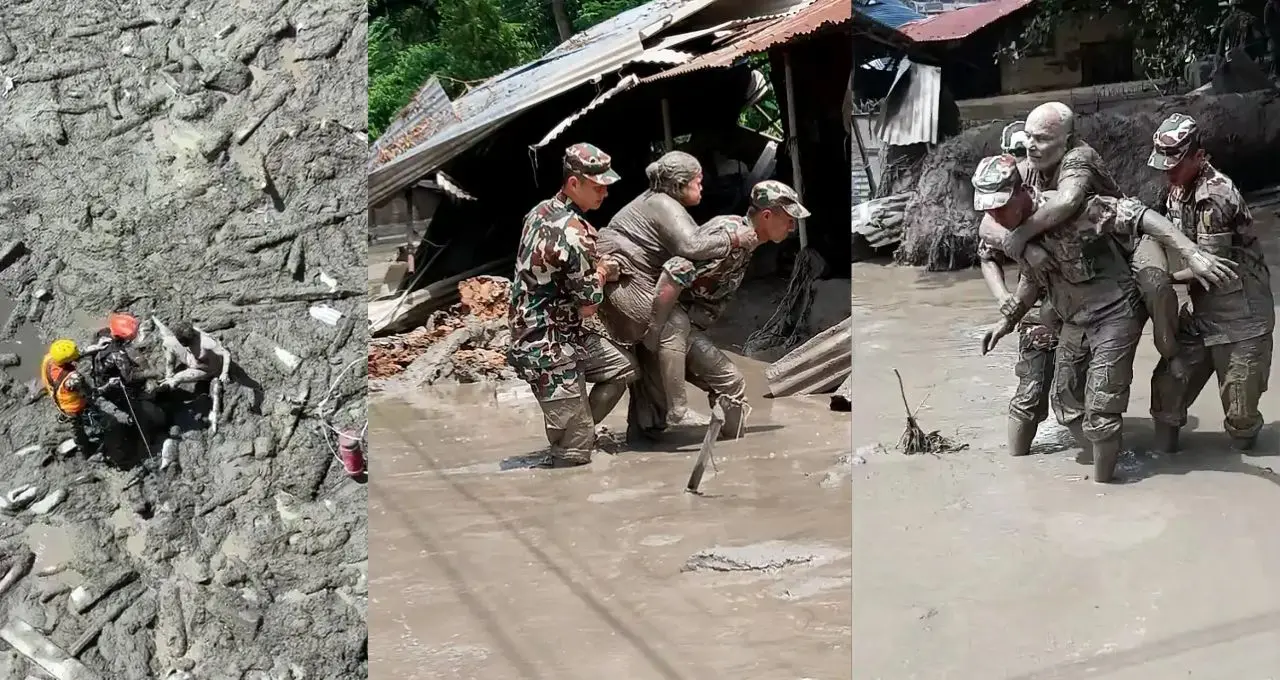
Information indicates that mud is around 1.5 metres deep in some locations. The edge of the landslide is reported to be around 2.5 kilometres from Gyirong Port. Rain during the night has made conditions more difficult. Rescue workers also face the risk of further landslides and road collapses.
The flooding in Nepal is also expected to affect border areas of India. Authorities are monitoring water levels in Bihar's Gandak River and connected rivers, with an alert reported over a flood wave of around 3 metres from Nepal.
Special vigilance is being maintained in West Champaran, East Champaran, Gopalganj, Saran, Muzaffarpur and Vaishali. Sitamarhi and Sheohar are also being monitored. Water from Nepal could reach the Gandak River through the Trishuli River, potentially raising water levels in low-lying areas of Bihar.
Alerts have also reportedly been issued in Maharajganj and Kushinagar in Uttar Pradesh. In Bihar's Bagaha area, the water level in the Gandak River has risen and debris from Nepal has also been seen.
International assistance is also being provided following the disaster. The United States has announced $500,000 in assistance for people and communities affected by flooding in Rasuwa.
The assistance will be used for essential needs including temporary shelter, critical relief supplies, clean water, sanitation and cleanup. The US administration has also said it will send a disaster adviser to the affected area. The US Embassy in Kathmandu is coordinating with local authorities to gather information on affected US citizens.
The flooding has caused extensive damage to Nepal's transport and energy infrastructure. According to available information, 13 hydropower projects in Rasuwa and surrounding areas have been affected. These include eight operational and five under-construction projects, with a combined capacity of around 748 MW.
Around 42 kilometres of the road from Betravati to the Rasuwagadhi border checkpoint has been damaged or washed away. At least 32 major bridges have also reportedly been destroyed. Several local suspension bridges have been damaged, cutting off connectivity to villages and settlements.
Conditions following the flooding remain challenging. Search operations for missing people are continuing, while poor weather, debris, damaged roads and the possibility of further landslides are affecting rescue efforts.
Finding missing people and gathering information about foreign nationals stranded in border areas remain priorities. Nepalese and Chinese authorities are engaged in relief and rescue operations, while India is also seeking information on the status of its citizens.