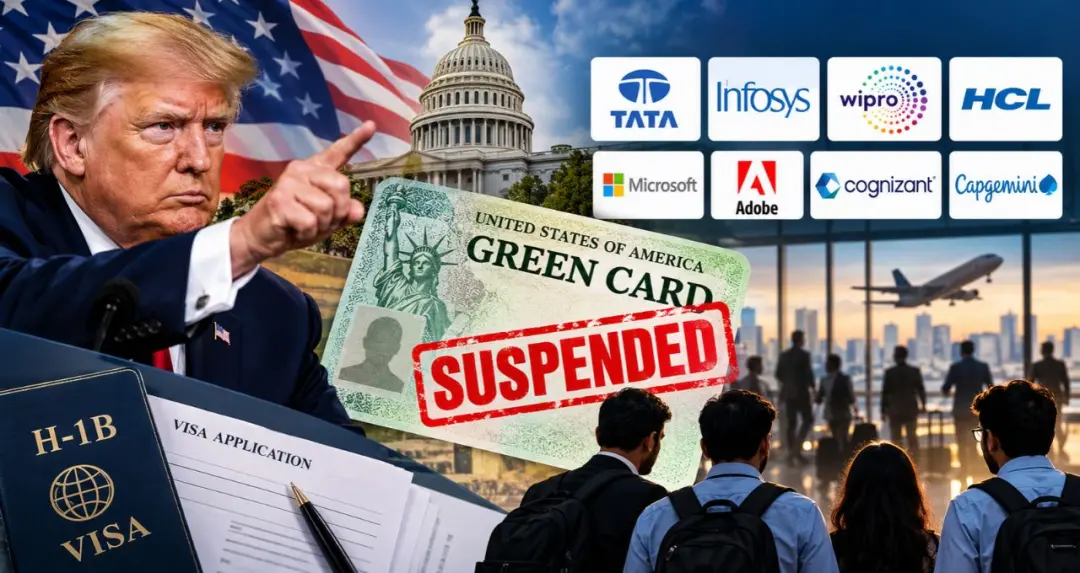
A report claims that the US administration under President Donald Trump has halted green card sponsorship-related processing for eight major IT companies, including Tata Consultancy Services (TCS), Infosys, Wipro and HCL. However, the official status of the alleged action, the terms of any order and the scope of affected applications remain to be independently verified.
The report also names Microsoft, Adobe, Cognizant and Capgemini. It claims that the action affects the Program Electronic Review Management (PERM) process, including the acceptance of new applications and the processing of pending cases. If formally implemented, such restrictions could affect foreign employees seeking permanent residence in the United States through the companies concerned.
According to the report, the US administration has taken action against eight IT companies, restricting the submission of new PERM applications and the progression of cases already pending. However, the existence of a formal restriction, its legal basis and the applications covered by any such measure have not been independently established.
The PERM process is a labour certification procedure used by the US Department of Labor for certain employment-based green card categories. Employers must generally demonstrate that they have completed the required recruitment process for the relevant position and that employing a foreign worker will not adversely affect the wages and working conditions of similarly employed US workers.
The identification of companies in a report does not, by itself, establish that a formal government restriction has been imposed on them. The terms and legal status of any alleged order would need to be confirmed through official documentation.




PERM stands for Program Electronic Review Management. It is the US Department of Labor's employment-based labour certification process and is required for certain categories of employment-based permanent residence applications.
Typically, an employer first completes the applicable recruitment requirements for a position and then submits a PERM application to the Department of Labor. After labour certification is granted, the employer may file an immigrant worker petition with US Citizenship and Immigration Services (USCIS), subject to the applicable eligibility requirements.
Subsequent steps depend on the applicant's employment-based category, priority date and visa availability. PERM is not itself a green card but an important stage in the permanent residence process for certain employment-based cases. Delays at this stage can affect the timing of subsequent immigration procedures.
If restrictions on PERM applications are formally imposed on any of the companies concerned, employees whose permanent residence processes have not yet begun, or who are waiting for their employers to file labour certification applications, could face delays in initiating the process.
The effect on employees with applications already in progress would depend on the terms of the relevant government order and the status of each case. Without reviewing an official order, it cannot be established that all previously filed applications have automatically been suspended.
The issue is relevant to Indian professionals employed by companies such as Tata Consultancy Services, Infosys, Wipro and HCL because permanent residence can affect long-term immigration planning, family arrangements and employment decisions.
The H-1B visa and the green card process operate under separate US immigration frameworks. H-1B is a non-immigrant visa category that allows eligible foreign professionals to work in the United States subject to applicable conditions. A green card grants permanent resident status.
Consequently, a potential restriction on PERM processing would not, by itself, mean that all affected employees' H-1B visas would be automatically cancelled or that they would have to leave the United States immediately.
An employee's eligibility to remain and work in the country depends on the validity of their immigration status, their employer, applicable immigration rules and individual circumstances. A delay in green card sponsorship does not automatically terminate otherwise valid H-1B status. Separate requirements may apply if the authorised period of stay expires, an employee changes employers or other circumstances arise.
The availability of employment-based green cards in the United States depends on visa limits, immigration categories and applicants' nationalities. Indian applicants can face lengthy waits in the EB-2 and EB-3 categories because of the limited number of available visas and the large backlog of applicants from India.
The timing of an individual's green card approval depends on the applicable employment-based category, priority date and the official visa bulletin for the relevant month. A uniform waiting period of 12 to 15 years cannot be applied to every Indian applicant.
Similarly, limited visa availability in a particular fiscal or government year does not, by itself, establish a universal restriction on all new applications. Labour certification, the immigrant petition and final green card approval are separate stages of the process.
The report attributes to the US labour secretary a claim that some companies have been using immigration rules improperly when hiring foreign workers. It also refers to concerns about the potential effects on employment opportunities and wages for US workers.
The report further cites allegations by US Vice President JD Vance concerning Microsoft. It claims that the company used H-1B visas and green card sponsorship for foreign employees while laying off US workers.
These allegations have not been established as proven facts on the basis of the information provided. Assessing them would require relevant government documents, official company statements and available employment data. Any responses from the companies concerned would also need to be considered.
Employees concerned about the reported restrictions should confirm their individual application status with their employers' human resources departments and immigration teams. They should establish whether their cases are at the PERM stage, the I-140 immigrant petition stage or the final green card processing stage.
Official updates from the US Department of Labor, USCIS and the visa bulletin can help establish the applicable requirements and the status of individual cases. Major employment or immigration decisions should not be based solely on an unverified report.
The official status of the alleged restrictions on the eight companies and their practical implications remain to be confirmed. If formally implemented, the effects would depend on the scope of the measures and the employment-based permanent residence applications covered. The circumstances of H-1B visa holders and other Indian employees would vary according to their individual immigration status and application stage.